

What size bike for 4 year old child
For most 4-year-old children, start by comparing 12-, 14- and 16-inch bikes. Measure the child’s height, then confirm inseam clearance, reach, brake control and confidence on the actual bike before choosing.
Which wheel size should you check first?
Age narrows the search, but measured height is the more useful starting point. XBikes uses the following wheel-size ranges:
| Wheel size | Starting age range | Rider height |
|---|---|---|
| 12 Inch | Ages 3–4 | 34–40 in / 86–102 cm |
| 14 Inch | Ages 3–6 | 37–45 in / 94–114 cm |
| 16 Inch | Ages 4–7 | 40–48 in / 102–122 cm |
A 4-year-old who is 34–40 inches tall should begin with a 12-inch comparison. At 37–45 inches, include 14-inch bikes. At 40–48 inches, include 16-inch bikes. The ranges overlap deliberately: height points you toward candidates, while a hands-on fit check decides between them.
Do not move up merely because the child has reached age four. The American Academy of Pediatrics advises having the child try the bicycle and avoiding an oversized bike bought for future growth. A larger wheel label does not compensate for poor control today.
Measure height and inseam before shopping
Measure height with the child standing straight against a wall without shoes. Keep the feet flat and together, mark the top of the head, and measure from the floor to the mark. Compare that result with the XBikes ranges above.
Next, measure inseam. Have the child stand naturally with shoes off. Place a firm, thin book between the legs and raise it gently to simulate the contact point of a saddle, then measure from the floor to the top edge. Record the result for the in-person fit check; wheel size alone does not establish stand-over clearance because bicycle frames can differ.
Check the child on the actual bicycle
Have the child stand over the frame with both feet planted securely. There should be usable clearance rather than pressure from the frame. Then place the child on the saddle and watch whether starting, stopping and putting a foot down appear controlled rather than stretched or hesitant.
Ask the child to hold the handlebars in a normal riding position. The hands should reach without leaning excessively, locking the arms or losing a balanced posture. The child must also be able to operate the bicycle’s braking controls confidently. If a brake lever cannot be reached or used effectively, that bicycle is not a suitable current fit even when its wheel size matches the chart.
Compare the smallest plausible size with the next size only when the height ranges overlap. Choose the bicycle on which the child can steer, start, stop and dismount with better control. Current confidence matters: a nervous beginner may be less capable on a physically larger bike than the height chart alone suggests.
How the supplied catalog option helps
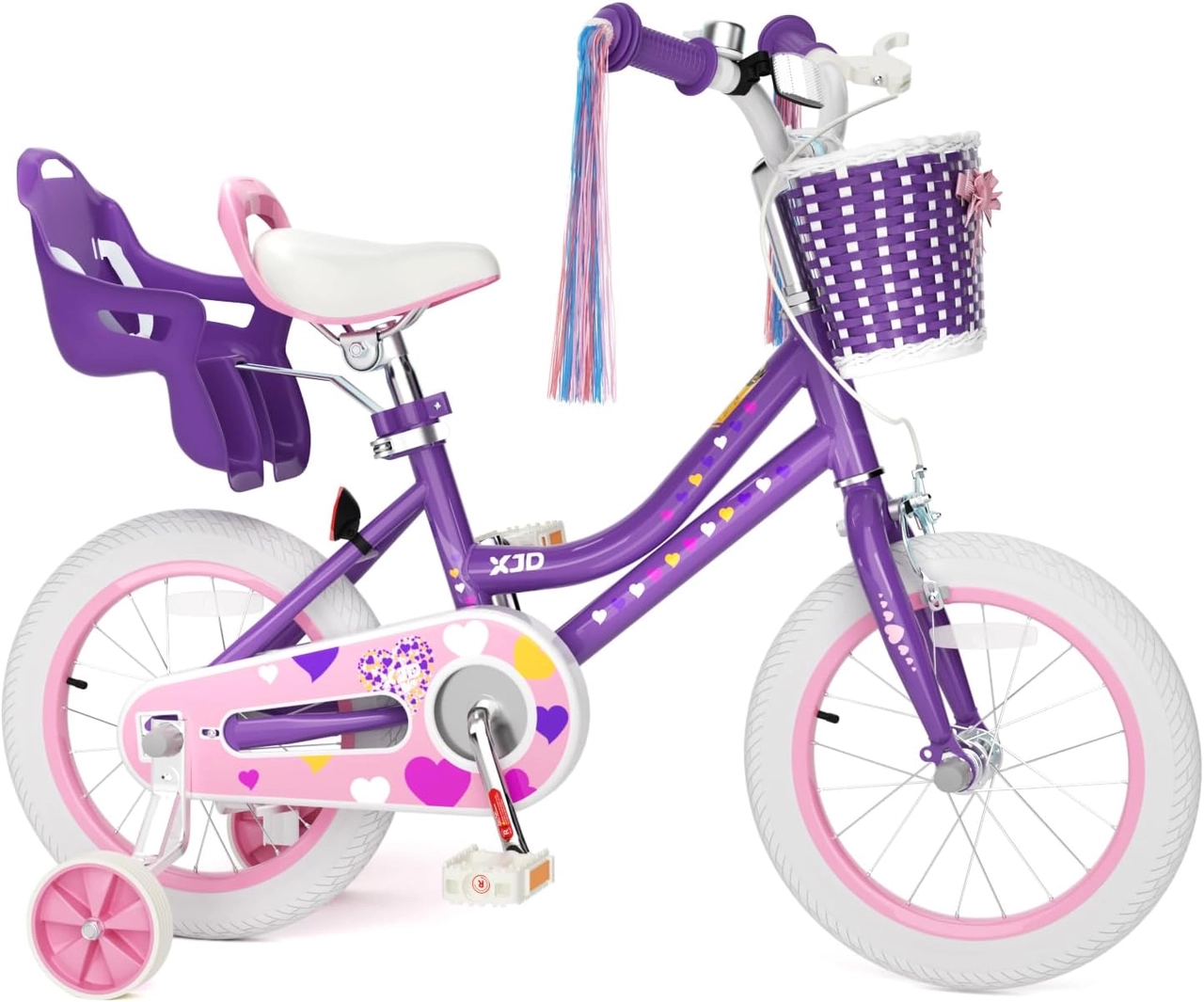
The Purple XJD Girls' Bike with Doll Seat & Basket is listed as a training-wheel bike with 12 Inch, 14 Inch and 16 Inch SKU labels. Those three options correspond to the main XBikes starting points relevant to many 4-year-olds, so they provide a direct way to compare candidate wheel sizes after measuring height. Its title and accessories do not prove fit; the individual check still determines relevance.
These particular catalog options help answer the sizing question because one product is offered under all three wheel-size labels a 4-year-old may need to compare. Select only the SKU label that matches the child’s measured range and successful fit check.
When this product is not relevant
The Purple XJD Girls' Bike with Doll Seat & Basket is not relevant if the child falls outside the supplied height ranges for its available 12-, 14- and 16-inch labels, or if the child cannot stand over, reach, steer or brake confidently on the selected version. Training wheels are a catalog category, not evidence that a bicycle fits every beginner.
Do not infer frame dimensions, brake type, weight, load limits, assembly details or component compatibility from the wheel-size label. For those matters, follow the exact product manual or ask a qualified bicycle mechanic. If an otherwise plausible size fails the hands-on check, reject that bicycle rather than trying to justify it by age.
Finish the decision safely
Once a candidate passes the fit check, add a properly fitting bicycle helmet. U.S. Consumer Product Safety Commission guidance says the helmet should sit level and its straps should be used according to the manufacturer’s instructions. Recheck the fit as the child grows and whenever control becomes awkward.
For a 4-year-old, the next action is simple: measure height and inseam, compare 12, 14 and 16 inches only where the chart supports them, and let the child try the exact bicycle. Buy the size the child can control now—not the larger one intended for later growth.
Bikes for your next adventure
-

Pink Girls' 12/14/16" Bike by XJD – Basket & Doll Seat
The XJD Pink Girls' Bike with Basket & Doll Seat is made for riders 71–122 cm ta…$75.99
$99.99 -

XJD Girls Bike for Kids Ages 3-8, 12/14/16 Inch with Training Wheels – Purple
The XJD Girls Bike in Purple is a training-wheel bicycle for kids ages 3 to 8, f…$149
$169 -

Light Purple XJD Toddler Bike Helmet, Adjustable, Size XS (46–51 cm)
This Light Purple XJD toddler bike helmet is made for the smallest riders — the …$20.39