

What size bike for a 4yr old
For most 4-year-olds, start by comparing a 12-inch, 14-inch or 16-inch bike. Measure the child first: height, inseam, reach and brake control matter more than age. XBikes places 12-inch bikes at 34–40 in (86–102 cm), 14-inch bikes at 37–45 in (94–114 cm), and 16-inch bikes at 40–48 in (102–122 cm).
Which wheel size should you check first?
Use the child’s current measured height to narrow the choice, then confirm the fit on the actual bicycle. At age four, the height ranges overlap deliberately: two wheel sizes may look plausible on paper, but differences in frame shape, seat adjustment and the child’s confidence can change which bike is manageable.
| Wheel size | XBikes starting range | When to compare it |
|---|---|---|
| 12 Inch | Ages 3–4; 34–40 in / 86–102 cm | Start here for a four-year-old within this height range, especially when confidence is still developing. |
| 14 Inch | Ages 3–6; 37–45 in / 94–114 cm | Compare this when the child is at least 37 in / 94 cm and can comfortably control the larger bike. |
| 16 Inch | Ages 4–7; 40–48 in / 102–122 cm | Consider it from 40 in / 102 cm, but only when stand-over, reach and controls all fit now. |
A 12-inch bike is therefore the usual first comparison for a smaller four-year-old. A taller child may fit a 14-inch bike, while a child at or above 40 in / 102 cm may be ready to compare a 16-inch bike. Do not move up merely because the child has recently turned four.
Measure height and inseam before shopping
Measure height with the child standing straight without shoes, heels against a wall and eyes level. Record the result in inches or centimetres so it can be compared with the XBikes ranges.
For inseam, have the child stand without shoes, feet slightly apart, with a firm book held gently upward between the legs as a saddle would sit. Measure from the floor to the top edge of the book. The supplied wheel-size ranges do not specify an inseam number, so use this measurement to check the actual bike’s stand-over clearance and lowest usable saddle position rather than applying an invented cutoff.
Check the bike with the child on it
A height range is only a starting point. Have the child try the exact bicycle and check whether they can:
- stand over the frame without being forced onto tiptoes or pressed against the bicycle;
- sit in a stable position and start, stop and dismount without struggling;
- reach the handlebar without locking the elbows or stretching the torso;
- turn the handlebar while remaining balanced and looking ahead;
- reach and operate the fitted braking controls reliably; and
- keep the bicycle upright with their present level of confidence.
If a larger wheel size makes any of these tasks difficult, choose the smaller bike that fits now. The American Academy of Pediatrics advises trying the bicycle and avoiding an oversized bike bought solely for future growth. Extra growing room is not useful if the child cannot control the bike today.
How the supplied catalog option helps
The XJD Girls' Bike with Training Wheels, 12/14/16/20 Inch – Purple is relevant because its supplied options include 12-inch, 14-inch and 16-inch labels—the three sizes most likely to be compared for a four-year-old under the XBikes starting ranges. Its 20-inch option is not a normal age-four starting point: XBikes places that size at ages 7–12 and heights of 48–60 in (122–152 cm). Each size remains a separate option, not an equivalent fit.

The product is categorized as a training-wheel bike, which may be relevant when a child currently needs that style of support. The catalog facts do not provide frame dimensions, seat range, brake type, assembly details, load limits or compatibility information. Confirm those points in the exact product manual, and use a qualified bicycle mechanic where assembly or fit remains uncertain.
Confidence can decide between overlapping sizes
If the child’s height falls within both the 12-inch and 14-inch ranges, compare both on the ground rather than automatically selecting 14 inches. A cautious or beginning rider may manage the smaller option more comfortably. A confident child may handle the larger option only if stand-over, reach, steering and braking remain easy.
Apply the same test where the 14-inch and 16-inch ranges overlap. Age eligibility does not prove readiness, and training wheels do not correct a frame that is too large or controls that cannot be reached.
What to do before the first ride
- Write down the child’s barefoot height and inseam.
- Use height to shortlist 12, 14 or 16 inches from the table.
- Have the child try each plausible size and demonstrate standing, reaching, steering, braking and dismounting.
- Follow the exact bicycle manual for assembly, adjustment, maintenance and limits, or ask a qualified bicycle mechanic.
- Fit a bicycle helmet properly. It should sit level, and its straps should be adjusted according to the helmet manufacturer’s instructions.
For a four-year-old, begin with the size matching today’s measured height—usually 12, 14 or 16 inches—then buy only after the child can comfortably stand over, reach, steer and brake that exact bike.
Bikes for your next adventure
-

Blue XJD Girls Bike with Training Wheels – 12/14/16 Inch
If you're shopping for a first pedal bike for a daughter roughly 3 to 8 years ol…$149
$169 -
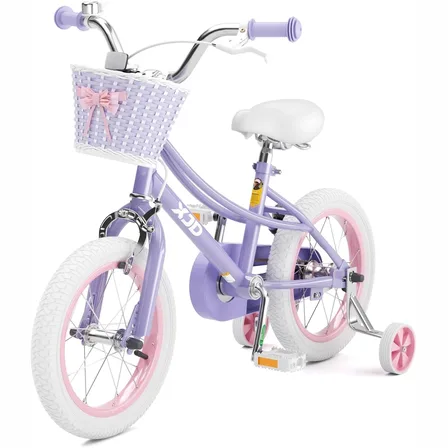
Girls' Training Wheel Bike by XJD with Basket – Purple
If you're shopping for a first bike for a girl roughly 3 to 12 years old (91–152…$75.99
-
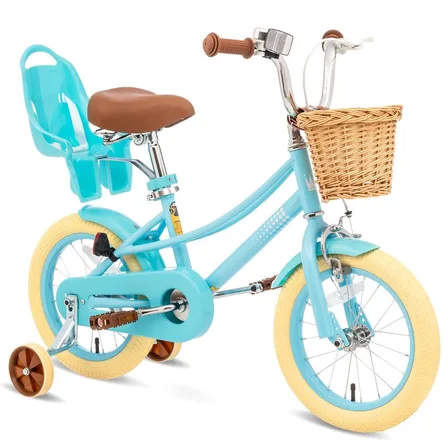
Girls' Training Wheel Bike by XJD, 12–20 Inch Wheels – Blue
This XJD girls' training wheel bike in Blue covers one of the widest fit ranges …$139
$159