

What size bike should a 4 year old use
A 4-year-old will usually compare a 12-, 14-, or 16-inch bike, but measured height and an individual fit check—not age alone—should decide the size.
Start with your child's height
Measure your child standing upright without shoes, then compare the result with the XBikes starting points below. Wheel size is only a starting category: two children of the same age can have different proportions, reach, strength, and confidence.
| Wheel size | XBikes age starting point | Rider-height starting point |
|---|---|---|
| 12 Inch | Ages 3–4 | 34–40 in / 86–102 cm |
| 14 Inch | Ages 3–6 | 37–45 in / 94–114 cm |
| 16 Inch | Ages 4–7 | 40–48 in / 102–122 cm |
The ranges overlap deliberately. A 4-year-old measuring 39 inches, for example, falls within both the 12-inch and 14-inch starting ranges. That does not make the sizes equivalent; it means the child should try both and the better-controlled fit should win.
Measure inseam as well as total height
Height helps narrow the wheel-size options, while inseam helps you assess stand-over room. Measure from the floor to the crotch while the child stands straight in the shoes normally worn for riding. Record the number rather than estimating it from clothing size.
Compare that measurement with the actual bicycle's stand-over height and adjustment information. Those product dimensions are not provided here, so consult the exact product manual or ask a qualified bicycle mechanic. When the child straddles the bicycle, the frame should not press uncomfortably against the body.
Make the child try the bike
A chart cannot confirm reach or control. The American Academy of Pediatrics advises having a child try the bicycle and avoiding an oversized bike bought merely for future growth. With an adult stabilizing the bike in a suitable area, check whether the child can:
- Get on and off without struggling or becoming trapped by the frame.
- Reach the handlebars without stretching, locking the elbows, or losing a centered position.
- Turn the handlebars while remaining balanced and in control.
- Reach and operate the fitted brakes reliably with their hands and current strength.
- Start, stop, and place their feet down with confidence appropriate to their present riding ability.
If the child meets the height range but cannot manage these checks, do not move ahead on the chart alone. Compare another size or setup and follow the bicycle's manual for permitted adjustments.
How the supplied bike helps with comparison
The XJD Light Purple Girls Bike with Basket, Training Wheels, 12/14/16/20 Inch is categorized as a training wheel bike, and the supplied catalog lists 12 Inch, 14 Inch, and 16 Inch SKU labels. Those three options correspond to the wheel sizes most likely to be compared for a 4-year-old under the XBikes starting points, making this product useful for a size-by-size fit discussion. The title also mentions 20 Inch, but 20 Inch is not among the supplied available SKU labels, and its XBikes starting range is ages 7–12 and 48–60 inches / 122–152 cm—not the normal starting comparison for this question.

The product's basket and training wheels are catalog facts, but neither feature proves that a particular size fits. Training wheels may be relevant to a child's current confidence, yet height, inseam, reach, brake operation, and control still need to be checked on the exact bicycle. Consult the exact manual or a qualified bicycle mechanic for assembly, adjustments, compatibility, maintenance, load limits, and torque information.
Choose between 12, 14, and 16 inches
- Begin with measured height. Use 12 Inch at 34–40 inches, 14 Inch at 37–45 inches, or 16 Inch at 40–48 inches as comparison starting points.
- Use inseam to assess stand-over. Compare the child's measurement with the exact bicycle rather than assuming all frames with the same wheel size have identical dimensions.
- Compare overlapping sizes in person. Favor the option the child can mount, steer, stop, and control now. Do not choose the larger option solely to provide growing room.
- Account for current confidence. A confident 4-year-old and a hesitant beginner of the same height may not control the same setup equally well.
A 16-inch bike becomes a relevant starting point at 40 inches / 102 cm, but age four alone does not justify moving up. Likewise, a 12-inch bike should not be selected merely because its age range ends at four if the child's measurements and control point toward a properly fitting 14-inch option.
Complete the safety check
Whichever size fits, use a bicycle helmet that fits properly. The U.S. Consumer Product Safety Commission advises that the helmet sit level and that its straps be used according to the helmet manufacturer's instructions. A helmet cannot correct a bicycle that is too large, too small, or difficult for the child to control.
Your next step is simple: measure height and inseam, shortlist the matching 12-, 14-, or 16-inch range, and let your 4-year-old try the overlapping options. Choose only the size they can comfortably straddle, reach, brake, steer, start, and stop today.
Bikes for your next adventure
-

Pink Girls' 12/14/16" Bike by XJD – Basket & Doll Seat
The XJD Pink Girls' Bike with Basket & Doll Seat is made for riders 71–122 cm ta…$75.99
$99.99 -

XJD Girls Bike for Kids Ages 3-8, 12/14/16 Inch with Training Wheels – Purple
The XJD Girls Bike in Purple is a training-wheel bicycle for kids ages 3 to 8, f…$149
$169 -
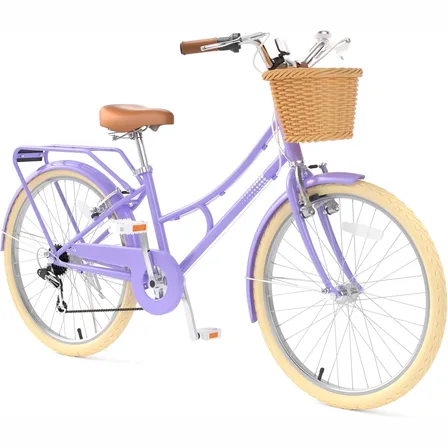
24-Inch Purple XJD Beach Cruiser Bike with U-Brake
The XJD 24-Inch Purple Beach Cruiser is built for girls and young women roughly …$159.99