

What style bike to get 4 year old
For most 4-year-olds, choose a correctly fitted 12-, 14-, or 16-inch kids’ bike, then decide on training wheels from confidence and control.
Choose the style from current ability
A pedal bike with training wheels is relevant when the child needs lateral support while learning to pedal, steer and stop. A pedal bike without training wheels is the better direction when the child already balances confidently and can start, steer and stop with control. Age does not settle that choice.
Do not buy a larger bicycle simply because the child may grow into it. An oversized bike can make mounting, steering and braking harder. The useful question is whether the child can control the bicycle now.
Measure height and inseam first
Measure the child’s height without shoes, standing straight against a wall. Then measure inseam from the floor to the crotch while the child stands naturally. Use height to identify likely wheel sizes and inseam to judge stand-over room when the actual bicycle is tried.
| Wheel size | XBikes starting point | Relevance at age 4 |
|---|---|---|
| 12 Inch | Ages 3–4; 34–40 in / 86–102 cm | Start here for a child within this height range. |
| 14 Inch | Ages 3–6; 37–45 in / 94–114 cm | Compare when the measured height fits this overlapping range. |
| 16 Inch | Ages 4–7; 40–48 in / 102–122 cm | Consider only when height and the individual fit check support it. |
These ranges overlap deliberately: they narrow the search but do not determine fit. If the child falls between sizes, compare both on the child instead of automatically choosing the larger one.
Perform the fit and control check
Have the child try the bicycle. Check that the child can stand over it comfortably, reach the handlebar without stretching, turn the handlebar while remaining balanced, and reach and operate the brakes with control. Also watch whether starting, stopping and putting a foot down look manageable rather than strained.
- Too large: the child stretches for the controls, struggles with stand-over, or cannot stop and steady the bike confidently.
- Too small: the riding position looks cramped or steering and pedalling are restricted.
- Appropriate now: the child can mount, steer, brake and stop under control at the current adjustment.
If those checks conflict with an age or height range, trust the individual fit check. For adjustment, assembly, maintenance, compatibility, load limits or torque, follow the exact product manual or ask a qualified bicycle mechanic.
How the supplied training-wheel bikes compare
The three catalog options are useful because each is a training-wheel bike and each offers 12, 14 and 16 Inch labels—the three XBikes starting sizes most relevant to a typical four-year-old fit comparison. Their supplied facts do not establish geometry, brake reach or suitability for a particular child, so an in-person fit check remains necessary.
 Black XJD Kids Bike for Boys – 12, 14 & 16 Inch Sizes
A Training Wheel Bike with supplied 12, 14 and 16 Inch labels, making it relevant for measurement-led comparison across the XBikes starting ranges associated with age four.
 XJD Kids' Training Wheel Bike for Boys & Girls, 12/14/16 Inch – White
This Training Wheel Bike offers 12, 14 and 16 Inch labels. Select a comparison size from measured height, then confirm stand-over, reach, braking and control on the individual child.
 Girls' Training Wheel Bike by XJD, 12–20 Inch Wheels – Blue
A Training Wheel Bike offered in 12, 14, 16 and 20 Inch labels. Its smaller labels are relevant comparison points for many four-year-olds; the 20 Inch label requires its own height-led fit assessment.
Black XJD Kids Bike for Boys – 12, 14 & 16 Inch Sizes is a Training Wheel Bike offered in 12 Inch, 14 Inch and 16 Inch labels. Compare the label matching the child’s measured-height starting point, then verify stand-over, reach and control.
XJD Kids' Training Wheel Bike for Boys & Girls, 12/14/16 Inch – White provides the same three supplied wheel-size labels in the Training Wheel Bikes category. Its title wording is a catalog description, not evidence that it fits any particular child.
Girls' Training Wheel Bike by XJD, 12–20 Inch Wheels – Blue offers 12 Inch, 14 Inch, 16 Inch and 20 Inch labels. For this age-specific decision, compare only the size supported by the child’s measurements. The 20 Inch starting point is ages 7–12 and 48–60 in / 122–152 cm, so age four alone does not support choosing it.
Color and title wording can distinguish these listings, but neither replaces fit evidence. The supplied catalog facts do not provide brake type, weight, material or other component differences, so those should not be assumed.
Make the final decision
- Record the child’s height and inseam.
- Use the 12, 14 and 16 Inch ranges to select the size or two sizes worth trying.
- Choose training wheels only if the child’s present balance and confidence call for lateral support.
- Reject any bicycle the child cannot stand over, steer or brake comfortably, even if its age label appears suitable.
- Fit a bicycle helmet so it sits level and secure, with its straps adjusted according to the helmet manufacturer’s instructions.
For a 4-year-old, the answer is therefore a child-sized pedal bike matched by measurement and hands-on control—often 12, 14 or 16 Inch—with training wheels only when the rider currently needs them.
Bikes for your next adventure
-
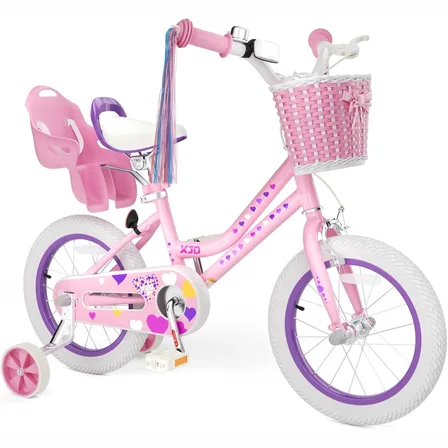
Light Pink XJD Girls' Bicycle with Basket & Training Wheels
The Light Pink XJD Girls' Bicycle with Basket & Training Wheels is a retro-style…$109.99
$129.99 -

Pink Girls' 12/14/16" Bike by XJD – Basket & Doll Seat
The XJD Pink Girls' Bike with Basket & Doll Seat is made for riders 71–122 cm ta…$75.99
$99.99 -

Light Purple XJD Toddler Bike Helmet, Adjustable, Size XS (46–51 cm)
This Light Purple XJD toddler bike helmet is made for the smallest riders — the …$20.39