

How to measure for toddler bike helmet
Measure your toddler’s head circumference at its widest point, with a soft tape level around the forehead. Compare that number with the helmet’s stated range, then confirm the actual helmet sits level, feels snug, and can be secured exactly as its manufacturer directs.
Measure the head, not the child’s age
Helmet sizing should begin with a current head measurement. Age is not a reliable substitute because toddlers of the same age can have different head shapes and circumferences.
- Use a flexible measuring tape. If you do not have one, wrap a non-stretch string around the head and measure the marked length against a ruler.
- Place it around the widest part of the head, passing across the forehead and around the back. Keep the tape level rather than letting it rise or dip.
- Hold the tape close to the head without compressing the skin or hair.
- Record the result in centimeters. Measuring twice helps catch a tilted tape or a reading error.
Measure the head as it will normally be when riding. Do not add room for growth, thick clothing, or padding that is not part of the helmet. Extra space can prevent a secure fit.
Compare the result with the listed size range
The measured circumference must fall within the manufacturer’s stated range for the exact size being considered. Do not round a measurement up or down merely to make a helmet qualify. A child below the smallest stated measurement needs another option with an appropriate smaller range.
The supplied XBikes catalog option is the Kids Bike Helmet by XJD for Boys & Girls – Black, Blue, Green, Pink, Purple. Its S variants are labeled 18.11–20.08 inches / 46–51 cm, while its M variants are labeled 20.47–22.05 inches / 52–56 cm. Those ranges make the product a useful comparison after measuring, and the color choices do not change the stated sizing.
These particular catalog options help answer the sizing question because they provide explicit circumference ranges in both centimeters and inches, allowing a parent to compare the child’s actual measurement rather than guessing from age or color.
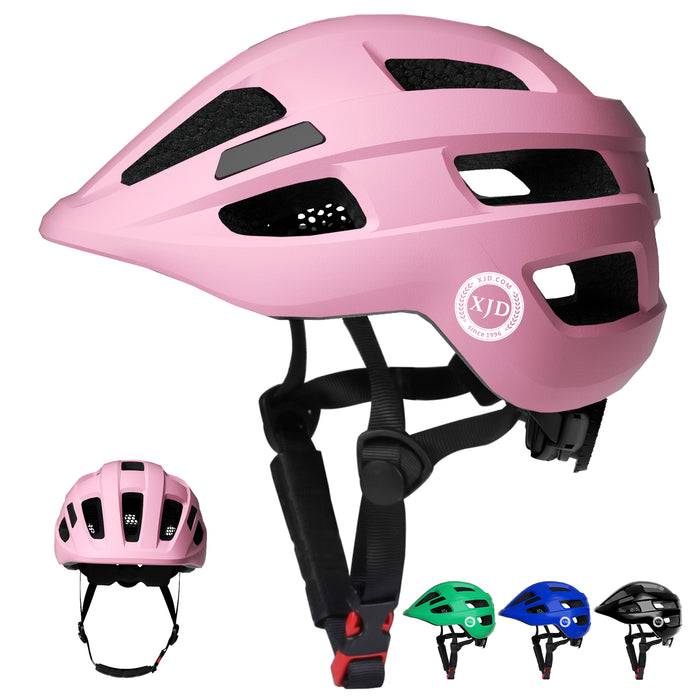
If the measurement is under 46 cm, this supplied product is not shown as relevant by the available size labels. If the measurement is between the printed S and M ranges, or exactly near a boundary, do not assume either size will fit: try the helmet and follow its exact sizing instructions.
Check the helmet on your toddler
A matching number identifies a candidate, not a completed fit. Place the helmet on the child and check it while the child is upright and looking forward. The helmet should sit level rather than tipped back or pushed low over the face.
Use only the helmet’s intended adjustment system and supplied padding. Adjust the straps according to the manufacturer’s instructions so the helmet remains properly positioned and securely fastened. It should feel evenly snug without obvious pressure points, discomfort, or loose movement.
Ask the child whether anything pinches or hurts, and watch for discomfort even if the child cannot describe it clearly. Recheck the position after fastening because a helmet that appears suitable while unfastened may shift once its straps are used.
Know when to reject the size
- Too small: it cannot settle into a level position, creates painful pressure, or the adjustment system cannot be used as directed.
- Too large: it remains loose, shifts out of position, or relies on improvised padding to take up space.
- Wrong shape: the circumference matches, but pressure is concentrated in one area while another area remains loose.
- Unclear fit: the measurement falls outside or between the listed ranges, or the manual’s instructions cannot be satisfied.
Do not buy an oversized helmet solely for future growth. The relevant size is the one that fits properly now. Re-measure periodically as the child grows and repeat the full on-head check rather than assuming the previous setting still works.
Keep helmet sizing separate from bike sizing
A helmet measurement does not determine bicycle wheel size. If you are also choosing a toddler bicycle, XBikes lists 12-inch bikes as a starting point for ages 3–4 and rider heights of 34–40 inches / 86–102 cm, and 14-inch bikes for ages 3–6 and 37–45 inches / 94–114 cm.
Those figures are starting points only. Prioritize measured rider height, inseam, reach, brake control, and current confidence. Have the child try the bicycle, check stand-over clearance and control, and do not buy an oversized bicycle for growth. These bike checks do not alter the helmet circumference requirement.
Make the final decision
Write down the toddler’s circumference, compare it with 46–51 cm for S or 52–56 cm for M, and try the corresponding helmet only if the measurement is inside its printed range. Keep it only when it sits level, stays snug, and its straps can be used exactly as the manufacturer instructs; otherwise choose a different size or model.
Bikes for your next adventure
-

Kids Bike Helmet by XJD for Boys & Girls – Black, Blue, Green, Pink, Purple
The XJD Kids Bike Helmet covers a wide 2-to-8-year age range thanks to two head-…$59.99
-
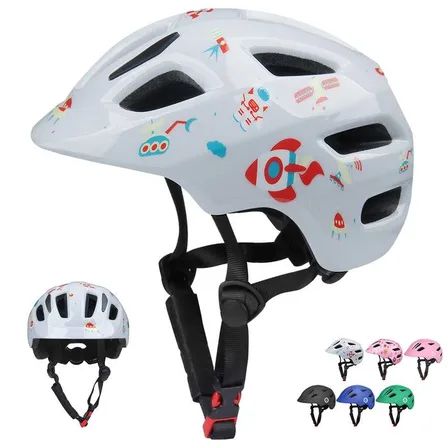
White Astronaut Bike Helmet for Kids by XJD – Toddler to Youth Sizes
4 reviews
The XJD White Astronaut kids' bike helmet is made for toddlers through younger e…$59.99
-
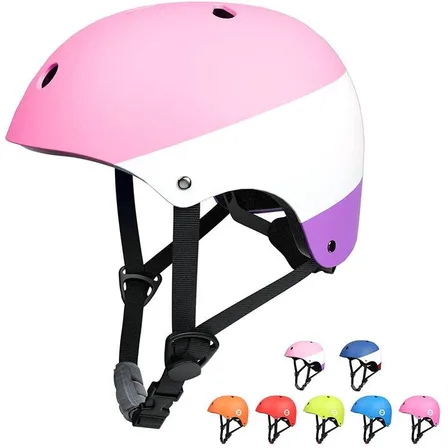
XJD Kids Bike Helmet for Boys & Girls, B White / Pink White
The XJD Kids Bike Helmet covers a wide age range — suggested for ages 2 through …$59.99