

What size bike helmet for 2 year old
For a 2-year-old, choose a bike helmet by measured head circumference—not age. Measure the head, match the result to the helmet’s size label, then check the fit on the child.
What size should you start with?
There is no single helmet size that fits every 2-year-old. Children of the same age can have different head measurements, so an age label or a guess such as “toddler size” is not enough.
Start by measuring around the widest part of your child’s head. Place a soft measuring tape just above the eyebrows, pass it above the ears and continue around the back of the head. Keep the tape level and comfortably snug rather than pulling it tight. Record the circumference in centimetres, because that makes comparison with most size labels straightforward.
If you do not have a soft tape, wrap a non-stretch string around the same path, mark where its ends meet and measure it against a ruler. Repeat the measurement to catch a tilted tape or loose string.
Compare the measurement with the actual size range
Use the exact range printed for the specific helmet and size. The child’s measurement must fall within that range; a size name such as S or M has no universal meaning across different products.
The supplied catalog option, Green XJD Kids Bike Helmet for Boys & Girls, has S labels covering 18.11–20.08 inches / 46–51 cm and M labels covering 20.47–22.05 inches / 52–56 cm. Its listed colors are Black, Blue, Green, Pink and Purple in both ranges.
| Measured circumference | Catalog comparison | Next step |
|---|---|---|
| 46–51 cm | S is the listed range | Try S on the child and perform a complete fit check. |
| 52–56 cm | M is the listed range | Try M only if the child’s measurement falls here, then check fit. |
| Below 46 cm, between listed ranges, or above 56 cm | No supplied SKU label clearly covers it | Choose another helmet whose stated range includes the measurement. |
This product is relevant because its numerical S and M ranges let you compare a 2-year-old’s actual head circumference instead of relying on age. It is not relevant when the measurement falls outside those supplied ranges.
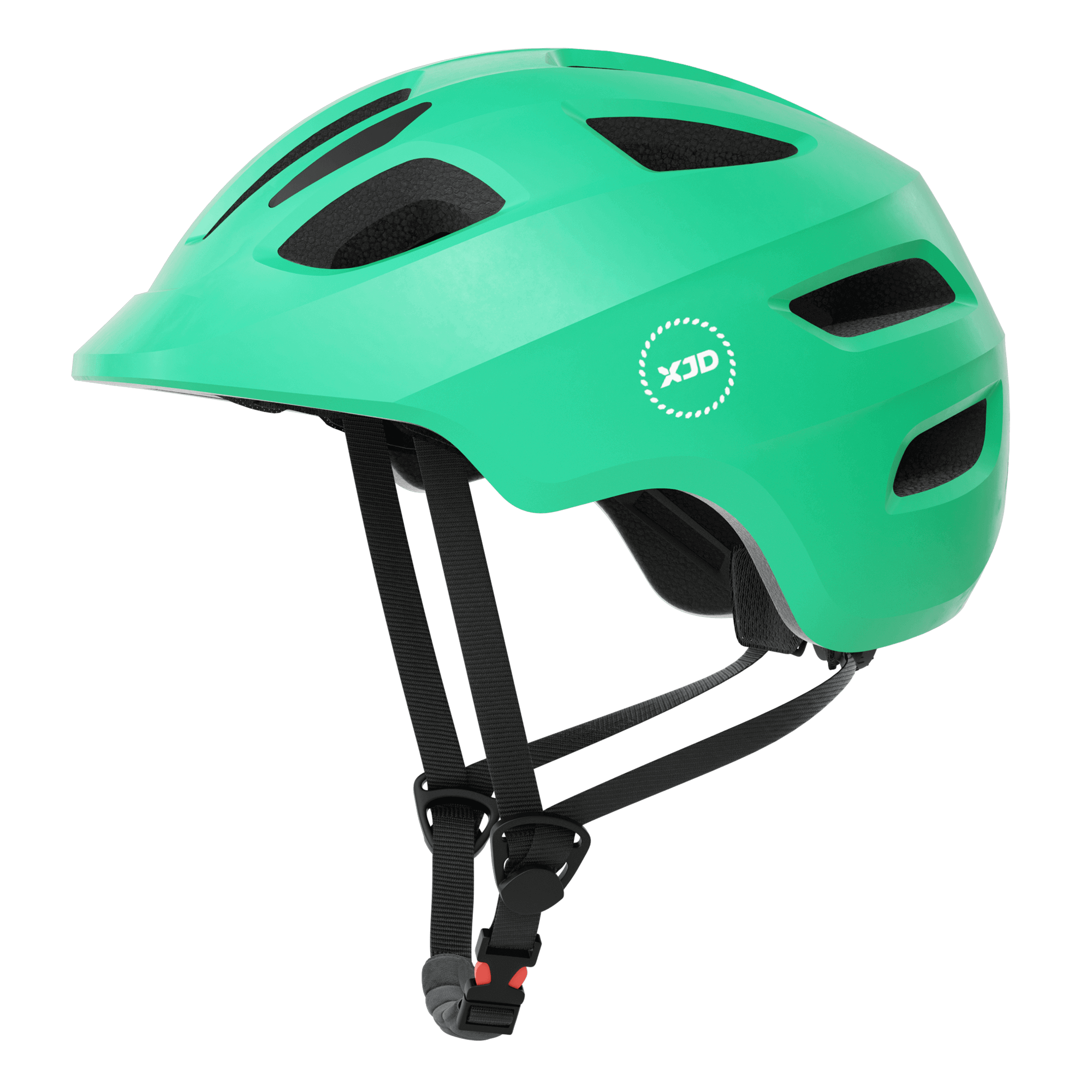
Check the helmet on your child
A matching number is only the first screen. The U.S. Consumer Product Safety Commission advises that a bicycle helmet must fit properly, sit level and have its straps used according to the manufacturer’s instructions.
- Set it level: The helmet should sit squarely on the head rather than tipping back and exposing the forehead or dropping over the eyes.
- Check stability: Follow the product instructions to adjust its fit system and straps. The helmet should remain properly positioned during normal head movement.
- Check comfort: Look for obvious pressure points, pinching or a helmet that moves around despite correct adjustment.
- Recheck the straps: Fasten and route them exactly as the manufacturer directs. Do not invent a strap arrangement or modification to rescue a poor fit.
If you cannot obtain a level, stable and comfortable fit while following the instructions, that helmet is the wrong fit even when the circumference appears to match.
Do not size up for growth
An oversized helmet is not a useful way to leave growing room. If it cannot be adjusted to fit properly now, choose a smaller or differently shaped model whose range includes the current measurement. Likewise, do not squeeze a child into a size that is too small simply because its age wording sounds appropriate.
Re-measure periodically and whenever the helmet begins to feel tight or no longer stays correctly positioned. Hair style and hats can also affect fit. Unless the manufacturer specifically instructs otherwise, do not place bulky headwear beneath the helmet.
What the bicycle wheel-size chart does—and does not—tell you
Wheel size cannot determine helmet size. The XBikes bicycle chart begins with 12-inch bikes at ages 3–4 and rider heights of 34–40 inches / 86–102 cm, but that is only a bicycle starting point and does not supply a helmet measurement for a 2-year-old.
If selecting a bicycle as well, prioritize the child’s measured height, inseam, reach, brake control and current confidence over age. The American Academy of Pediatrics advises having the child try the bicycle, checking stand-over, control and brake reach, and avoiding an oversized bicycle bought merely for growth. Those checks remain separate from measuring the head for a helmet.
Your next decision
Measure your 2-year-old’s head now. Consider the Green XJD Kids Bike Helmet for Boys & Girls in S only for 46–51 cm or M only for 52–56 cm, then verify a level, stable fit according to its instructions. If the measurement is not covered or the on-child check fails, select a different helmet range rather than sizing by age.
Bikes for your next adventure
-

Light Purple XJD Toddler Bike Helmet, Adjustable, Size XS (46–51 cm)
This Light Purple XJD toddler bike helmet is made for the smallest riders — the …$20.39
-

Black XJD Toddler Bike Helmet, Adjustable – Kids' Protective Helmet
The XJD Toddler Bike Helmet in black is an adjustable protective helmet for kids…$20.39
-

Blue XJD Kids Bike Helmet for Boys & Girls
The Blue XJD Kids Bike Helmet is a lightweight, adjustable multi-sport helmet fo…$59.99
$99