

How big of a bike for 3 year old
Most 3-year-olds should start with a 12-inch bike; a taller child may fit a 14-inch. Measure height and inseam, then confirm control in person.
Choose between 12 and 14 inches
Use age only as a starting point. XBikes places a 12-inch bike at ages 3–4 and heights of 34–40 in (86–102 cm). A 14-inch bike starts at ages 3–6 and heights of 37–45 in (94–114 cm).
The ranges overlap, so a 3-year-old who is 37–40 in (94–102 cm) could fall within either starting range. In that situation, do not automatically choose the larger wheel. Compare both bikes using the child's inseam, reach, brake control and current confidence.
A 16-inch bike is generally too large for this age: its starting range is ages 4–7 and heights of 40–48 in (102–122 cm). Consider it only if the child meets the height guidance and passes every hands-on fit check. Do not buy an oversized bike merely to allow room for growth.
Measure your child before comparing bikes
- Height: Have the child stand straight against a wall without shoes. Mark the top of the head and measure from the floor.
- Inseam: With feet slightly apart, measure from the floor to the crotch. Use a thin book held level between the legs to make the upper point easier to identify.
- Record both measurements: Bring them when shopping, but treat the wheel-size ranges as a shortlist rather than proof of fit.
Wheel diameter does not tell you the frame's stand-over clearance, seat range or handlebar reach. Those details can differ between bikes carrying the same wheel-size label, so the child still needs to try the exact model and size.
Perform the hands-on fit check
Have the child stand over the frame with both feet securely on the ground. There should be comfortable clearance rather than contact with the frame. Follow the exact product manual for seat and handlebar adjustment limits; if setup is uncertain, use a qualified bicycle mechanic.
Next, seat the child and watch their posture. They should reach the handlebars without stretching, twisting or locking their elbows. Ask them to turn the bars both ways while remaining balanced. They must also be able to operate the bike's controls and reach and use its brakes confidently. Do not assume that training wheels correct an otherwise poor fit.
If the child cannot mount, stop, steer or use the brakes with control, choose a smaller option or wait. A bike that technically matches the height table can still be unsuitable for the child's proportions or present skill level.
How the supplied XBikes options compare
These catalog options help answer the sizing question because all three offer 12-, 14- and 16-inch labels for a direct comparison, and each is listed as a training-wheel bike. The choice should begin with 12 versus 14 inches for most 3-year-olds, followed by a fit check on the exact bike.
 Light Pink XJD Girls' Bicycle with Basket & Training Wheels
Offers 12, 14, 16 and 20 Inch labels with training wheels. Its 12- and 14-inch choices are the relevant starting comparison for most 3-year-olds, subject to an individual fit check.
 Blue XJD Girls Bike with Training Wheels – 12/14/16 Inch
Offers 12, 14 and 16 Inch labels with training wheels. Compare its 12- and 14-inch options against the child's measured height, inseam, reach, brake control and confidence.
 XJD Boys 12/14/16" Training Wheel Bike – Blue
Offers 12, 14 and 16 Inch labels with training wheels. The 12- and 14-inch sizes may be relevant at age three, but the child must try the exact configuration.
- Light Pink XJD Girls' Bicycle with Basket & Training Wheels: Available in 12, 14, 16 and 20 Inch labels. For this question, compare only the size that matches the child's measurements; the 20 Inch option starts well beyond the supplied range for age three.
- Blue XJD Girls Bike with Training Wheels – 12/14/16 Inch: Available in 12, 14 and 16 Inch labels, making its 12- and 14-inch options the relevant starting comparison for a typical 3-year-old.
- XJD Boys 12/14/16" Training Wheel Bike – Blue: Also available in 12, 14 and 16 Inch labels. Use the label only to identify the candidate size, then verify stand-over, reach, controls and braking on that exact configuration.
The catalog facts do not supply geometry, component specifications, load limits or adjustment procedures. Check the exact product manual or consult a qualified bicycle mechanic for those details.
Do not skip helmet fit and a controlled first ride
Use a bicycle helmet that fits properly. It should sit level, and its straps should be adjusted according to the helmet manufacturer's instructions. A correctly sized bike does not replace protective equipment or close supervision.
Begin in a flat area away from traffic and obstacles. Ask the child to demonstrate starting, steering, braking and stopping while an adult stays close. If the child looks stretched, cannot control the bike, or repeatedly loses balance despite an appropriate setup, reassess the size rather than expecting them to grow into it.
The practical decision
Measure first. If the child is 34–40 in (86–102 cm), begin with a 12-inch bike; if they are 37–45 in (94–114 cm), include a 14-inch bike in the comparison. Where those ranges overlap, select the smaller bike unless the child clearly controls the larger one during the full fit check. Choose 16 inches only when the child is at least 40 in (102 cm), meets its stated range and demonstrates confident control.
Bikes for your next adventure
-

26-Inch XJD Beach Cruiser Bike for Girls – Purple, V-Brake
This XJD 26-inch purple beach cruiser is sized for big kids and teens — suggeste…$218.49
$229.99 -

Light Pink XJD Girls' Bicycle with Basket & Training Wheels
The Light Pink XJD Girls' Bicycle with Basket & Training Wheels is a retro-style…$109.99
$129.99 -
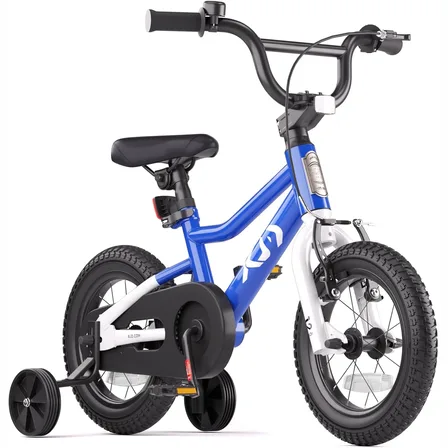
XJD Boys & Girls BMX Bike with Training Wheels, 12/14/16" – Blue
The XJD Boys & Girls BMX Bike in Blue is a first pedal bike for kids roughly age…$99.99
$119.99