

How to choose a bike for 3 year old
Choose a bike for a 3-year-old by measuring height and inseam, then checking stand-over clearance, reach, brake control and confidence on the actual bike. Start with 12-inch or 14-inch wheels, but never size up only for growth.
Measure your child before comparing bikes
Measure standing height without shoes, with the child upright against a wall. Then measure inseam from the floor to the crotch while the child stands naturally. Height gives you a starting wheel size; inseam helps you judge whether the child can stand over and manage the bicycle comfortably.
For a 3-year-old, the XBikes starting points are:
| Wheel size | Age starting point | Rider-height starting point |
|---|---|---|
| 12 Inch | Ages 3–4 | 34–40 in / 86–102 cm |
| 14 Inch | Ages 3–6 | 37–45 in / 94–114 cm |
If your child's height falls in both ranges, compare both sizes in person rather than assuming the larger one is better. Age is only a rough filter; measured fit and control decide.
Check fit on the actual bicycle
Have the child try the bike. Do not buy an oversized bicycle merely because they may grow into it. With the child standing over the frame, check that they can stand securely rather than being forced onto tiptoes or against the bicycle.
Next, seat the child and observe whether they can reach the handlebar without stretching, locking their elbows or leaning awkwardly. They should be able to steer left and right while remaining balanced. Confirm that they can reach and operate the available braking controls with their hands in a normal riding position.
A suitable bike should feel manageable at walking speed. If the child cannot start, stop, steer or hold the bicycle upright with reasonable confidence, the nominal age or height range does not make that bike a good fit.
Choose between 12-inch and 14-inch wheels
A 12-inch bike is the first comparison for a child measuring 34–40 inches (86–102 cm). A 14-inch bike becomes another candidate from 37–45 inches (94–114 cm). In the overlapping 37–40-inch range, try both and favor the one that gives better stand-over security, easier reach and more confident control.
Do not jump to 16 inches simply because it will last longer. The XBikes 16-inch starting point is ages 4–7 and 40–48 inches (102–122 cm), so it is generally outside the starting age guidance for a 3-year-old. Individual fit checks remain necessary even when a child reaches that height.
How the supplied XBikes options compare
The two catalog options are relevant because both include 12-inch and 14-inch SKU labels and are categorized as training-wheel bikes, letting parents compare the two most plausible wheel-size starting points for many 3-year-olds.
 XJD Kids Bike for Girls – Pink, 12/14/16/20 Inch with Training Wheels
Relevant because its supplied sizes include 12 Inch and 14 Inch, the main starting comparisons for many 3-year-olds. Its 16 Inch and 20 Inch labels should not be treated as fit evidence.
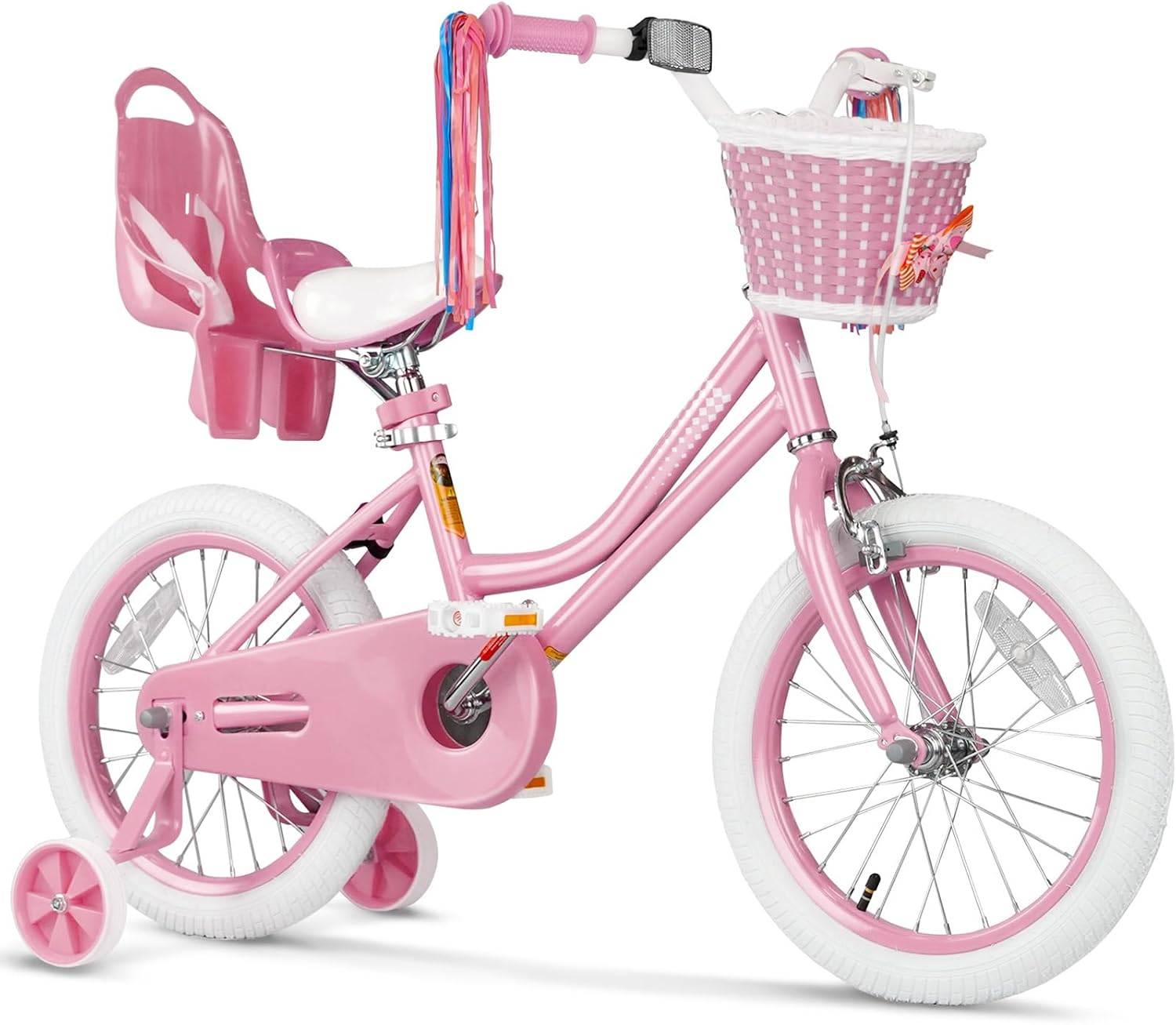 XJD Pink Girls' Bike – Kids 12/14/16 Inch Training Wheel Bicycle
Relevant as a training-wheel bicycle offered in 12 Inch and 14 Inch, plus 16 Inch. Compare the two smaller supplied sizes using the child's measured height and an individual control check.
XJD Kids Bike for Girls – Pink, 12/14/16/20 Inch with Training Wheels offers 12 Inch, 14 Inch, 16 Inch and 20 Inch labels. For this specific age, begin by evaluating its 12-inch and 14-inch versions. Its 16-inch and 20-inch labels do not establish suitability for a 3-year-old.
XJD Pink Girls' Bike – Kids 12/14/16 Inch Training Wheel Bicycle offers 12 Inch, 14 Inch and 16 Inch labels. Again, the 12-inch and 14-inch versions are the relevant initial comparisons. Wording in a product title is a catalog label, not proof of fit.
Neither supplied listing includes the measurements or control details needed to choose remotely. Confirm the exact selected SKU, then perform the same stand-over, reach, braking and confidence checks on that bicycle.
Account for confidence and training wheels
Training wheels identify the type of both supplied products, but they do not replace correct sizing. A hesitant new rider may benefit from the stability of this category, yet the child must still be able to sit naturally, steer without overreaching and operate the braking controls.
If your child already balances confidently, compare the training-wheel format with the way they currently ride before buying. Use only the configuration permitted by the exact product manual. For assembly, adjustment, compatibility, maintenance, load limits or torque instructions, follow that manual or ask a qualified bicycle mechanic.
Complete the safety and buying check
- Record the child's height and inseam.
- Use 12 inches as a starting comparison at 34–40 inches, and include 14 inches at 37–45 inches.
- Have the child stand over, sit on and steer each candidate.
- Verify comfortable handlebar reach and effective brake control.
- Choose the size the child controls now, not an oversized bike for future growth.
Add a properly fitting bicycle helmet. It should sit level and be secured with its straps according to the helmet manufacturer's instructions.
For your 3-year-old, measure today, shortlist the matching 12-inch or 14-inch SKU, and buy only after the child demonstrates secure stand-over, comfortable reach, brake control and confidence on that exact bike.
Bikes for your next adventure
-

Kids Bike Helmet by XJD for Boys & Girls – Black, Blue, Green, Pink, Purple
The XJD Kids Bike Helmet covers a wide 2-to-8-year age range thanks to two head-…$59.99
-

Kids Bike Helmet by XJD for Girls – Pink
The XJD Kids Bike Helmet in Pink is a lightweight multi-sport helmet for girls r…$59.99
$99 -

XJD Kids Bike for Girls – Pink, 12/14/16/20 Inch with Training Wheels
The XJD Kids Bike for Girls in Pink is a training-wheel bike built to carry your…$139
$159