

What bike for 3 year old
For most 3-year-olds, start with a 12-inch bike; consider a 14-inch bike only if the child measures at least 37 inches (94 cm) and can control it comfortably.
Measure before choosing
Age narrows the search, but the child’s measured height, inseam, reach, brake control and confidence decide the fit. Measure height without shoes, with the child standing straight against a wall. For inseam, measure from the floor to the crotch while the child stands naturally.
Then arrange an individual fit check on the exact bike. The child should be able to stand over it without being pressed against the frame, reach the controls without stretching, steer through turns and operate the brakes reliably. A bike that fits on a chart can still be unsuitable if its reach or controls overwhelm the rider.
Choose between 12 and 14 inches
| Wheel size | XBikes starting range | What it means at age 3 |
|---|---|---|
| 12 Inch | Ages 3–4; 34–40 in / 86–102 cm | The usual first size to check for a 3-year-old within this height range. |
| 14 Inch | Ages 3–6; 37–45 in / 94–114 cm | Worth comparing for a child at least 37 in / 94 cm tall, provided the complete fit check is successful. |
| 16 Inch | Ages 4–7; 40–48 in / 102–122 cm | Generally outside the supplied age starting point for a 3-year-old; do not move up merely to allow growth. |
The 12-inch and 14-inch ranges overlap from 37 to 40 inches (94 to 102 cm). In that overlap, do not automatically choose the larger wheel. Compare both bikes and favor the one the child can mount, balance, steer, stop and handle with greater confidence.
What the child should demonstrate
A short supervised try is more informative than an age label. Check the complete sequence of getting on, starting, riding, turning, braking and getting off. The child should remain in control instead of leaning, stretching or depending on an adult to hold the bike upright throughout the attempt.
- Stand-over: Confirm comfortable clearance when standing over the frame.
- Reach: The child should hold the bars and turn without an awkward forward stretch.
- Brake control: Confirm that the child can reach and operate the provided braking controls.
- Confidence: Watch for calm, deliberate steering and stopping rather than fear or loss of control.
If either candidate fails one of these checks, it is not the right fit now. Do not buy an oversized bicycle on the assumption that the child will grow into it.
How the supplied bikes are relevant
The supplied catalog choices are relevant because each is a kids’ BMX bike offered with training wheels and includes 12-inch and 14-inch SKU labels, the two sizes most likely to merit comparison for a 3-year-old. Each also has a 16-inch option, but that label alone does not make the larger size appropriate.
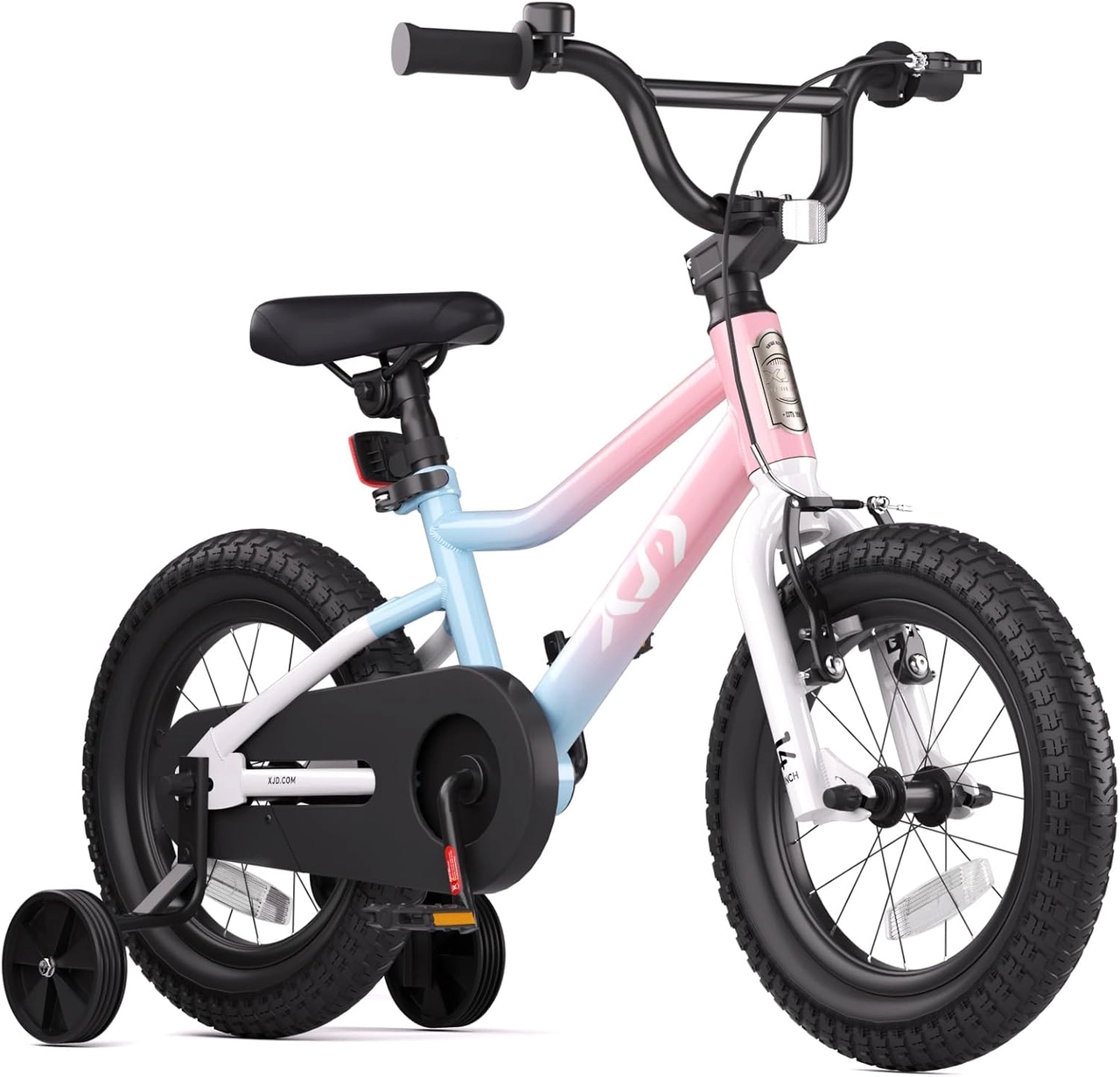 XJD Girls BMX Bike 12/14/16 Inch with Training Wheels – Pink Blue
Relevant because it is a kids’ BMX bike with training wheels and supplied 12-, 14- and 16-inch choices. For a 3-year-old, compare only the size supported by measured height and an individual fit check.
 XJD Boys & Girls BMX Bike with Training Wheels, 12/14/16" – Blue
This Blue kids’ BMX bike includes training wheels and 12-, 14- and 16-inch SKU labels. Its 12- and possibly 14-inch versions are relevant to the title, depending on measured height, reach, control and confidence.
XJD Girls BMX Bike 12/14/16 Inch with Training Wheels – Pink Blue
This kids’ BMX bike is offered in Pink Blue with 12 Inch, 14 Inch and 16 Inch labels. Begin with its 12-inch version when the child measures 34–40 inches (86–102 cm). Compare its 14-inch version only from 37 inches (94 cm), and still require a successful hands-on fit check.
XJD Boys & Girls BMX Bike with Training Wheels, 12/14/16" – Blue
This Blue kids’ BMX option has the same supplied wheel-size labels: 12 Inch, 14 Inch and 16 Inch. Its relevance is therefore determined by the same height ranges and individual checks, not by the wording of its title. Choose between the two products by fit and the child’s preferred catalog presentation, not by assuming a difference that the supplied facts do not establish.
Training wheels do not replace correct sizing
Training wheels may assist the early riding stage, but their presence does not justify extra reach, poor stand-over clearance or controls the child cannot operate. They also do not change the supplied height ranges. Check the bicycle as a complete setup after assembly and before every ride.
For assembly, adjustments, maintenance, load limits, compatibility and torque requirements, follow the manual for the exact product. If any instruction is unclear or the setup cannot be verified, use a qualified bicycle mechanic rather than guessing.
Helmet and final decision
Use a bicycle helmet that fits the child properly. It should sit level, with its straps positioned and secured according to the helmet manufacturer’s instructions. Recheck the fit whenever the helmet is adjusted or worn over different clothing.
For a 3-year-old, measure first and try a 12-inch bike first when height is 34–40 inches (86–102 cm). If the child is at least 37 inches (94 cm), compare a 14-inch model directly—but select it only when stand-over, reach, braking, steering and confidence are all clearly suitable today.
Bikes for your next adventure
-

XJD Girls Bike for Kids Ages 3-8, 12/14/16 Inch with Training Wheels – Purple
The XJD Girls Bike in Purple is a training-wheel bicycle for kids ages 3 to 8, f…$149
$169 -

Pink Girls' 12/14/16" Bike by XJD – Basket & Doll Seat
The XJD Pink Girls' Bike with Basket & Doll Seat is made for riders 71–122 cm ta…$75.99
$99.99 -

Light Purple XJD Toddler Bike Helmet, Adjustable, Size XS (46–51 cm)
This Light Purple XJD toddler bike helmet is made for the smallest riders — the …$20.39