

What bike should a 3 year old
For most 3-year-olds, start by trying a 12-inch bike; consider a 14-inch bike only if the child is tall enough and can control it comfortably. Measure height and inseam, then check stand-over space, reach, brake control and confidence on the actual bicycle. Never choose a larger bike merely to allow room for growth.
Start with height, not the third birthday
The XBikes starting point for a 12-inch bike is ages 3–4 and a rider height of 34–40 in (86–102 cm). A 14-inch bike overlaps this age group but starts at 37 in (94 cm), with a stated range of ages 3–6 and 37–45 in (94–114 cm).
That overlap means age alone cannot settle the choice. A shorter 3-year-old will generally begin the comparison with 12-inch models. A child at least 37 in (94 cm) tall can also try a 14-inch model, but only an individual fit check can show whether its stand-over height and reach are manageable.
| Wheel size to try | XBikes age starting point | XBikes rider-height range | Relevance at age 3 |
|---|---|---|---|
| 12 Inch | 3–4 | 34–40 in / 86–102 cm | Usual first size to compare |
| 14 Inch | 3–6 | 37–45 in / 94–114 cm | Consider for a taller child who passes the fit check |
| 16 Inch | 4–7 | 40–48 in / 102–122 cm | Normally outside the age starting point for a 3-year-old; do not size up for growth |
Measure before comparing models
Measure the child without shoes, standing upright against a wall, to find total height. For inseam, have the child stand with feet slightly apart and measure from the floor to the crotch. Record both measurements rather than relying on clothing size or an estimate.
Height identifies which wheel sizes are worth trying, while inseam helps you evaluate stand-over room on a particular frame. Published wheel size is not a complete fit measurement: two bicycles with the same wheel label can still feel different to the rider.
Make the child try the actual bicycle
Have the child stand over the bike with both feet firmly on the ground. There should be comfortable space between the child and the bicycle, without the frame forcing an awkward stance. Then let the child sit in a normal riding position and hold the handlebar.
- Can the child reach the handlebar without stretching or leaning excessively?
- Can the child steer in both directions while remaining balanced and relaxed?
- Can the child reach and operate the bicycle's braking controls reliably?
- Can the child get on and off without fear or significant assistance?
- Does the bicycle feel manageable at the child's current confidence level?
If any answer is no, reject that fit even when the child's age and height fall inside the starting range. Do not assume the child will quickly grow into a bicycle that is presently difficult to stand over, steer or stop.
How the supplied XBikes options fit this decision
The two catalog options are Kids' BMX Bikes offered with 12-, 14- and 16-inch SKU labels and training wheels. That makes them useful for directly comparing the two wheel sizes most relevant to many 3-year-olds, while the 16-inch variants should be set aside unless the rider meets the stated starting points and passes every fit check.
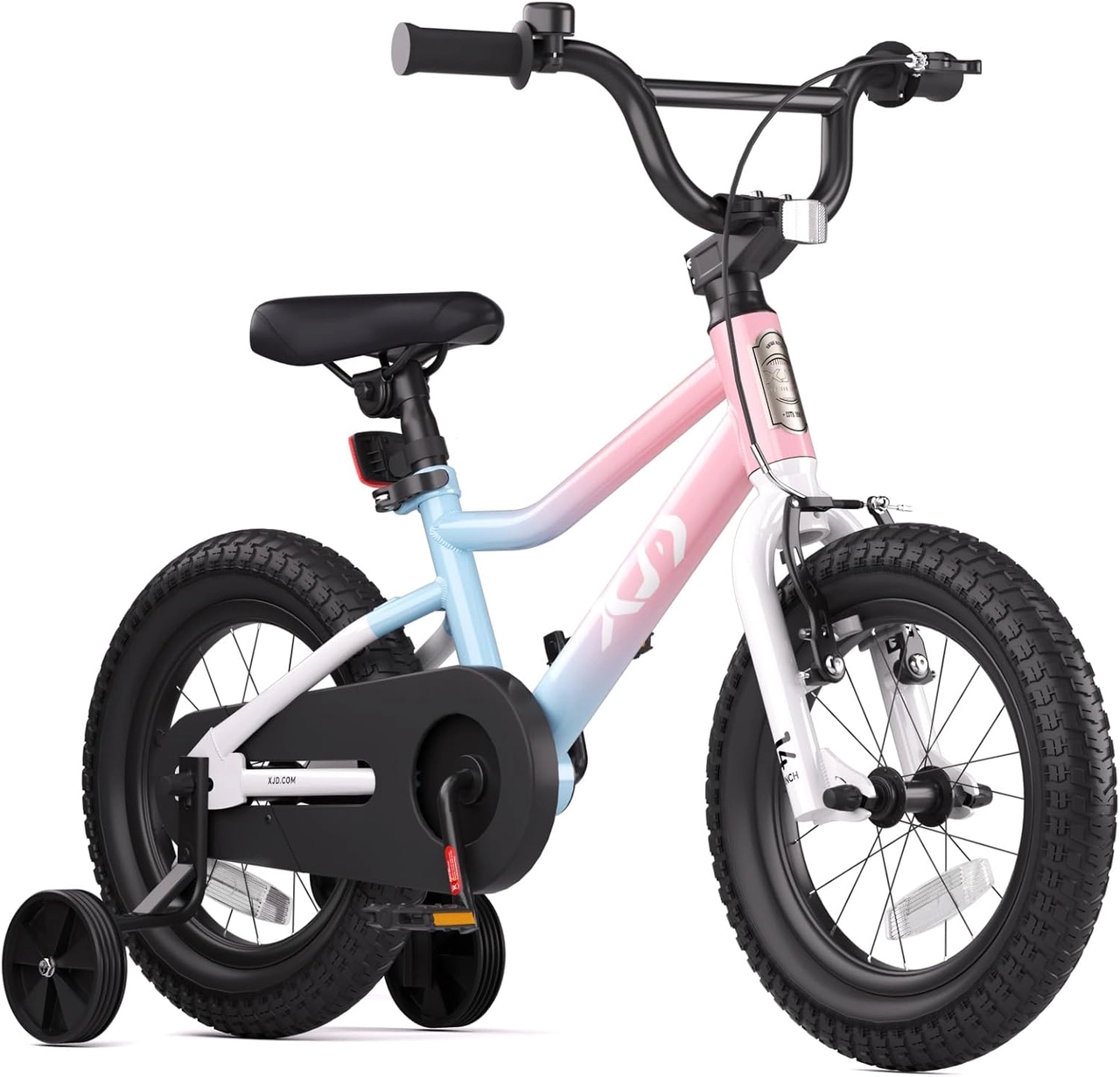 XJD Girls BMX Bike 12/14/16 Inch with Training Wheels – Pink Blue
A Kids' BMX Bike offered in 12-, 14- and 16-inch labels with training wheels. Its 12- and 14-inch options are relevant sizes to try for a 3-year-old who falls within the supplied height ranges.
 XJD Boys & Girls BMX Bike with Training Wheels, 12/14/16" – Blue
A blue Kids' BMX Bike with training wheels and 12-, 14- and 16-inch selections. Compare its 12- and potentially 14-inch variants using the child's measured height, inseam, reach, brake control and confidence.
XJD Girls BMX Bike 12/14/16 Inch with Training Wheels – Pink Blue offers 12 Inch, 14 Inch and 16 Inch selections. XJD Boys & Girls BMX Bike with Training Wheels, 12/14/16" – Blue offers the same three listed wheel-size selections. Based on the supplied facts, the meaningful comparison is the exact size that fits and the catalog color/title preference; no further performance difference is established here.
Training wheels are included in both exact product titles, so these options are relevant if that is part of the intended setup. They are less relevant if the parent specifically wants a catalog option without training wheels. Follow the exact product manual for assembly, adjustment, maintenance, compatibility and load limits, or ask a qualified bicycle mechanic; those details are not supplied here.
Complete the safety check
Choose a bicycle helmet made for cycling and ensure it fits the child properly. It should sit level, with its straps adjusted according to the helmet manufacturer's instructions. Recheck the fit whenever the helmet is put on.
Before each ride, an adult should also confirm that the bicycle is assembled and operating as described in its exact manual. If anything appears loose, damaged or difficult for the child to operate, stop and have it checked rather than improvising a repair or adjustment.
The decision to make now
Measure the child today. If height is 34–40 in (86–102 cm), arrange a 12-inch trial; if height is at least 37 in (94 cm), compare a 14-inch trial as well. Choose only the size the child can comfortably stand over, reach, steer and brake. For a 3-year-old, leave the 16-inch option for later unless the child reaches its 40 in (102 cm) height starting point and demonstrates full control during an individual fit check.
Bikes for your next adventure
-

XJD Girls Bike for Kids Ages 3-8, 12/14/16 Inch with Training Wheels – Purple
The XJD Girls Bike in Purple is a training-wheel bicycle for kids ages 3 to 8, f…$149
$169 -

Pink Girls' 12/14/16" Bike by XJD – Basket & Doll Seat
The XJD Pink Girls' Bike with Basket & Doll Seat is made for riders 71–122 cm ta…$75.99
$99.99 -

Black XJD Kids Bike for Boys – 12, 14 & 16 Inch Sizes
For a son between roughly 3 and 8 years old, the XJD Kids Bike in Black covers t…$169
$199