

What size bicycle for a 3 year old
For most 3-year-olds, start with a 12-inch bicycle if the child is 34–40 in (86–102 cm) tall. Also compare a 14-inch bike at 37–45 in (94–114 cm), but choose only after checking the child’s inseam, stand-over clearance, reach, brake control and confidence on the actual bicycle.
Measure before choosing 12 or 14 inches
Measure the child’s height without shoes, standing straight against a wall. Then measure inseam from the floor to the crotch while the child stands with feet slightly apart. Wheel size is only a starting point; frame shape and component placement can make two bicycles with the same wheel label fit differently.
Use the XBikes ranges to narrow the choice:
| Wheel size | Starting range | Meaning for a 3-year-old |
|---|---|---|
| 12 Inch | Ages 3–4; 34–40 in / 86–102 cm | The usual first size to try when the measured height falls in range. |
| 14 Inch | Ages 3–6; 37–45 in / 94–114 cm | Worth comparing when the child is at least 37 in / 94 cm tall. |
| 16 Inch | Ages 4–7; 40–48 in / 102–122 cm | Not the age-based starting point at three; consider only when measurements and an individual fit check support it. |
If the child is shorter than the listed 12-inch range, this standard does not establish a suitable bicycle size. Do not move ahead by guessing; arrange an in-person fit check instead.
Check fit on the actual bicycle
Have the child try the bicycle rather than selecting from age or wheel size alone. With the child standing over the frame, confirm there is comfortable clearance and no need to balance awkwardly against the frame. The child should be able to get on and off with control.
While seated, check that the child can hold the grips without stretching, turning the shoulders or locking the elbows. Ask the child to turn the handlebar both ways while staying balanced. If the bicycle has hand-operated brakes, verify that the child can reach and operate them reliably. Brake control cannot be inferred from height.
Finally, observe confidence. A size that produces hesitation, tiptoe scrambling or difficulty steering is not a good present fit, even if the child appears in its age range. Do not buy an oversized bicycle merely to leave room for growth.
How the supplied XBikes options compare
The three supplied catalog bicycles help because each offers 12-inch and 14-inch SKU labels, the two sizes most relevant to this decision. They are training-wheel bicycles, so parents can compare those wheel choices within that category; training wheels do not remove the need for the same fit and control checks.
 XJD Boys 12/14/16" Training Wheel Bike – Blue
Offers 12 Inch and 14 Inch options relevant to the supplied age-three fit ranges, plus a 16 Inch option. Select by measured height and confirm stand-over, reach, brake control and confidence.
 XJD Kids' Training Wheel Bike for Boys & Girls, 12/14/16 Inch – White
Available with 12 Inch, 14 Inch and 16 Inch labels. Its 12- and 14-inch choices can be compared for a 3-year-old, but the child must try the bicycle before selection.
 Girls' Training Wheel Bike by XJD, 12–20 Inch Wheels – Blue
Offers 12 Inch, 14 Inch, 16 Inch and 20 Inch options. The 12- and 14-inch versions are the relevant age-three comparison points; the 20-inch range starts at ages 7–12.
- XJD Boys 12/14/16" Training Wheel Bike – Blue is listed with 12 Inch, 14 Inch and 16 Inch options. Begin with the size matching the child’s measured-height range, then verify physical fit.
- XJD Kids' Training Wheel Bike for Boys & Girls, 12/14/16 Inch – White also offers 12 Inch, 14 Inch and 16 Inch labels. Its title does not supply additional fit evidence, so use the same measurement and try-on process.
- Girls' Training Wheel Bike by XJD, 12–20 Inch Wheels – Blue is available in 12 Inch, 14 Inch, 16 Inch and 20 Inch. For this question, its 12-inch and 14-inch versions are the relevant comparison points. The 20-inch starting range is ages 7–12 and 48–60 in (122–152 cm), so it is not an age-three starting point.
These listings identify wheel-size options only. They do not provide enough information here to compare brake type, weight, materials, load limits or other specifications.
Do a short control check
- Place the child in a properly fitting helmet before riding.
- Confirm comfortable stand-over clearance and controlled mounting and dismounting.
- Check that the grips are easy to reach and steering does not pull the child forward.
- Verify that every fitted brake control is within reach and can be operated confidently.
- Let the child start, stop and steer in a traffic-free area under close adult supervision.
A bicycle helmet should fit properly, sit level and have its straps adjusted according to the helmet manufacturer’s instructions. A helmet does not correct a bicycle that is too large or difficult to control.
Make the final size decision
Choose 12 Inch when the child measures 34–40 in (86–102 cm) and controls that specific bicycle comfortably. Within the overlapping 37–40 in (94–102 cm) range, try both 12 Inch and 14 Inch rather than assuming the larger size is preferable. At 37–45 in (94–114 cm), a 14-inch bicycle may fit, but only if stand-over clearance, reach, braking and confidence all check out.
Follow the exact product manual for assembly, adjustments, maintenance, compatibility and load limits; use a qualified bicycle mechanic when the instructions or final setup are uncertain. For a 3-year-old, measure first, compare 12 and 14 inches where the height ranges overlap, and buy only the size the child can control today.
Bikes for your next adventure
-

XJD Girls Bike for Kids Ages 3-8, 12/14/16 Inch with Training Wheels – Purple
The XJD Girls Bike in Purple is a training-wheel bicycle for kids ages 3 to 8, f…$149
$169 -

Pink Girls' 12/14/16" Bike by XJD – Basket & Doll Seat
The XJD Pink Girls' Bike with Basket & Doll Seat is made for riders 71–122 cm ta…$75.99
$99.99 -
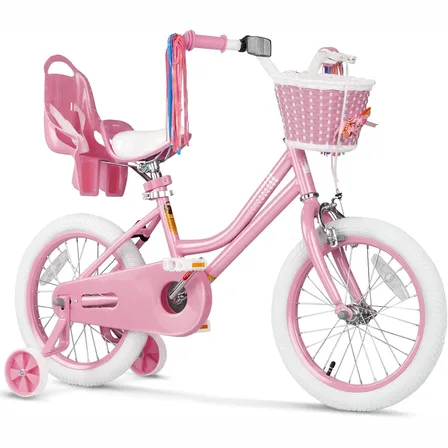
XJD Pink Girls' Bike – Kids 12/14/16 Inch Training Wheel Bicycle
The XJD Pink Girls' Bike is a training-wheel bicycle for girls ages 3 to 8 (ride…$149
$169