

What size bike can a 3 year old ride
Most 3-year-olds should start by trying a 12-inch bike. Use the child’s measured height and fit—not age alone—to decide between 12 and 14 inches.
Start with height, then confirm the fit
Under the XBikes starting points, a 12-inch bike corresponds to ages 3–4 and heights of 34–40 in (86–102 cm). A 14-inch bike corresponds to ages 3–6 and heights of 37–45 in (94–114 cm). Because those ranges overlap, a taller 3-year-old may need to compare both sizes in person.
Do not move up merely because the child will grow. An oversized bike can be harder to mount, balance, steer and stop. Age ranges are screening tools; the child’s height, inseam, reach, brake control and current confidence determine whether a particular bike fits.
Measure the child before comparing bikes
- Measure standing height: Have the child stand without shoes, with their back against a wall. Measure from the floor to the top of the head.
- Measure inseam: With feet slightly apart, place a thin, firm book between the legs and raise it gently to simulate a saddle. Measure from the floor to the book’s top edge.
- Note current confidence: Consider whether the child already balances and steers independently or still needs substantial support.
Use height to identify a likely wheel size, then take both measurements to the exact bike’s sizing information. Wheel diameter alone does not establish stand-over clearance or saddle fit because frame geometry can differ. If the manual does not provide enough detail, ask a qualified bicycle mechanic to check the fit.
Compare the likely wheel sizes
| Wheel size | XBikes starting point | Relevance for a 3-year-old |
|---|---|---|
| 12 Inch | Ages 3–4; 34–40 in / 86–102 cm | The usual first size to try when the child falls within this height range. |
| 14 Inch | Ages 3–6; 37–45 in / 94–114 cm | Worth comparing when the child is at least 37 in / 94 cm, provided the individual fit checks succeed. |
| 16 Inch | Ages 4–7; 40–48 in / 102–122 cm | Generally outside the age starting point for a 3-year-old; do not choose it simply for growth. |
The Black XJD Kids Bike for Boys – 12, 14 & 16 Inch Sizes helps with this comparison because its catalog lists 12 Inch, 14 Inch and 16 Inch SKU labels. Those are size options to investigate, not proof that every version fits a particular child. The 12- and 14-inch labels are the most relevant starting points for the title; the 16-inch label should still be judged against the separate XBikes range and an individual fit check.

Perform a hands-on fit check
Have the child try the exact bicycle while wearing the shoes they will use for riding. First check stand-over clearance: the child should be able to straddle the bike without the frame preventing stable footing. Follow the product manual for the intended stand-over and saddle setup rather than inventing a clearance number.
Next, seat the child and observe the riding position. They must be able to reach the handlebar without stretching, turn it while remaining balanced, and place their hands where the controls are intended to be used. Ask them to operate the brakes. They need enough hand reach and control to use the bicycle’s braking system as its manual directs.
Finally, watch the child start, steer, stop and get off in a controlled practice area. A size that matches a chart can still be unsuitable if the child appears strained, cannot control the bike or lacks confidence. Conversely, overlapping chart ranges do not automatically make the larger option preferable.
Know when the catalog options are relevant
The supplied product is relevant when you want to compare catalog-labeled 12- and 14-inch versions for a 3-year-old whose measured height falls in the corresponding XBikes ranges. The 12-inch option is the first comparison for 34–40 in (86–102 cm); the 14-inch option becomes a comparison point from 37–45 in (94–114 cm).
It is not enough to choose a SKU label from height alone. If the child cannot straddle, reach, steer or brake comfortably, that version is not an appropriate fit. If the child is under 34 in (86 cm), the supplied sizing standard does not identify a suitable listed wheel size; seek an individual assessment rather than forcing the smallest catalog option. If the child is unusually tall for age, use the measured range but do not skip the control and confidence checks.
Complete the safety and setup checks
Use a bicycle helmet that fits properly, sits level and has its straps adjusted according to the helmet manufacturer’s instructions. Supervise the first rides in a controlled area away from traffic while the child becomes familiar with starting, turning and stopping.
For assembly, maintenance, load limits, component compatibility and torque settings, follow the exact bicycle’s manual. If instructions are missing, unclear or beyond your experience, use a qualified bicycle mechanic.
Decision: measure the child now. Try 12 inches first at 34–40 in (86–102 cm), compare 14 inches within its 37–45 in (94–114 cm) range, and buy only the version the child can straddle, reach, steer and brake with control.
Bikes for your next adventure
-

Black XJD Toddler Bike Helmet, Adjustable – Kids' Protective Helmet
The XJD Toddler Bike Helmet in black is an adjustable protective helmet for kids…$20.39
-
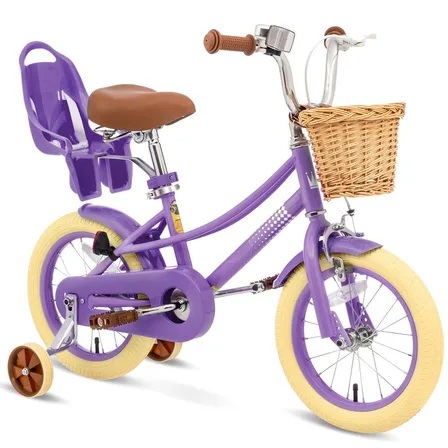
XJD Girls' Bike with Training Wheels, 12/14/16/20 Inch – Purple
The XJD girls' bike with training wheels in Purple is built to grow with your ri…$139
$159 -

Blue XJD Girls Bike with Training Wheels – 12/14/16 Inch
If you're shopping for a first pedal bike for a daughter roughly 3 to 8 years ol…$149
$169