

What size bike frame for 3 year old
For most 3-year-olds, start by comparing a 12-inch or 14-inch bike: 12-inch suits riders 34–40 in (86–102 cm) tall, while 14-inch suits 37–45 in (94–114 cm). These are wheel sizes, not frame measurements. Measure the child and confirm stand-over clearance, reach, brake control and confidence on the actual bicycle before choosing.
Choose the starting size from measured height
Age gives only a starting point. Under the XBikes sizing standard, both 12-inch and 14-inch bicycles can cover age three, but their height ranges overlap only partly.
| Wheel size | XBikes age starting point | Rider height | Likely role at age three |
|---|---|---|---|
| 12 Inch | Ages 3–4 | 34–40 in / 86–102 cm | The first comparison for a smaller or less confident rider |
| 14 Inch | Ages 3–6 | 37–45 in / 94–114 cm | A comparison for a taller child who can comfortably control it |
| 16 Inch | Ages 4–7 | 40–48 in / 102–122 cm | Usually outside the age-three starting point; consider only if individual fit and control are clearly suitable |
If the child is 37–40 in (94–102 cm), height alone places them in the overlap between 12-inch and 14-inch options. Do not automatically choose 14-inch for extra growing room. The better choice is the one the child can mount, balance, steer and stop with confidence now.
Measure before visiting or ordering
- Height: Have the child stand straight without shoes against a wall. Mark the top of the head and measure from the floor.
- Inseam: With feet slightly apart, measure from the floor to the crotch. This helps assess whether the child can straddle the bicycle comfortably.
- Reach and hand control: Note whether the child can hold the handlebar naturally and operate the bicycle’s controls without stretching or shifting position.
- Current confidence: Consider whether the child already balances and steers calmly or is still learning basic movement and stopping.
Write down height and inseam in the same unit used by the size information you compare. A wheel label such as “12 Inch” does not tell you every frame dimension, so the final check must be made on the assembled bicycle.
What a proper fit looks like
Have the child try the bike. When straddling it, the child should have comfortable clearance rather than being pressed against the frame. Seated, they should reach the handlebar without leaning or stretching excessively. They must be able to steer through a turn and reach and operate the brakes or other supplied controls reliably.
Watch for warning signs: tiptoeing merely to hold the bicycle upright, shoulders pulled forward, difficulty turning the handlebar, hands unable to reach the controls, or fear caused by the bicycle’s size. Any of these means the nominal age or height range has not produced a usable individual fit.
How the supplied bikes help with the comparison
The catalog options are relevant because each provides 12 Inch, 14 Inch and 16 Inch SKU labels, allowing parents to compare the two main age-three starting sizes and see the next listed size without assuming they fit alike. The XJD Pink Girls' Bike – Kids 12/14/16 Inch Training Wheel Bicycle and Girls 12/14/16 Inch Kids Bike by XJD with Training Wheels – Peach are both categorized as training wheel bikes. Their supplied facts do not establish frame geometry, brake reach or the correct fit for a particular child.
 XJD Pink Girls' Bike – Kids 12/14/16 Inch Training Wheel Bicycle
Offers 12 Inch, 14 Inch and 16 Inch SKU labels for comparing XBikes starting sizes. It is a training wheel bike, but the correct choice still depends on the child’s measurements and an individual fit check.
 Girls 12/14/16 Inch Kids Bike by XJD with Training Wheels – Peach
This peach training wheel bike has 12 Inch, 14 Inch and 16 Inch SKU labels, making its smaller options relevant to age-three size comparisons. Height, stand-over, reach, brake control and confidence must determine the final fit.
For a rider 34–40 in (86–102 cm), compare the 12 Inch SKU first. For a rider 37–45 in (94–114 cm), the 14 Inch SKU is also within the height starting point, but it remains suitable only if the child passes the physical control checks. A 16 Inch SKU is not equivalent to either smaller size: its starting point is ages 4–7 and 40–48 in (102–122 cm), so age three alone does not justify moving up.
Do not size up merely for growth
An oversized bicycle can make mounting, steering and stopping harder. Follow the American Academy of Pediatrics guidance reflected in the editorial basis: let the child try the bicycle, check stand-over and control, confirm brake reach, and do not buy an oversized bike simply because the child may grow into it.
If two sizes appear possible, repeat the fit check on both. Favor present control over the longer theoretical age range. If neither lets the child straddle, reach, steer and stop comfortably, neither is the right choice today.
What to do next
- Measure height and inseam.
- Use 12 Inch as the initial comparison at 34–40 in (86–102 cm), and add 14 Inch at 37–45 in (94–114 cm).
- Have the child try each candidate and verify stand-over clearance, reach, steering and stopping control.
- Use the exact product manual or a qualified bicycle mechanic for assembly, maintenance, load limits, compatibility and torque information.
- Fit a bicycle helmet so it sits level and secure its straps according to the helmet manufacturer’s instructions.
For a 3-year-old, choose 12 Inch or 14 Inch only after the measured height points there and the child demonstrates comfortable control; if that fit check fails, do not buy the larger size for future growth.
Bikes for your next adventure
-

XJD Girls Bike for Kids Ages 3-8, 12/14/16 Inch with Training Wheels – Purple
The XJD Girls Bike in Purple is a training-wheel bicycle for kids ages 3 to 8, f…$149
$169 -

Pink Girls' 12/14/16" Bike by XJD – Basket & Doll Seat
The XJD Pink Girls' Bike with Basket & Doll Seat is made for riders 71–122 cm ta…$75.99
$99.99 -
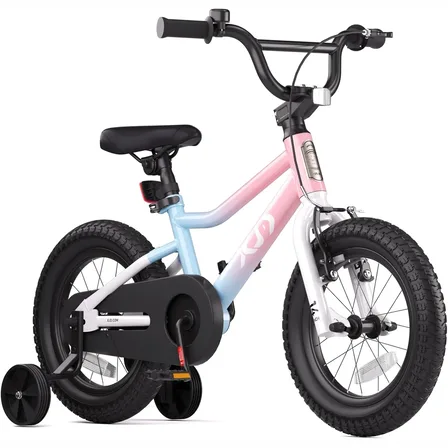
XJD Girls BMX Bike 12/14/16 Inch with Training Wheels – Pink Blue
The XJD Girls BMX Bike in Pink/Blue is built as a first pedal bike for kids roug…$99.99
$119.99