

What size bike frame for a 3 year old
For most 3-year-olds, start with a 12-inch bike, then confirm the fit in person. XBikes places 12-inch bikes at ages 3–4 and heights 34–40 in (86–102 cm). A taller child may compare a 14-inch bike, but age alone cannot determine the correct fit.
Frame size or wheel size?
Children’s bikes are commonly compared by wheel size rather than an adult-style frame measurement. For this question, “12 Inch” and “14 Inch” refer to wheel-size categories, not a measurement of the frame itself.
The useful starting point for a 3-year-old is therefore the child’s measured height: 12 Inch corresponds to 34–40 in (86–102 cm), while 14 Inch corresponds to 37–45 in (94–114 cm). These ranges overlap, so a child between 37 and 40 in (94 and 102 cm) still needs to try both sizes rather than choosing from the chart alone.
What to measure before choosing
- Standing height: Measure the child without shoes, standing straight against a wall. Compare that result with the XBikes height ranges.
- Inseam: With feet slightly apart, measure from the floor to the crotch. Use this measurement during an actual stand-over check; do not assume that matching the height chart guarantees clearance.
- Reach: On the bike, check whether the child can hold the handlebar without stretching, locking the elbows or leaning excessively forward.
- Brake control: If the bike has hand-operated controls, confirm that the child can reach and operate them while maintaining a secure grip. Follow the exact product manual for operation and adjustment details.
How to perform the fit check
Have the child try the exact bicycle. With the child standing over it, confirm comfortable clearance and stable footing. When seated, the child should be able to start, stop, steer and get off without struggling against the bike’s size.
Watch the whole movement rather than checking only whether the child can touch the ground. A fit is unsuitable if the child must stretch for the handlebar, cannot control the brakes, has difficulty steering, or appears intimidated by the bike. Current confidence matters alongside physical dimensions.
Do not move up to an oversized bicycle simply to leave room for growth. Guidance from the American Academy of Pediatrics emphasizes trying the bicycle and checking stand-over clearance, control and brake reach. If fit or setup is uncertain, consult the exact product manual or a qualified bicycle mechanic.
When 12 Inch and 14 Inch are relevant
A 12-inch bike is the clearest starting comparison for a child who is 34–40 in (86–102 cm). A 14-inch bike becomes a reasonable comparison at 37–45 in (94–114 cm), especially near the upper end of the 12-inch range, but it is not automatically preferable for a taller or older 3-year-old. The child must still demonstrate comfortable stand-over, reach, braking and control.
The supplied catalog options help answer the sizing question because both are training-wheel bikes offered in 12 Inch and 14 Inch—the two sizes most relevant to this age-and-height comparison. They also have 16 Inch options, but XBikes starts that size at ages 4–7 and heights 40–48 in (102–122 cm), so it should not be selected for a 3-year-old merely for future growth.
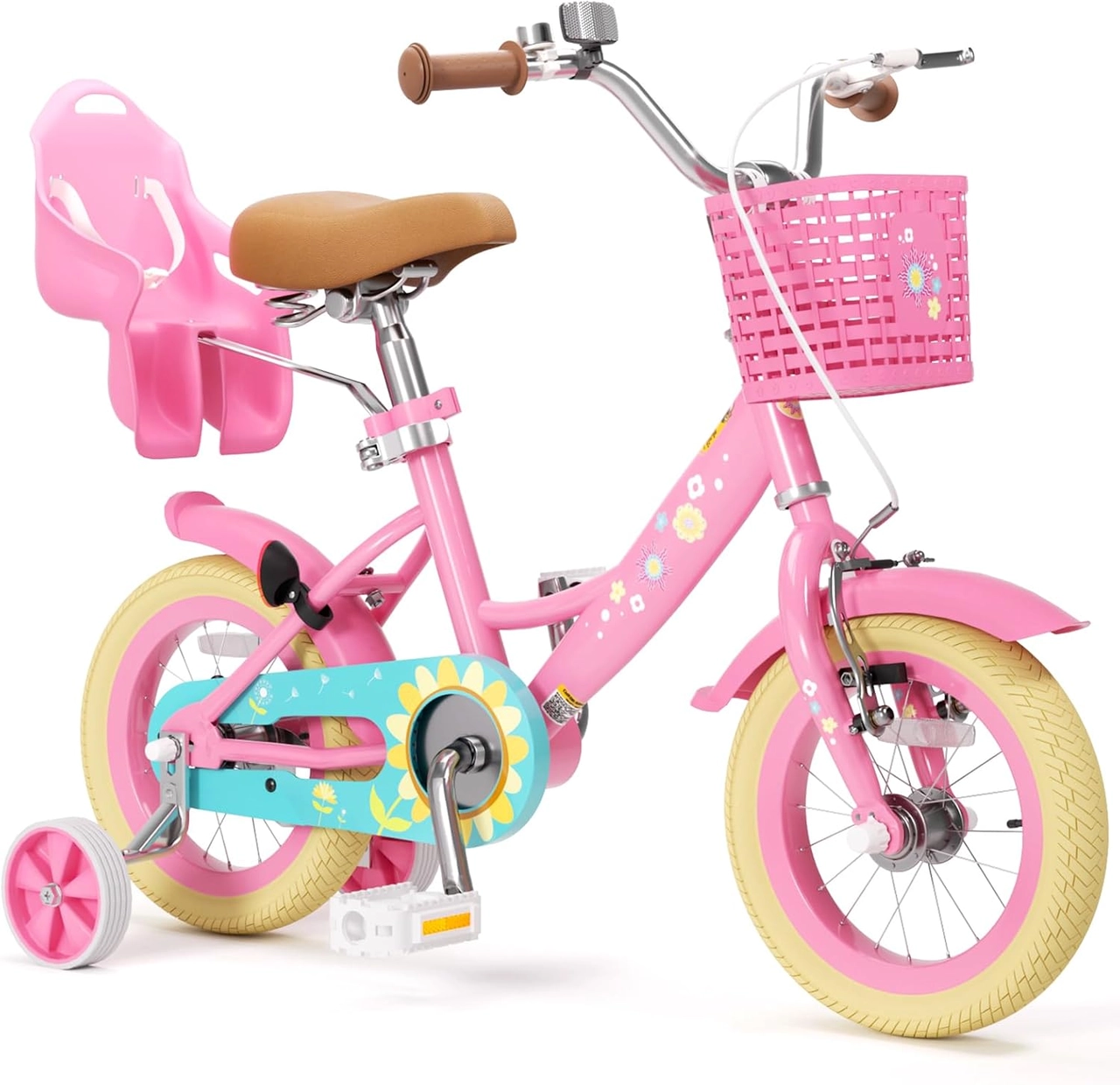 Flower Pink XJD Girls Bike with Doll Seat & Basket
A Training Wheel Bike offered in 12 Inch, 14 Inch and 16 Inch labels. Its 12- and 14-inch options are relevant comparison points, but the child’s measured height and in-person control check determine fit.
 Purple XJD Girls' Bike with Doll Seat & Basket
This Training Wheel Bike is available in 12 Inch, 14 Inch and 16 Inch labels. Compare its 12- and 14-inch sizes using height, stand-over clearance, reach, brake control and confidence rather than age alone.
How the two catalog options compare
Flower Pink XJD Girls Bike with Doll Seat & Basket is categorized as a Training Wheel Bike and is offered in 12 Inch, 14 Inch and 16 Inch labels. Purple XJD Girls' Bike with Doll Seat & Basket has the same category and the same three available size labels.
On the supplied sizing facts, neither product has a fit advantage: both let a parent compare 12 Inch with 14 Inch. Choose the size through the child’s measurements and trial fit, not through the color wording or accessories in the product titles. The 16 Inch versions are separate sizes, not equivalents to 12 Inch or 14 Inch.
No supplied facts establish brake type, weight, materials, load limits, assembly procedure or component compatibility. Check the manual for the exact selected product and size, or ask a qualified bicycle mechanic, before setup or adjustment.
Make the final decision
- If the child measures 34–36 in (86–93 cm), begin with a 12-inch trial.
- If the child measures 37–40 in (94–102 cm), compare 12 Inch and 14 Inch in person.
- If the child measures 41–45 in (104–114 cm), 14 Inch is the chart-based starting point, but confirm every control check.
- If the child cannot stand over, reach, brake, steer, start and stop confidently, reject that size even when the chart appears to match.
Finish by fitting a bicycle helmet that sits level, fits properly and uses its straps according to the helmet manufacturer’s instructions. For a 3-year-old, select the smallest chart-matching bike that passes the complete in-person fit and control check—usually 12 Inch, with 14 Inch considered only when height and demonstrated control support it.
Bikes for your next adventure
-

Pink Girls' 12/14/16" Bike by XJD – Basket & Doll Seat
The XJD Pink Girls' Bike with Basket & Doll Seat is made for riders 71–122 cm ta…$75.99
$99.99 -

XJD Girls Bike for Kids Ages 3-8, 12/14/16 Inch with Training Wheels – Purple
The XJD Girls Bike in Purple is a training-wheel bicycle for kids ages 3 to 8, f…$149
$169 -

Blue XJD Girls Bike with Training Wheels – 12/14/16 Inch
If you're shopping for a first pedal bike for a daughter roughly 3 to 8 years ol…$149
$169