

What size bike is best for 3 year old
For most 3-year-olds, start with a 12-inch bike. Compare the child’s measured height with the 34–40 in (86–102 cm) range, then confirm the fit in person. A taller child measuring at least 37 in (94 cm) may also compare a 14-inch bike, but age alone cannot determine the right size.
Choose the starting size from measured height
Measure the child without shoes, standing straight against a wall. Record the floor-to-top-of-head height. Then measure the inseam from the floor to the crotch while the child stands naturally. The XBikes starting points most relevant to a 3-year-old are:
| Wheel size | Age starting point | Rider-height starting point |
|---|---|---|
| 12 Inch | Ages 3–4 | 34–40 in / 86–102 cm |
| 14 Inch | Ages 3–6 | 37–45 in / 94–114 cm |
| 16 Inch | Ages 4–7 | 40–48 in / 102–122 cm |
If the child is 34–36 in (86–93 cm) tall, 12 inches is the only one of these starting ranges that matches. From 37–40 in (94–102 cm), both 12- and 14-inch ranges overlap, so a hands-on fit comparison is essential. A 16-inch bike begins at 40 in (102 cm), but its age starting point is four; it should not be selected for a 3-year-old merely to allow room for growth.
Check the bike with the child on it
Height narrows the choice; it does not finish it. Have the child try the exact bicycle. The American Academy of Pediatrics advises against buying an oversized bike for future growth and recommends checking stand-over clearance, control and brake reach.
- Stand-over: With the child straddling the frame and both feet on the ground, there should be clear space between the child and the top tube.
- Seat position: The child should be able to get on and off without tipping or stretching. Set adjustment details according to the exact product manual.
- Reach: While seated, the child should hold the handlebar without leaning excessively or locking the arms.
- Brake control: The child must be able to reach and operate the bicycle’s supplied braking controls confidently.
- Confidence: Ask the child to start, steer, stop and put a foot down. Hesitation or loss of control is a reason to try a smaller or differently proportioned bicycle.
When 12 inches or 14 inches makes sense
Choose 12 inches as the first comparison when the measured height falls within 34–40 in (86–102 cm), especially for a new or cautious rider. Compare 14 inches when the child is within 37–45 in (94–114 cm) and can comfortably pass every stand-over, reach, braking and control check.
Where the ranges overlap, neither wheel size wins automatically. Frame shape and adjustment can affect how two bicycles of the same labeled wheel size feel. Favor the exact bike the child can control now, rather than the larger label that promises longer use.
How the supplied XBikes options relate
The two supplied catalog options are useful because each offers 12-inch and 14-inch SKU labels for the two most relevant comparisons, plus larger labels that help show what not to choose without a matching fit. Their training wheels may suit families specifically seeking a training-wheel bicycle, but the catalog facts do not establish individual fit.
 XJD Girls Bike for Kids Ages 3-8, 12/14/16 Inch with Training Wheels – Purple
Offers 12 Inch and 14 Inch SKU labels for the key fit comparison, plus 16 Inch. Its title’s age wording is a catalog label; confirm fit using measured height and an individual control check.
 Light Pink XJD Girls' Bicycle with Basket & Training Wheels
Offers 12 Inch and 14 Inch SKU labels relevant to many 3-year-old comparisons, along with 16 Inch and 20 Inch. Select only from sizes supported by the child’s measurements and hands-on fit.
XJD Girls Bike for Kids Ages 3-8, 12/14/16 Inch with Training Wheels – Purple is listed in Training Wheel Bikes with 12 Inch, 14 Inch and 16 Inch choices. The age wording in its title is only a catalog label, not proof that every version fits a particular 3-year-old.
Light Pink XJD Girls' Bicycle with Basket & Training Wheels is also listed in Training Wheel Bikes. Its available SKU labels are 12 Inch, 14 Inch, 16 Inch and 20 Inch. For this decision, compare only the sizes supported by the child’s measurement and hands-on fit; extra available sizes do not make them appropriate.
Complete the safety and setup checks
A properly fitting bicycle helmet is required for every ride. Following U.S. Consumer Product Safety Commission guidance, place it level on the head and adjust its fit and straps according to the helmet manufacturer’s instructions.
Before riding, follow the exact bicycle manual for assembly, adjustment, maintenance, load limits, compatibility and any torque requirements. If the manual is missing, a component does not operate correctly or the setup is uncertain, use a qualified bicycle mechanic rather than guessing.
The decision to make now
Measure height and inseam first. Start the in-person comparison with 12 inches if the child is 34–40 in (86–102 cm); add a 14-inch comparison only from 37 in (94 cm). Buy neither until the child can straddle, reach, steer and brake comfortably. For a 3-year-old, the right choice is the bike that fits and can be controlled today—not the largest one the child may grow into.
Bikes for your next adventure
-
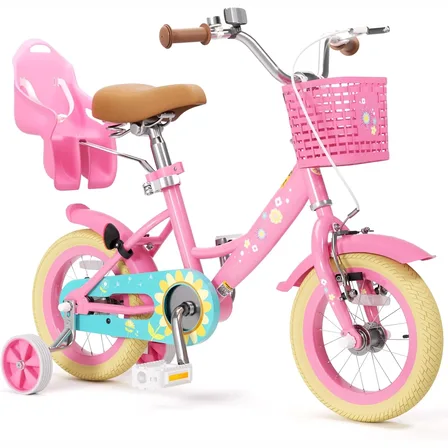
Flower Pink XJD Girls Bike with Doll Seat & Basket
The XJD Flower Pink girls' bike is made for riders 71–122 cm tall (roughly ages …$69.99
-

XJD Girls Bike for Kids Ages 3-8, 12/14/16 Inch with Training Wheels – Purple
The XJD Girls Bike in Purple is a training-wheel bicycle for kids ages 3 to 8, f…$149
$169 -

Pink Girls' 12/14/16" Bike by XJD – Basket & Doll Seat
The XJD Pink Girls' Bike with Basket & Doll Seat is made for riders 71–122 cm ta…$75.99
$99.99