

What size bike should i get a 3 year old
For most 3-year-olds, start with a 12-inch bike, then confirm the fit in person. A 14-inch bike may fit a taller child measuring at least 37 in (94 cm), but never size up only for future growth.
Choose the starting size from measured height
Measure your child without shoes, standing straight against a wall. Compare that height with the XBikes starting points below. Age narrows the search, but measured height and an actual fit check decide whether a bike is suitable.
| Wheel size | XBikes age starting point | Rider height | Relevance at age 3 |
|---|---|---|---|
| 12 Inch | Ages 3–4 | 34–40 in / 86–102 cm | The usual first size to try |
| 14 Inch | Ages 3–6 | 37–45 in / 94–114 cm | Worth trying for a taller child |
| 16 Inch | Ages 4–7 | 40–48 in / 102–122 cm | Normally outside the age starting point; consider only after a careful individual check |
The ranges overlap, so height alone does not prove that a bike fits. For example, a child who is 38 in (97 cm) tall falls within both the 12-inch and 14-inch ranges. Try both if available and choose according to control—not the larger number.
Measure inseam as well as total height
To measure inseam, have the child stand in socks with feet slightly apart. Place a firm, thin book between the legs and raise it gently to simulate the saddle, then measure from the floor to the book’s top edge.
Compare that measurement with the bicycle’s stand-over clearance and lowest usable saddle position when trying the exact model. No universal inseam number is supplied here because frame geometry can differ even when wheel sizes match. The child should be able to get on and off without the frame obstructing them and should feel stable when stopped.
Perform a hands-on fit check
Have your child try the assembled bicycle rather than relying on its wheel label. The American Academy of Pediatrics recommends checking fit and control and avoiding an oversized bicycle bought merely for growth.
- Stand-over: Check that the child can straddle the bicycle comfortably rather than being forced onto tiptoes by the frame.
- Reach: With hands on the controls, the child should sit naturally without stretching, locking the elbows or leaning excessively.
- Braking: Confirm that the child can reach and operate the provided braking controls. Do not assume small wheels guarantee accessible controls.
- Steering and confidence: In a clear, supervised area, check that the child can start, steer, stop and dismount without becoming overwhelmed.
If the child cannot manage these checks on a 14-inch model, choose a suitable 12-inch model even if the larger bicycle promises more growing room. Training wheels can assist balance, but they do not correct excessive reach, poor stand-over clearance or inaccessible controls.
How the supplied XBikes options compare
These catalog options help because they provide 12-inch and 14-inch comparison choices—the two sizes most relevant to a 3-year-old under the XBikes starting points—while their larger variants show what not to select without a separate fit check.
 XJD Boys & Girls BMX Bike with Training Wheels, 12/14/16" – Blue
Offers 12 Inch and 14 Inch labels relevant to the XBikes starting ranges for a 3-year-old, plus a 16 Inch option that requires a separate age, height and fit assessment.
 Girls' Training Wheel Bike by XJD with Basket – Purple
Its smallest label is 14 Inch, so it is relevant only for a 3-year-old whose measured height and hands-on fit support that size; it has no 12 Inch option.
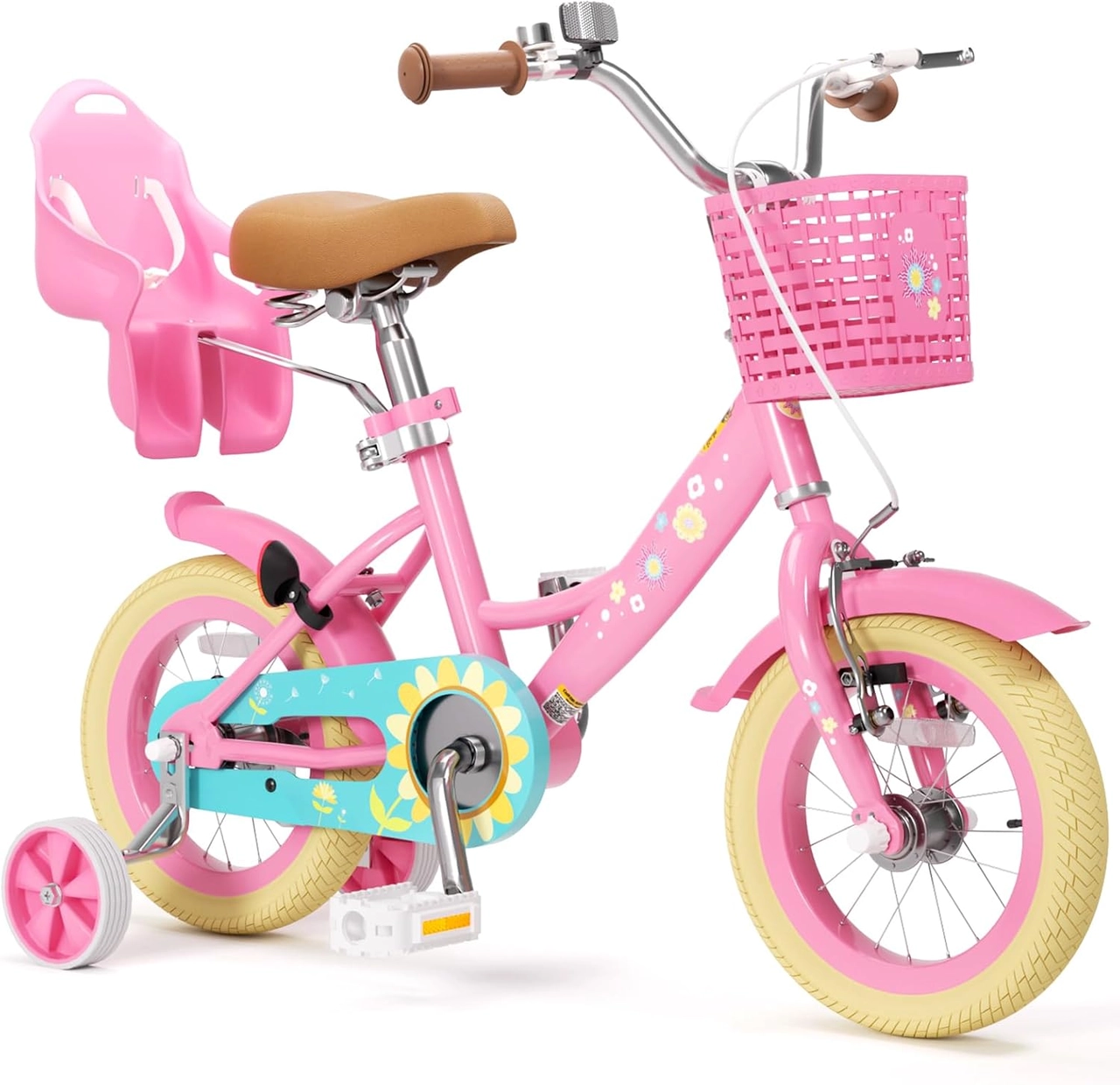 Flower Pink XJD Girls Bike with Doll Seat & Basket
Provides both 12 Inch and 14 Inch labels for a direct fit comparison, while the 16 Inch variant falls outside the XBikes age starting point for most 3-year-olds.
XJD Boys & Girls BMX Bike with Training Wheels, 12/14/16" – Blue is listed under Kids' BMX Bikes and has 12 Inch, 14 Inch and 16 Inch SKU labels. Its 12-inch and 14-inch variants are the relevant ones to compare for this question.
Girls' Training Wheel Bike by XJD with Basket – Purple is a Training Wheel Bikes option with 14 Inch, 16 Inch and 20 Inch labels. Because it has no 12-inch variant, it is relevant only if the child’s measured height and hands-on control support trying the 14-inch version. Its 16-inch and 20-inch variants do not match the XBikes age starting point for a 3-year-old.
Flower Pink XJD Girls Bike with Doll Seat & Basket is listed under Training Wheel Bikes with 12 Inch, 14 Inch and 16 Inch labels. Compare its 12-inch and 14-inch variants by fit; do not infer fit from the styling or accessories named in the title.
Wheel-size labels do not establish frame dimensions, assembly requirements or compatibility. Follow the exact product manual for setup and maintenance, or ask a qualified bicycle mechanic when details are unavailable.
Make the final decision
Begin with 12 inches if your 3-year-old measures 34–40 in (86–102 cm). Add a 14-inch trial if the child is at least 37 in (94 cm), especially within the overlap, but choose it only when stand-over, reach, braking and confidence are all comfortable. If neither size passes those checks, do not purchase it for the child to grow into.
Finish the setup with a properly fitting bicycle helmet. Following U.S. Consumer Product Safety Commission guidance, position it level and adjust its straps according to the helmet manufacturer’s instructions. Your next step is simple: record height and inseam, try the relevant 12-inch and possibly 14-inch variants, and select the smallest size that provides comfortable, confident control.
Bikes for your next adventure
-

Pink Girls' 12/14/16" Bike by XJD – Basket & Doll Seat
The XJD Pink Girls' Bike with Basket & Doll Seat is made for riders 71–122 cm ta…$75.99
$99.99 -

Light Purple XJD Toddler Bike Helmet, Adjustable, Size XS (46–51 cm)
This Light Purple XJD toddler bike helmet is made for the smallest riders — the …$20.39
-

Black XJD Toddler Bike Helmet, Adjustable – Kids' Protective Helmet
The XJD Toddler Bike Helmet in black is an adjustable protective helmet for kids…$20.39