

What size bike wheels for a 3 year old
For most 3-year-olds, start with 12-inch bike wheels. Measure the child first: 12-inch bikes suit heights of 34–40 in (86–102 cm), but an individual fit check decides.
Choose by measured height, not birthday
Age gives you a starting point, not a guaranteed size. According to the XBikes sizing starting points, both 12-inch and 14-inch wheels overlap age three. A 12-inch bike is the usual first comparison because its range begins at a shorter rider height. A 14-inch bike may fit a taller 3-year-old, but it should not be chosen merely to leave room for growth.
| Wheel size | Starting age range | Rider height | Relevance at age 3 |
|---|---|---|---|
| 12 Inch | 3–4 | 34–40 in / 86–102 cm | Usual first size to try |
| 14 Inch | 3–6 | 37–45 in / 94–114 cm | Compare for a taller rider who passes every fit check |
| 16 Inch | 4–7 | 40–48 in / 102–122 cm | Generally outside the age-three starting point; do not size up for growth |
If the child is below 34 in (86 cm), none of these numerical starting points confirms a suitable wheel size. If the child falls within an overlap, test both relevant sizes and choose by control, not by the larger number.
Measure height and inseam
Measure without shoes on a hard, level floor. For height, have the child stand upright against a wall, looking straight ahead, then mark and measure from the floor to the top of the head.
For inseam, place a book upright between the legs so its top edge sits firmly like a bicycle saddle. Measure from the floor to that top edge. The supplied chart does not assign inseam numbers to wheel sizes, so do not invent a cutoff. Instead, compare the measurement with the actual bicycle’s stand-over clearance and lowest usable saddle position.
Do the fit check on the actual bike
Have the child try the bicycle. A size shown in the correct height band can still be unsuitable because frame shapes, reach and the child’s confidence differ. Check these points before deciding:
- Stand-over: The child should be able to straddle the bicycle securely rather than being forced onto tiptoes or against the frame.
- Starting and stopping: The child should be able to get on, set off and stop without the bike overwhelming them.
- Reach: Hands should reach the handlebar naturally without a strained stretch or cramped posture.
- Brake control: If the bicycle has hand controls, the child must be able to reach and operate them reliably. Verify the exact controls on the individual model rather than assuming a brake type.
- Current confidence: Choose the size the child can control now. Do not buy an oversized bicycle solely for future growth.
If either 12-inch or 14-inch wheels pass the height comparison, prefer the bicycle on which the child demonstrates easier control and a more natural reach. Wheel diameter alone cannot establish fit.
How the supplied XBikes options compare
The catalog options are useful because they provide 12-inch and 14-inch comparison points, the two sizes that overlap the supplied age-three guidance. They also show larger sizes, but those are relevant only when the rider later meets the corresponding height, control and confidence checks.
 Girls' Training Wheel Bike by XJD with Basket – Purple
Offers 14 Inch, 16 Inch and 20 Inch options. Only the 14-inch version is a relevant age-three comparison, and only for a rider within the supplied height range who passes an individual fit check.
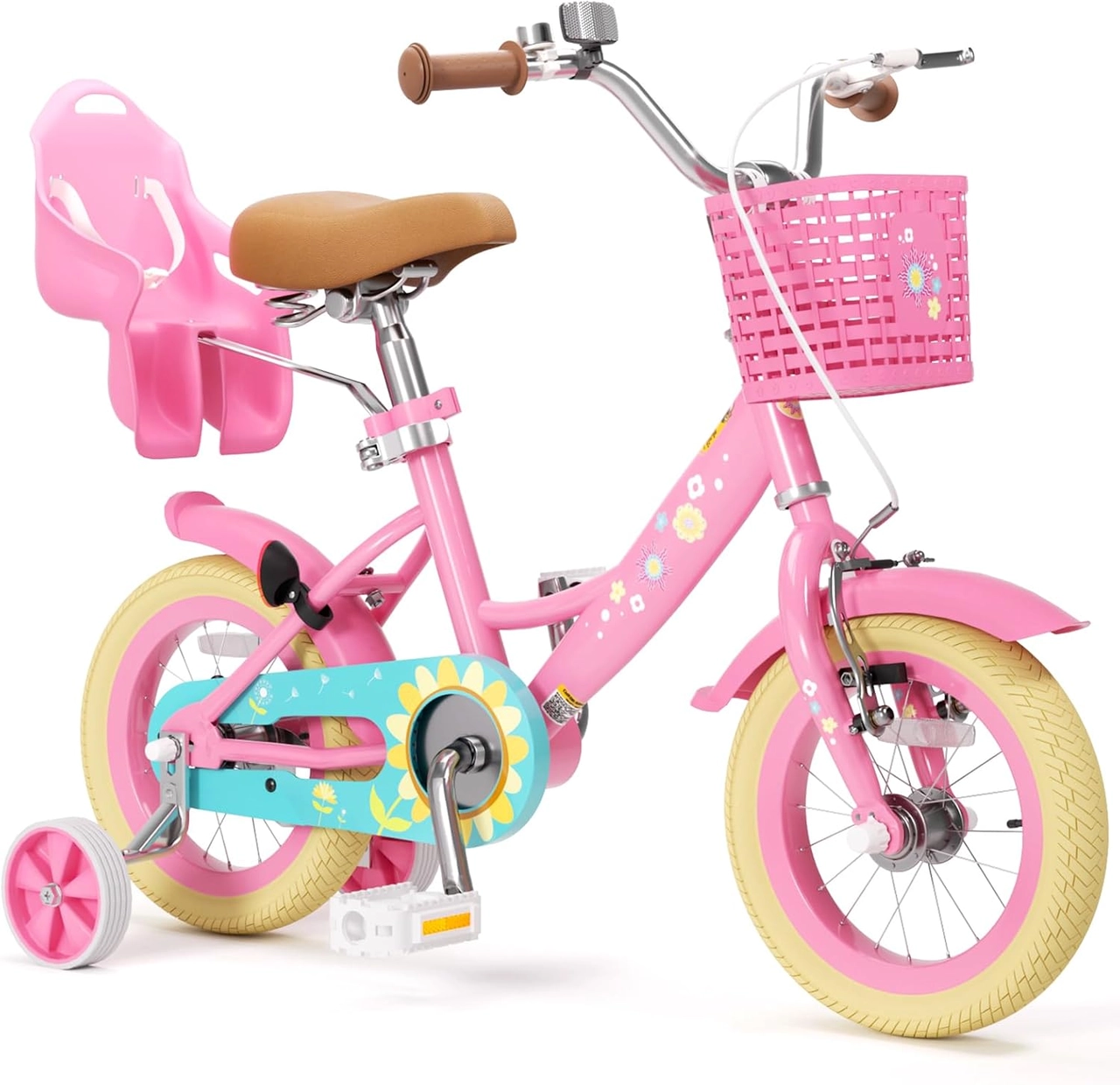 Flower Pink XJD Girls Bike with Doll Seat & Basket
Offers 12 Inch, 14 Inch and 16 Inch options. The 12-inch version is the usual starting comparison for a 3-year-old; the 14-inch version may suit a taller child after a complete fit check.
Flower Pink XJD Girls Bike with Doll Seat & Basket is offered with 12 Inch, 14 Inch and 16 Inch SKU labels. Its 12-inch version is the direct starting point for a 3-year-old measuring 34–40 in (86–102 cm). Its 14-inch version is worth comparing only when the rider measures within 37–45 in (94–114 cm) and controls the actual bike comfortably.
Girls' Training Wheel Bike by XJD with Basket – Purple is offered with 14 Inch, 16 Inch and 20 Inch SKU labels. It has no 12-inch option, so it is not a substitute when the fit check points to 12 inches. Its 14-inch version is relevant as a comparison for a taller 3-year-old within the 14-inch height range who passes the full fit check. The 16-inch and 20-inch versions do not match the supplied age-three starting ranges.
Check setup and helmet fit
Before riding, follow the exact product manual for assembly, adjustments, maintenance, compatibility, load limits and torque requirements. If anything is unclear or the bicycle cannot be adjusted for secure control, use a qualified bicycle mechanic. Do not improvise specifications.
A bicycle helmet must fit properly, sit level on the head and have its straps used according to the helmet manufacturer’s instructions. A helmet does not correct a bicycle that is too large or difficult for the child to control.
Make the size decision
Measure height and inseam, begin with a 12-inch bicycle for a child within 34–40 in (86–102 cm), and compare a 14-inch bicycle only if the child is at least 37 in (94 cm). Then choose solely after the child can straddle, reach, brake, start and stop confidently on the actual bike. If those checks fail, reject that size—even when the age or height chart appears to match.
Bikes for your next adventure
-

Pink Girls' 12/14/16" Bike by XJD – Basket & Doll Seat
The XJD Pink Girls' Bike with Basket & Doll Seat is made for riders 71–122 cm ta…$75.99
$99.99 -

XJD Girls Bike for Kids Ages 3-8, 12/14/16 Inch with Training Wheels – Purple
The XJD Girls Bike in Purple is a training-wheel bicycle for kids ages 3 to 8, f…$149
$169 -
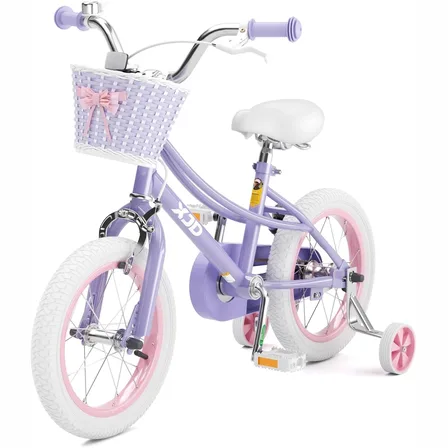
Girls' Training Wheel Bike by XJD with Basket – Purple
If you're shopping for a first bike for a girl roughly 3 to 12 years old (91–152…$75.99