

What size bike will a 3 year old need
Most 3-year-olds should start with a 12-inch bike; consider a 14-inch bike only if the child’s measured height and fit check support it.
Start with height, not age alone
XBikes lists a 12-inch bike as a starting point for ages 3–4 and heights of 34–40 inches (86–102 cm). This is the first size to check for a typical 3-year-old.
A 14-inch bike overlaps the upper part of that range: it starts at 37 inches (94 cm) and covers ages 3–6. That does not make 14 inches automatically suitable for a tall 3-year-old. The child must still be able to stand over the bike, reach the controls and steer without stretching.
| Wheel size | XBikes age starting point | Rider height starting point | What it means at age 3 |
|---|---|---|---|
| 12 Inch | 3–4 | 34–40 in / 86–102 cm | Check this size first. |
| 14 Inch | 3–6 | 37–45 in / 94–114 cm | Compare it when height overlaps and the child can control it confidently. |
| 16 Inch | 4–7 | 40–48 in / 102–122 cm | Usually not the starting point for a 3-year-old; use only if an individual fit check clearly supports it. |
Measure before choosing a wheel size
Measure the child without shoes against a wall for an accurate standing height. Then measure inseam from the floor to the crotch while the child stands upright. Record both measurements rather than relying on clothing size or a recent age-based recommendation.
Height lets you compare the rider with the XBikes starting ranges. Inseam helps you judge stand-over clearance and whether the child can get on, stop and stabilize the bike comfortably. Because frame shapes and adjustment ranges can differ, wheel diameter alone cannot confirm fit.
Do a hands-on fit and control check
Have the child try the exact bicycle. Do not buy a larger model merely to provide growing room. An oversized bike can make starting, stopping, turning and recovering balance harder.
- Check stand-over: with the child standing over the frame, confirm that the position is comfortable and does not trap or force the rider onto tiptoes.
- Check seated position: adjust only as directed by the product manual, then confirm that the child can settle onto the bike and stabilize it without strain.
- Check reach: the child should hold the handlebars and turn them without leaning far forward, locking the arms or losing a centered position.
- Check braking: confirm that the child can reach and operate the bike’s supplied braking controls reliably. A reachable control is not enough if the child cannot use it with confidence.
- Watch movement: ask the child to start, steer, stop and get off in a controlled setting. Hesitation caused by the bike feeling large is a reason to reconsider the size.
How the supplied XBikes options help
The Purple XJD Girls' Bike with Doll Seat & Basket is listed in 12 Inch, 14 Inch and 16 Inch options within Training Wheel Bikes. Those three labels provide useful comparison points around the likely size for a 3-year-old, while the child’s measurements and hands-on control determine which option is relevant.
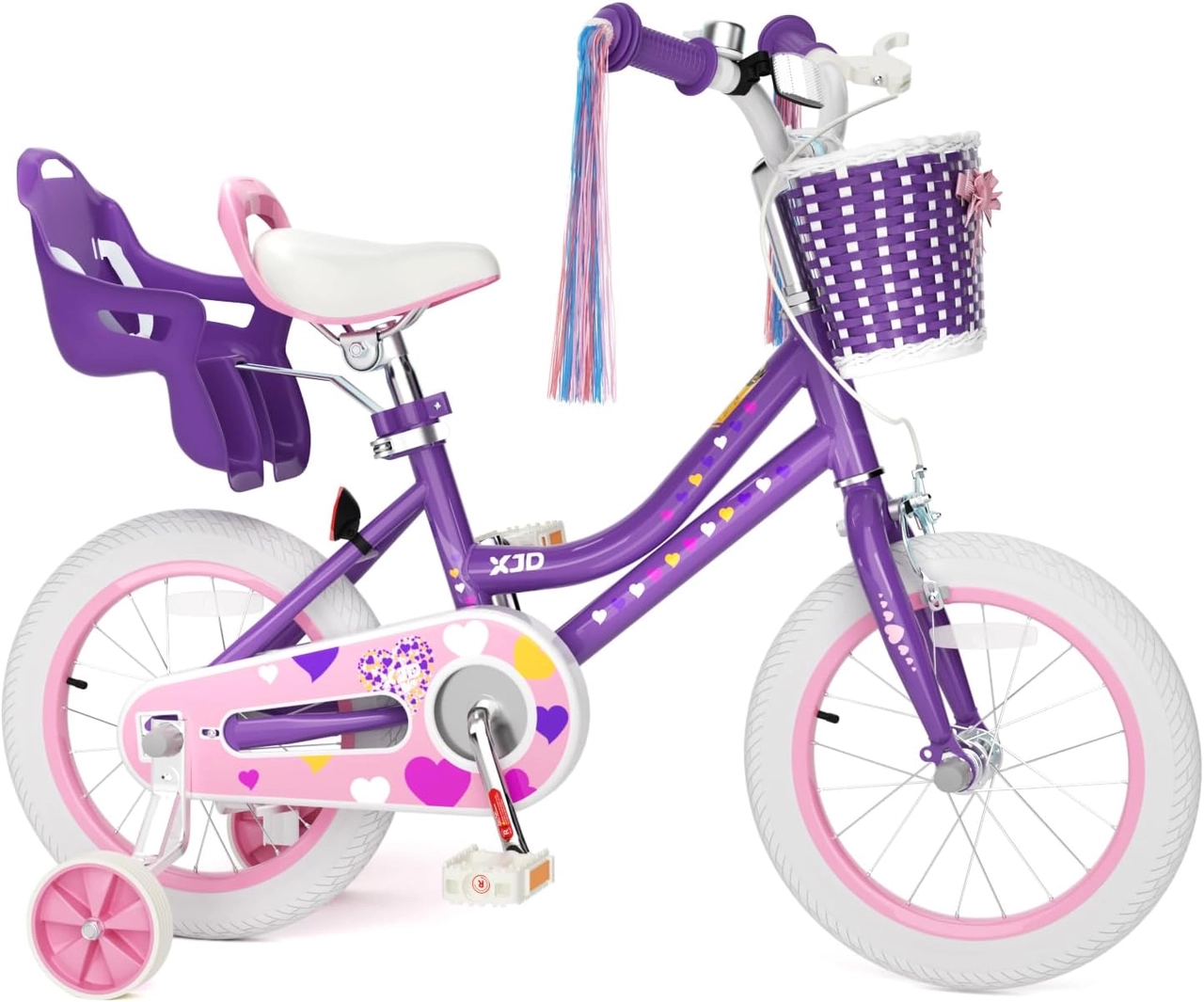
Begin with its 12 Inch option when the rider is 34–40 inches (86–102 cm). Compare the 14 Inch option if the rider is at least 37 inches (94 cm), but reject it if stand-over, reach, braking or confidence is worse than on the smaller size. Its 16 Inch option corresponds to the XBikes starting range of ages 4–7 and heights of 40–48 inches (102–122 cm), so it should not be chosen for a 3-year-old from age or future growth alone.
The product’s category and available size labels do not prove an individual fit. Follow the exact product manual for assembly, adjustments, maintenance, load limits, compatibility and torque information, or ask a qualified bicycle mechanic when the manual does not resolve a question.
Include confidence and current riding ability
Two children with the same height may need different choices. A cautious beginner may control the smaller fitting option more readily, while a confident rider still should not move up unless stand-over, reach and braking remain appropriate. Training wheels describe the supplied product category; they do not remove the need to check fit or control.
Use a properly fitting bicycle helmet every ride. It should sit level and be secured with its straps according to the helmet manufacturer’s instructions. Recheck the fit rather than assuming a helmet remains correct as the child grows.
Make the final decision
For a 3-year-old, measure height and inseam, try a 12-inch bike first, and compare a 14-inch bike only within the overlapping height range. Choose the exact bike on which the child has comfortable stand-over clearance, natural reach, dependable brake control and present confidence—never the larger size simply because it may last longer.
Bikes for your next adventure
-

XJD Girls Bike for Kids Ages 3-8, 12/14/16 Inch with Training Wheels – Purple
The XJD Girls Bike in Purple is a training-wheel bicycle for kids ages 3 to 8, f…$149
$169 -

Light Purple XJD Toddler Bike Helmet, Adjustable, Size XS (46–51 cm)
This Light Purple XJD toddler bike helmet is made for the smallest riders — the …$20.39
-

Blue XJD Girls Bike with Training Wheels – 12/14/16 Inch
If you're shopping for a first pedal bike for a daughter roughly 3 to 8 years ol…$149
$169