

What size wheels for 3 year old bike
For most 3-year-olds, start with 12-inch wheels. Consider 14-inch wheels only when measured height, inseam, reach and control support the larger fit.
The short answer: usually 12 inches
XBikes lists a 12-inch bike as a starting point for ages 3–4 and rider heights of 34–40 inches (86–102 cm). That makes 12 inches the first size to check for a typical 3-year-old, but age alone cannot confirm the fit.
A 14-inch bike is the next comparison point. Its starting range is ages 3–6 and heights of 37–45 inches (94–114 cm). Because the height ranges overlap, some taller or more confident 3-year-olds may fit either size. The deciding factor should be how the individual child fits and controls each bicycle—not the promise of extra growing room.
A 16-inch bike starts at ages 4–7 and heights of 40–48 inches (102–122 cm), so it is generally outside the age starting point for a 3-year-old. Do not move up merely because the child is near a birthday or because a larger bike may last longer.
Measure before choosing
Measure the child’s current standing height without relying on clothing size or an old measurement. Measure the inseam from the floor to the crotch while the child stands naturally. The inseam helps you evaluate stand-over space when the actual bicycle is available, even though wheel diameter alone does not reveal that dimension.
Use these XBikes starting points for the two sizes most likely to enter the decision:
| Wheel size | Age starting point | Rider-height starting point | What it means at age 3 |
|---|---|---|---|
| 12 Inch | 3–4 | 34–40 in / 86–102 cm | Check this size first. |
| 14 Inch | 3–6 | 37–45 in / 94–114 cm | Compare it when height and actual fit support it. |
| 16 Inch | 4–7 | 40–48 in / 102–122 cm | Usually not the starting choice for a 3-year-old. |
If the child falls within an overlap, do not choose from the chart alone. Frame shape, saddle position and handlebar reach can make bicycles with the same wheel size fit differently.
Do an individual fit check
Have the child try the bicycle whenever possible. The American Academy of Pediatrics advises against buying an oversized bicycle for future growth. During the fit check, look for these specific signs:
- Stand-over: With the child standing over the bicycle, confirm there is appropriate space rather than contact with the frame.
- Reach: The child should reach the handlebars without an awkward stretch or losing a controlled riding position.
- Brake access: If the bicycle has hand-operated brakes, verify that the child can reach and operate them reliably.
- Control: Check whether the child can hold, steer, start and stop the bicycle without the size overwhelming them.
- Confidence: Hesitation caused by excessive height or reach is evidence to reconsider the fit, even when the chart includes the child’s age or height.
If either 12 or 14 inches produces uncertain stand-over, reach or braking control, do not assume the larger option will become suitable after a little practice. Recheck setup according to the exact product manual or ask a qualified bicycle mechanic to assess the fit.
How the supplied bike helps with the comparison
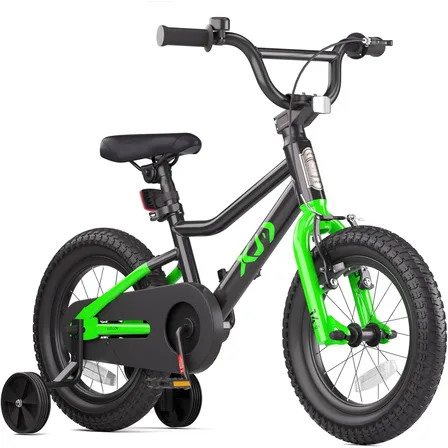
The cataloged Black XJD Kids Bike for Boys – 12, 14 & 16 Inch Sizes is in the Training Wheel Bikes category and offers 12 Inch, 14 Inch and 16 Inch SKU labels. Those options make it relevant for comparing the likely 12-inch starting point with the possible 14-inch alternative, while the 16-inch option shows the next listed step. The title wording is a catalog label, not evidence that the bicycle fits a particular child.

For a 3-year-old measuring 34–40 inches (86–102 cm), examine the 12 Inch option first. If the child measures at least 37 inches (94 cm), the 14 Inch option also enters the chart range, but it remains relevant only if the real-world fit check confirms stand-over, reach, brake access, control and confidence. The 16 Inch option should not be treated as equivalent to either smaller size or chosen simply for growth.
What to do before the first ride
Once the size is selected, follow the exact bicycle manual for assembly, adjustments, maintenance, load limits and any required tightening procedures. If instructions are missing or the setup is uncertain, use a qualified bicycle mechanic rather than guessing at a procedure or torque.
Add a properly fitting bicycle helmet. The U.S. Consumer Product Safety Commission advises that the helmet sit level and that its straps be adjusted according to the helmet manufacturer’s instructions. Recheck the helmet and bicycle fit as the child grows.
Make the size decision
Measure height and inseam now, then try a 12-inch bicycle first. Compare a 14-inch bicycle only if the child is within its height range and demonstrates comfortable stand-over, reach, braking and control. For a 3-year-old, choose the size that fits today; do not buy up to 16 inches solely for future growth.
Bikes for your next adventure
-

Pink Girls' 12/14/16" Bike by XJD – Basket & Doll Seat
The XJD Pink Girls' Bike with Basket & Doll Seat is made for riders 71–122 cm ta…$75.99
$99.99 -

XJD Girls Bike for Kids Ages 3-8, 12/14/16 Inch with Training Wheels – Purple
The XJD Girls Bike in Purple is a training-wheel bicycle for kids ages 3 to 8, f…$149
$169 -
Black XJD Kids' BMX Bicycle with Training Wheels
The XJD Kids' BMX Bicycle with Training Wheels is built for children roughly 3 t…$99.99
$119.99