

How to pick the right size bike for a boy
Pick the right size bike for a boy by measuring his height and inseam, then checking stand-over clearance, reach, brake control and confidence on the actual bike.
Measure the rider before choosing a wheel size
Have the child wear the shoes he will normally use for riding. Measure his standing height against a wall, with his feet flat and posture relaxed. Record the result in inches or centimetres.
Next, measure his inseam. Ask him to stand with his feet slightly apart, then measure from the floor to the top of the inside leg. Inseam is useful for assessing whether he can stand over a particular bicycle comfortably, but the supplied wheel-size chart is based on overall rider height. Compare height first, then confirm the complete fit on the bike.
Age is only a starting point. Children of the same age can differ considerably in height, proportions, coordination and confidence, so a birthday should never decide the size by itself.
Compare his height with these starting points
| Wheel size | Age starting point | Rider height |
|---|---|---|
| 12 Inch | 3–4 | 34–40 in / 86–102 cm |
| 14 Inch | 3–6 | 37–45 in / 94–114 cm |
| 16 Inch | 4–7 | 40–48 in / 102–122 cm |
| 18 Inch | 5–9 | 43–52 in / 109–132 cm |
| 20 Inch | 7–12 | 48–60 in / 122–152 cm |
| 24 Inch | 10–14 | 54–64 in / 137–163 cm |
| 26 Inch | Youth and adults | Over 60 in / 153 cm |
Overlapping ranges are intentional: wheel size alone cannot settle every fit decision. If his height appears in two ranges, test both sizes rather than automatically choosing the larger one. The better choice is the bike he can mount, balance, steer and stop with calm, deliberate control.
Check the actual bike, not just the label
Have him try the bicycle with an adult supervising. When he straddles it, he should be able to stand securely rather than being forced onto tiptoes or against the frame. His inseam, the bicycle’s frame shape and its setup all affect this check.
Seat him in a normal riding position and look at his upper body. He should reach the handlebar without stretching, locking his elbows or losing a stable posture. Ask him to turn the handlebar both ways and show that he can keep control.
He must also be able to reach and operate the brakes fitted to the particular bicycle without shifting his hands into an insecure position. Follow the exact product manual for adjustment and assembly; if the setup or brake reach is uncertain, use a qualified bicycle mechanic.
Account for skill and current confidence
A confident rider may manage a size differently from a beginner of identical height. Watch what the child can do now: start without panic, hold a line, turn at low speed, stop on request and put a foot down securely. A size that turns those basic actions into a struggle is not the right fit merely because he falls within its age range.
Do not buy an oversized bicycle solely to allow room for growth. Extra size can make mounting, steering and braking harder. Choose for present control, then repeat the fit check as he grows.
When the supplied 12, 14 and 16 Inch bikes are relevant
The two supplied catalog options help when the measured rider falls within the 12, 14 or 16 Inch height starting points. Each offers those three labeled sizes, allowing you to compare the relevant label with his measurements before performing an individual fit check.
 XJD Boys & Girls BMX Bike with Training Wheels, 12/14/16" – Blue
Relevant for riders whose measured height points to a 12, 14 or 16 Inch bike; this Kids' BMX Bikes listing offers all three labeled sizes and still requires an individual fit check.
 Black XJD Kids Bike for Boys – 12, 14 & 16 Inch Sizes
This Training Wheel Bikes option has 12 Inch, 14 Inch and 16 Inch labels, making it relevant only when the rider’s measured height and hands-on control checks support one of those sizes.
XJD Boys & Girls BMX Bike with Training Wheels, 12/14/16" – Blue is listed in Kids' BMX Bikes and has 12 Inch, 14 Inch and 16 Inch SKU labels. Black XJD Kids Bike for Boys – 12, 14 & 16 Inch Sizes is listed in Training Wheel Bikes and has the same three size labels.
Those catalog facts do not prove that either bicycle fits a particular child. They are relevant only if his measured height points toward one of those wheel sizes and he passes the stand-over, reach, brake-control and confidence checks. If his measurement points to 18, 20, 24 or 26 Inch, neither supplied product provides a matching listed size, so continue with an appropriately sized option instead.
Make the final decision in this order
- Measure his standing height and inseam in riding shoes.
- Use measured height to identify the likely wheel size or two overlapping candidates.
- Have him straddle and sit on each candidate bike.
- Confirm comfortable reach, steering control and access to the brakes.
- Watch him start, turn, stop and place a foot down securely.
- Choose the size he controls now rather than sizing up for future growth.
Before riding, provide a properly fitting bicycle helmet. It should sit level and its straps should be used according to the helmet manufacturer’s instructions. For bicycle assembly, maintenance, load limits, compatibility and torque requirements, follow the exact product manual or consult a qualified bicycle mechanic.
The right boys’ bike size is therefore the height-matched option that he can stand over, reach, steer and stop confidently today; if any of those checks fail, try a different size.
Bikes for your next adventure
-
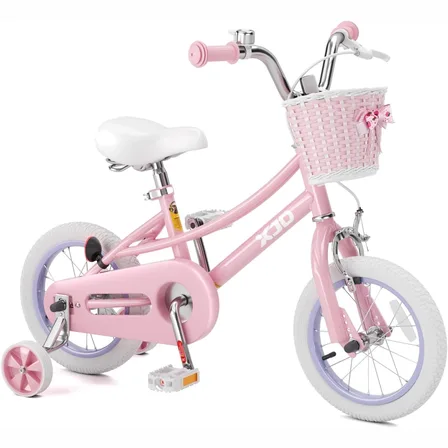
Pink 12/14/16/20" XJD Girls Bike with Training Wheels & Basket
The Pink XJD Girls Bike with Training Wheels & Basket is a first-bike pick f…$65.99
$75.99 -

Light Pink XJD Girls' Bicycle with Basket & Training Wheels
The Light Pink XJD Girls' Bicycle with Basket & Training Wheels is a retro-style…$109.99
$129.99 -

Black XJD Kids Bike for Boys – 12, 14 & 16 Inch Sizes
For a son between roughly 3 and 8 years old, the XJD Kids Bike in Black covers t…$169
$199