

What age do most boys learn to ride a bike
Most boys learn to ride a bike in the preschool or early primary-school years, but there is no single correct age. Measure the child and judge control and confidence before choosing a bike.
Age gives you a starting point, not the decision
Children develop balance, coordination and confidence at different rates. A boy who is eager to practise may learn earlier than an older child who is cautious or has had little riding time. The useful question is not whether he has reached a particular birthday, but whether he can comfortably control a correctly fitted bicycle.
Use age only to narrow the likely wheel sizes. Then compare his measured height, inseam, reach, brake control and current confidence. Do not buy an oversized bicycle for future growth: a bike that is difficult to stand over, steer or stop can make learning harder.
Measure before comparing wheel sizes
- Measure standing height: Have him stand upright without shoes against a wall and measure from the floor to the top of his head.
- Measure inseam: With feet slightly apart, measure from the floor to the crotch. This helps assess whether he can stand over the bicycle with suitable clearance.
- Check reach: On the actual bike, he should be able to hold the handlebar without stretching, locking his arms or losing a stable seated position.
- Check braking and control: He must be able to reach and operate the bike's brakes as designed, steer smoothly, start and stop under control, and place his feet securely when needed.
A size chart cannot confirm these points remotely. Have the child try the bicycle whenever possible and follow the exact product manual for setup and adjustments. If assembly or fit remains uncertain, use a qualified bicycle mechanic.
Compare his measurements with these starting points
| Wheel size | Age starting point | Rider height starting point |
|---|---|---|
| 12 Inch | 3–4 | 34–40 in / 86–102 cm |
| 14 Inch | 3–6 | 37–45 in / 94–114 cm |
| 16 Inch | 4–7 | 40–48 in / 102–122 cm |
| 18 Inch | 5–9 | 43–52 in / 109–132 cm |
| 20 Inch | 7–12 | 48–60 in / 122–152 cm |
| 24 Inch | 10–14 | 54–64 in / 137–163 cm |
| 26 Inch | Youth and adults | Over 60 in / 153 cm |
Overlapping ranges are intentional starting points, not proof that two sizes fit equally well. If his measurements fall into more than one row, compare the bicycles in person. Choose according to stand-over room, natural reach, usable brake control and confidence rather than selecting the larger wheel automatically.
How training wheels relate to learning age
Training wheels can let a child practise pedalling, steering and stopping while receiving extra support. They do not establish that he is ready to balance independently, so watch what he can do instead of treating age or wheel size as a graduation date.
The catalog option relevant to this question is the XJD Kids' Training Wheel Bike for Boys & Girls, 12/14/16 Inch – White. Its available 12 Inch, 14 Inch and 16 Inch labels cover several of the chart's younger starting points, making those versions useful options to compare after measuring the rider. The supplied facts do not establish fit, components or setup for an individual child, so the exact version still needs an in-person control check.

This product is relevant only when the child's measurements and control place him in one of those three wheel-size ranges. It is not a substitute for an 18 Inch, 20 Inch, 24 Inch or 26 Inch bicycle when one of those sizes proves appropriate. Follow the exact product manual for assembly, maintenance, compatibility and any limits not stated here.
Signs that he is ready to learn
- He wants to try and can follow simple stopping and practice-area instructions.
- He can sit securely, hold the handlebar comfortably and steer without fighting the bike.
- He can reach and operate the brakes as designed.
- He can start and stop with enough control to avoid panic or repeated falls caused by poor fit.
- He is willing to practise in short sessions without being pressured by siblings or friends.
If these signs are missing, waiting and practising basic control is more useful than moving to a larger bike. A smaller suitable bicycle is not a setback; the goal is confident control.
What to do before the first practice
Choose a flat area away from traffic and obstacles. Use a bicycle helmet that fits properly, sits level on the head and has straps adjusted according to the helmet manufacturer's instructions. Check the bicycle according to its manual before riding, and keep an adult close enough to guide the child without forcing speed.
Your next decision is simple: measure height and inseam, identify the likely wheel-size row, and have him try that size. Proceed when he can stand over, reach, brake and steer confidently—regardless of the age at which another boy learned.
Bikes for your next adventure
-

Black XJD Kids Bike for Boys – 12, 14 & 16 Inch Sizes
For a son between roughly 3 and 8 years old, the XJD Kids Bike in Black covers t…$169
$199 -
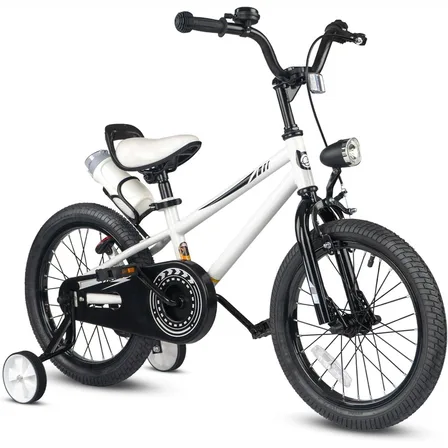
XJD Kids' Training Wheel Bike for Boys & Girls, 12/14/16 Inch – White
The XJD kids' training wheel bike in White is made for riders ages 3–8 (roughly …$169
$199 -
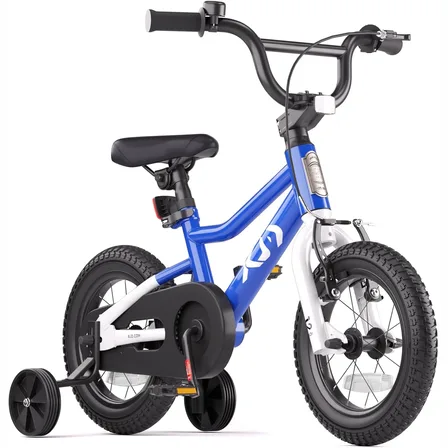
XJD Boys & Girls BMX Bike with Training Wheels, 12/14/16" – Blue
The XJD Boys & Girls BMX Bike in Blue is a first pedal bike for kids roughly age…$99.99
$119.99