

What age should boys learn to bike
Boys can start learning to bike around age 3, but readiness matters more than age. Measure height and inseam, then check balance, reach, braking and confidence on the actual bike.
Start with readiness, not a birthday
There is no separate learning age for boys. Many children begin between ages 3 and 4 on a 12-inch or 14-inch bicycle, according to the XBikes starting points, while others are ready later. A child is ready to practise when he can follow simple directions, look ahead, steer deliberately and remain interested without being pressured.
Age narrows the search; it does not confirm fit. Measure the child barefoot from the floor to the top of his head. Measure inseam from the floor to the crotch with his feet slightly apart. Compare those measurements with the wheel-size starting points, and then have him try the bicycle.
Compare his height with these starting points
| Wheel size | Starting age | Rider height |
|---|---|---|
| 12 Inch | 3–4 | 34–40 in / 86–102 cm |
| 14 Inch | 3–6 | 37–45 in / 94–114 cm |
| 16 Inch | 4–7 | 40–48 in / 102–122 cm |
| 18 Inch | 5–9 | 43–52 in / 109–132 cm |
| 20 Inch | 7–12 | 48–60 in / 122–152 cm |
| 24 Inch | 10–14 | 54–64 in / 137–163 cm |
| 26 Inch | Youth and adults | Over 60 in / 153 cm |
Overlapping ranges are intentional: two children of the same age or height may need different sizes because their inseams, arm lengths and confidence differ. Never move up merely because a child is near the upper end of an age band.
Perform the fit check on the actual bicycle
Have the child try the bicycle rather than ordering solely from an age chart. Do not buy an oversized model for him to grow into. Check these points before deciding:
- Stand-over: He should be able to straddle the bicycle securely rather than being forced onto his toes or against the frame.
- Reach: He should hold the handlebar without stretching, locking his elbows or leaning excessively.
- Brake control: If the bicycle has hand controls, his fingers must reach and operate them while he maintains a stable grip.
- Steering: He should turn the handlebar both ways without losing his seated position or balance.
- Confidence: He should feel in control while starting, stopping and putting a foot down.
If he cannot satisfy these checks, try another size even when his age and height appear to match the table.
When the supplied bikes are relevant
The three catalog options are relevant when the fit check points toward 12, 14 or 16 inches and the parent wants to compare training-wheel bikes or a kids' BMX bike with training wheels. Their listed sizes let you compare the same three wheel-size labels across the supplied options; the titles and categories do not replace an individual fit check.
The options below therefore help answer which catalog models cover common starting sizes for boys learning to ride.
 Black XJD Kids Bike for Boys – 12, 14 & 16 Inch Sizes
A Training Wheel Bike offered with 12 Inch, 14 Inch and 16 Inch SKU labels, making it relevant when the rider’s measurements and individual fit check point to one of those sizes.
 XJD Kids' Training Wheel Bike for Boys & Girls, 12/14/16 Inch – White
This white Training Wheel Bike lists 12 Inch, 14 Inch and 16 Inch options for comparison after height, inseam, reach, brake control and confidence have been checked.
 XJD Boys & Girls BMX Bike with Training Wheels, 12/14/16" – Blue
A blue Kids' BMX Bike with training wheels, supplied in 12 Inch, 14 Inch and 16 Inch labels; relevant only when one of those sizes passes the child’s fit check.
Black XJD Kids Bike for Boys – 12, 14 & 16 Inch Sizes is categorized as a Training Wheel Bike and is offered in the three listed sizes. XJD Kids' Training Wheel Bike for Boys & Girls, 12/14/16 Inch – White is also categorized as a Training Wheel Bike with 12-, 14- and 16-inch labels.
XJD Boys & Girls BMX Bike with Training Wheels, 12/14/16" – Blue is categorized as a Kids' BMX Bike and likewise lists 12, 14 and 16 inches. That category difference is the only supplied basis for distinguishing it from the two Training Wheel Bikes beyond exact title and color wording.
These products are not relevant substitutes if the fit check indicates 18, 20, 24 or 26 inches. They are smaller-size comparison points only. Do not assume a listed size is available now, or infer specifications such as brake type, weight, material or load limit from the title.
Make the first practice sessions manageable
Choose a flat, open area away from traffic and obstacles. Begin with short sessions focused on looking ahead, steering, controlled stopping and putting a foot down. Training wheels may support early practice, but their presence does not prove that a bicycle fits or that the child is ready.
Use a bicycle helmet that fits properly, sits level and has straps adjusted according to its manufacturer's instructions. An adult should supervise and stop the session if the child becomes frightened, tired or unable to control the bicycle.
For assembly, adjustment, maintenance, compatibility, load limits or torque, follow the exact product manual or ask a qualified bicycle mechanic. Do not guess at an adjustment or transfer instructions from a different model.
What to do next
- Measure the boy's height and inseam.
- Use the table to identify one or two plausible wheel sizes.
- Have him try each candidate and compare stand-over clearance, reach, brake control and confidence.
- Choose the smaller correctly fitting option over an oversized bicycle bought for future growth.
So, consider starting around age 3, but make the decision only after measuring and observing the child on the bike. If 12, 14 or 16 inches fits, compare the supplied models; if none fits, leave those options aside and test the size his measurements and control actually support.
Bikes for your next adventure
-

Black XJD Kids Bike for Boys – 12, 14 & 16 Inch Sizes
For a son between roughly 3 and 8 years old, the XJD Kids Bike in Black covers t…$169
$199 -
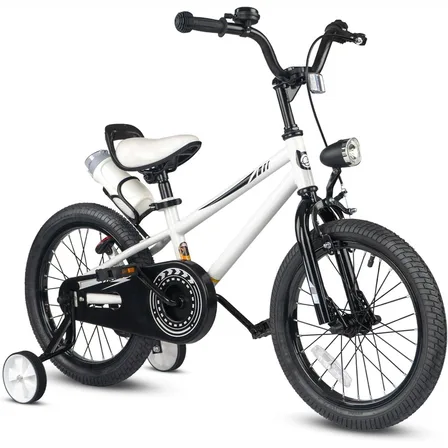
XJD Kids' Training Wheel Bike for Boys & Girls, 12/14/16 Inch – White
The XJD kids' training wheel bike in White is made for riders ages 3–8 (roughly …$169
$199 -

XJD Kids Bike for Girls – Pink, 12/14/16/20 Inch with Training Wheels
The XJD Kids Bike for Girls in Pink is a training-wheel bike built to carry your…$139
$159