

What kind of bike for a 9 year old boy
For most 9-year-old boys, start by trying a 20-inch bike. Choose by measured height and fit, though—not age or gender alone. An 18-inch bike may suit a shorter rider, while a sufficiently tall child may need to compare a 24-inch bike.
Measure before choosing a wheel size
Measure the child’s height without shoes, standing straight against a wall. Also measure inseam from the floor to the crotch. Height identifies a sensible wheel-size starting point; inseam helps you judge whether the child can stand over the actual bicycle comfortably.
For a 9-year-old, the most relevant XBikes starting points are:
| Wheel size | XBikes age guide | Rider-height guide | Likely reason to try it |
|---|---|---|---|
| 18 Inch | Ages 5–9 | 43–52 in / 109–132 cm | The rider is shorter or needs a smaller, more manageable fit. |
| 20 Inch | Ages 7–12 | 48–60 in / 122–152 cm | This is the usual first comparison for a 9-year-old. |
| 24 Inch | Ages 10–14 | 54–64 in / 137–163 cm | The rider is tall enough and can fully control the larger bicycle. |
These ranges overlap deliberately. If height points toward two sizes, the child should try both rather than automatically selecting the larger one. Do not buy an oversized bicycle merely to allow room for growth.
Check the actual bicycle, not just its label
Have the child sit on and stand over each candidate. The frame should not press into the child when standing over it, and mounting, starting, turning and stopping should feel controlled rather than stretched or awkward.
Next, check reach. With hands in the normal riding position, the child should reach the controls without leaning excessively or locking the arms. If the bicycle has hand-operated brakes, confirm that the child can reach and operate them reliably. Also check whether the child can place a foot down confidently when stopping.
A wheel-size label does not guarantee identical fit across bicycles. Frame shape, seat adjustment and control position can change how two bikes of the same nominal size feel. Use the exact product manual for adjustment, assembly, compatibility, load limits and torque information, or ask a qualified bicycle mechanic.
Match the bike to current confidence
A confident rider who starts, steers and stops independently may be ready for a conventionally configured bike in the correctly fitted size. A rider who still depends on training wheels needs a different comparison: appropriate fit remains essential, but the bicycle must also match that current learning stage.
Do not move up a wheel size to compensate for uncertainty. A larger bicycle can make reaching the ground, steering and braking harder. Conversely, a bike that is clearly too small can restrict comfortable posture and control. When two sizes fit on paper, prefer the one the child can handle smoothly during a supervised tryout.
How the supplied catalog option fits this decision
The supplied catalog choice is relevant specifically when training wheels are wanted. Girls' Training Wheel Bike by XJD with Basket – Purple is listed as a Training Wheel Bike and offers 14 Inch, 16 Inch and 20 Inch SKU labels. For a typical 9-year-old comparison, only its 20 Inch option falls within the usual age starting point, and it still requires the same height, stand-over, reach and control checks. The “Girls'” wording and purple color in the catalog title describe the listed product; they are not evidence about whether it fits a particular child.

The 14 Inch option corresponds to ages 3–6 and heights 37–45 in / 94–114 cm, while the 16 Inch option corresponds to ages 4–7 and heights 40–48 in / 102–122 cm. Those options would generally be outside the starting range for a 9-year-old, though measured height—not the birthday alone—determines whether further investigation is warranted. No supplied version of this product has an 18 Inch or 24 Inch label.
Do the final control and safety check
- Record the child’s height and inseam.
- Use height to shortlist 18 Inch, 20 Inch or, for a tall rider, 24 Inch.
- Have the child try each shortlisted bicycle and compare stand-over, reach, starting, steering, stopping and brake control.
- Choose for present control rather than future growth.
- Follow the exact manual for assembly and adjustment, or use a qualified bicycle mechanic.
Finish the setup with a properly fitting bicycle helmet. It should sit level and its straps should be adjusted according to the helmet manufacturer’s instructions.
For a 9-year-old boy, measure first and try a 20-inch bike first; switch the comparison to 18 inches if he is shorter or less comfortable, or include 24 inches only when his height and real-world control support it.
Bikes for your next adventure
-

Flower Pink XJD Girls Bike with Doll Seat & Basket
The XJD Flower Pink girls' bike is made for riders 71–122 cm tall (roughly ages …$69.99
-
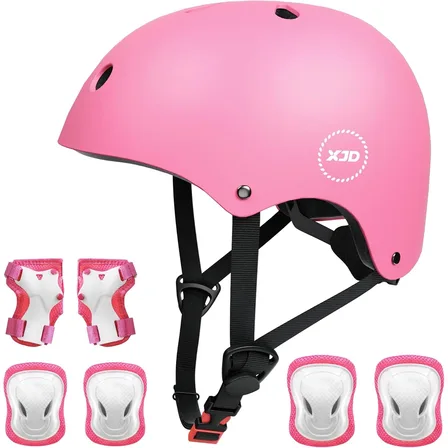
XJD Kids Helmet & Protective Gear Set for Girls, Pink
The XJD Kids Helmet & Protective Gear Set in Pink is a complete safety kit for g…$24.64
-

Kids Bike Helmet by XJD for Boys & Girls – Black, Blue, Green, Pink, Purple
The XJD Kids Bike Helmet covers a wide 2-to-8-year age range thanks to two head-…$59.99