

What kind of bike for boys age 5
For most 5-year-old boys, start by comparing 14-inch and 16-inch bikes. Measure his height first, then confirm stand-over clearance, reach, brake control and confidence on the actual bike.
Choose by height, not by his fifth birthday
XBikes lists a 14-inch bike as a starting point for riders 37–45 in (94–114 cm) tall and ages 3–6. A 16-inch bike starts at 40–48 in (102–122 cm) and ages 4–7. Many 5-year-olds therefore overlap both ranges, so age alone cannot settle the choice.
A 12-inch bike is generally associated with ages 3–4 and heights of 34–40 in (86–102 cm). It may remain relevant to a shorter 5-year-old, but only an individual fit check can show whether it provides enough room and comfortable control. An 18-inch bike begins at ages 5–9 and heights of 43–52 in (109–132 cm); it is worth considering only when the rider’s measurements and control support that larger size.
Measure before comparing bikes
Have the child wear the shoes he normally uses for riding. Measure his standing height against a wall. Then measure his inseam from the floor to the crotch while he stands naturally. Height narrows the wheel-size range; inseam helps evaluate whether he can stand over a particular bicycle without the frame interfering.
Record both measurements rather than estimating them. Because frame shapes can differ even when wheel labels match, an inseam measurement does not replace trying the actual bicycle.
Check the fit on the actual bicycle
The American Academy of Pediatrics advises having a child try the bicycle and avoiding an oversized bike bought merely for future growth. During the tryout, check these points:
- Stand-over: He should be able to straddle the bicycle without the frame pressing into him.
- Starting and stopping: He should be able to get into position, start and stop without the bike overwhelming him.
- Reach: He should hold the controls without stretching, locking his elbows or leaning excessively.
- Brake control: He must be able to reach and operate the bicycle’s provided braking controls reliably.
- Steering: He should turn the handlebar while remaining balanced and in control.
- Confidence: Hesitation caused by the bike feeling tall, long or heavy to manage is a reason to reassess the fit.
If two wheel sizes match his height, choose between them by these real-bike checks—not by assuming the larger one will last longer.
How the supplied 12-, 14- and 16-inch options help
The two supplied XBikes models each offer 12 Inch, 14 Inch and 16 Inch SKU labels, covering the most relevant comparison sizes for many boys age 5. They let you compare a training-wheel bike and a BMX-labeled bike with training wheels while keeping wheel-size selection tied to the child’s measurements.
 XJD Kids' Training Wheel Bike for Boys & Girls, 12/14/16 Inch – White
A training-wheel bike offered in 12 Inch, 14 Inch and 16 Inch labels. Compare the 14- and 16-inch versions for many 5-year-olds, subject to measured height and an individual fit check.
 XJD Boys & Girls BMX Bike with Training Wheels, 12/14/16" – Blue
A kids' BMX-category bike with training wheels, offered in 12 Inch, 14 Inch and 16 Inch labels. The BMX catalog wording does not replace checks for height, inseam, reach, brake control and confidence.
XJD Kids' Training Wheel Bike for Boys & Girls, 12/14/16 Inch – White is categorized as a Training Wheel Bike and is offered in 12 Inch, 14 Inch and 16 Inch labels. For a typical age-five comparison, examine the 14- and 16-inch versions first; consider 12 inches only when the child’s measured height and actual fit support it.
XJD Boys & Girls BMX Bike with Training Wheels, 12/14/16" – Blue is categorized as a Kids' BMX Bike and also has 12 Inch, 14 Inch and 16 Inch labels. Its BMX wording identifies the catalog category, not a different fit standard. Apply the same height, inseam, reach, brake-control and confidence checks.
Neither supplied product has an 18-inch option. If the child measures within the 18-inch starting range and controls an 18-inch bike properly, these products are nearest-size comparison points, not substitutes for an 18-inch bicycle.
Decide whether training wheels are relevant
Both catalog options include training wheels in their exact titles. That makes them relevant when the child still needs that type of riding support. If he already starts, balances, turns and stops confidently without training wheels, do not select one merely because the wheel size fits; compare bicycles suited to his current riding ability.
Fit must still be checked with any training-wheel setup. For assembly, adjustment, compatibility, maintenance, load limits and torque instructions, follow the exact product manual or ask a qualified bicycle mechanic. Do not improvise specifications from another model.
Complete the riding check safely
Use a bicycle helmet that fits properly. U.S. Consumer Product Safety Commission guidance says the helmet should sit level, with its straps used according to the manufacturer’s instructions. A helmet cannot correct a poorly fitting bicycle, so verify both separately.
Your next decision is concrete: measure the 5-year-old’s height and inseam, try the matching 14- and 16-inch candidates, and select only the bike on which he can stand over, reach, steer and brake confidently. Check 12 or 18 inches only when his measurements place him in those starting ranges.
Bikes for your next adventure
-

Flower Pink XJD Girls Bike with Doll Seat & Basket
The XJD Flower Pink girls' bike is made for riders 71–122 cm tall (roughly ages …$69.99
-
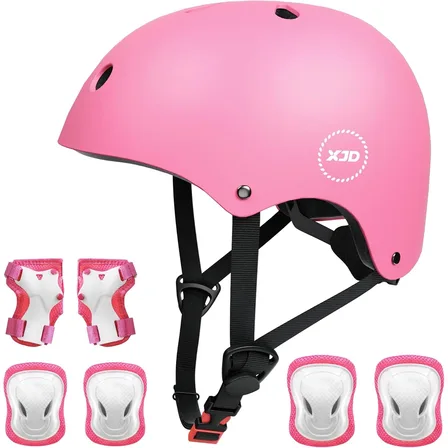
XJD Kids Helmet & Protective Gear Set for Girls, Pink
The XJD Kids Helmet & Protective Gear Set in Pink is a complete safety kit for g…$24.64
-

Kids Bike Helmet by XJD for Boys & Girls – Black, Blue, Green, Pink, Purple
The XJD Kids Bike Helmet covers a wide 2-to-8-year age range thanks to two head-…$59.99