

What kind of bike good for 8 year old boy
For most 8-year-old boys, start by trying a 20-inch bike, then confirm fit with measured height, inseam, reach, brake control and confidence.
Start with height, not age
XBikes lists a 20-inch bike as the usual starting point for ages 7–12 and rider heights of 48–60 inches (122–152 cm). That makes it the most likely wheel size for an average 8-year-old, but age alone cannot establish a good fit.
Measure the child’s height without shoes. Also measure inseam from the floor to the crotch while he stands straight with his feet slightly apart. Record both measurements rather than estimating them from clothing sizes.
If he is shorter than 48 inches (122 cm), compare an 18-inch bike, whose starting range is ages 5–9 and heights 43–52 inches (109–132 cm). Do not automatically move to 20 inches simply because he is eight. If he is unusually tall, remember that the 24-inch starting range begins at 54 inches (137 cm), but is associated with ages 10–14 and still requires an individual fit check.
| Wheel size to try | XBikes starting point | What it means here |
|---|---|---|
| 18 Inch | Ages 5–9; 43–52 in / 109–132 cm | Worth comparing for a shorter or less-confident 8-year-old |
| 20 Inch | Ages 7–12; 48–60 in / 122–152 cm | The normal first trial for this age |
| 24 Inch | Ages 10–14; 54–64 in / 137–163 cm | Consider only when measurements and real-bike control support it |
Check the bike with the child on it it
Have him try the exact bicycle rather than relying only on its wheel label. He should be able to stand over it without the frame pressing into him, start and stop without struggling, steer predictably and remain balanced while looking ahead. His riding position should not require an uncomfortable stretch to the handlebar.
Check every hand-operated brake individually. He must be able to reach the controls, pull them with useful force and stop while maintaining steering control. A wheel size that matches the chart is still unsuitable if reach or braking is difficult.
Do not buy an oversized bike for him to “grow into.” Extra growing room is not worth reduced control now. If adjustment, assembly, compatibility or maintenance details are uncertain, follow the exact product manual or ask a qualified bicycle mechanic.
Match the bike to current confidence
A confident rider who starts, turns and brakes independently may be ready to compare conventional 20-inch configurations. A beginner needs a bicycle he can control calmly at low speed. Training wheels may be relevant if that is the support being sought, but their presence does not correct a frame that is too large or controls that are out of reach.
Let intended riding influence the comparison only after fit. Consider where he will actually ride and whether he can manage the bicycle’s controls there. Color and gender wording are preferences or catalog labels; they do not determine whether a bicycle fits a boy.
How the supplied XBikes options relate
The supplied catalog contains two training-wheel models with 20-inch variants and one beach-cruiser model with 20-, 24- and 26-inch variants. They help compare likely sizes and configurations, although their exact titles use girls’ styling or color labels. Suitability still depends on the boy’s measurements, control and preferences.
 Pink 12/14/16/20" XJD Girls Bike with Training Wheels & Basket
Available in 12-, 14-, 16- and 20-inch labels. The 20-inch variant is relevant to the usual starting range for an 8-year-old, while its training wheels, basket and pink girls’ catalog styling should be compared with the rider’s needs and preferences.
 26-Inch XJD Beach Cruiser Bike for Girls – Purple, V-Brake
Listed in 20-, 24- and 26-inch variants and several colors. The 20-inch version is the most age-relevant comparison; 24 inches requires measurements and control to support it, while the 26-inch starting standard is above 60 inches.
 Light Pink XJD Girls' Bicycle with Basket & Training Wheels
This training-wheel bicycle offers 12-, 14-, 16- and 20-inch labels. Its 20-inch variant may be relevant after an individual fit check; the light-pink girls’ catalog presentation may or may not suit the boy’s preferences.
Pink 12/14/16/20" XJD Girls Bike with Training Wheels & Basket offers listed 12-, 14-, 16- and 20-inch choices. Its 20-inch variant is relevant to the usual starting range for an 8-year-old, while the smaller variants provide size comparisons. The training wheels and basket are stated catalog features.
Light Pink XJD Girls' Bicycle with Basket & Training Wheels also has listed 12-, 14-, 16- and 20-inch variants. Its relevance is similar: the 20-inch option may enter the fit check, particularly when training wheels are wanted, but its title and color may not match his preferences.
26-Inch XJD Beach Cruiser Bike for Girls – Purple, V-Brake has listed 20-, 24- and 26-inch variants in specified colors. Only its 20-inch variant falls within the normal starting range for many 8-year-olds. A 24-inch version should not replace a 20-inch fit merely for growth, and the 26-inch standard starts above 60 inches (153 cm) for youth and adults.
Helmet and final decision
Use a bicycle helmet that fits properly, sits level and has its straps adjusted according to the helmet manufacturer’s instructions. Recheck the fit whenever the helmet is adjusted or replaced.
Next, measure his height and inseam, try a 20-inch bike first if he is 48–60 inches tall, and compare an 18-inch bike if he is shorter or lacks control. Choose only the bicycle on which this particular 8-year-old can stand over, reach, steer, brake, start and stop confidently.
Bikes for your next adventure
-

Flower Pink XJD Girls Bike with Doll Seat & Basket
The XJD Flower Pink girls' bike is made for riders 71–122 cm tall (roughly ages …$69.99
-
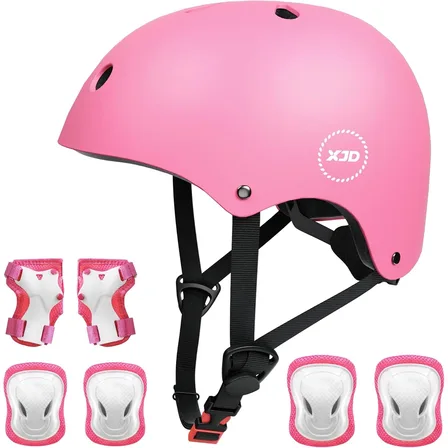
XJD Kids Helmet & Protective Gear Set for Girls, Pink
The XJD Kids Helmet & Protective Gear Set in Pink is a complete safety kit for g…$24.64
-

Kids Bike Helmet by XJD for Boys & Girls – Black, Blue, Green, Pink, Purple
The XJD Kids Bike Helmet covers a wide 2-to-8-year age range thanks to two head-…$59.99