

What size bike for boys inches
Choose a boys’ bike size in inches by measuring the rider’s height first, then checking stand-over clearance, reach and brake control on the actual bike. Age is only a starting point.
Boys’ bike size chart in inches
The inch number refers to wheel size, not the child’s height or the bicycle’s frame size. Compare the rider’s measured standing height with these XBikes starting points, then confirm the fit in person.
| Wheel size | Age starting point | Rider height |
|---|---|---|
| 12 Inch | 3–4 | 34–40 in / 86–102 cm |
| 14 Inch | 3–6 | 37–45 in / 94–114 cm |
| 16 Inch | 4–7 | 40–48 in / 102–122 cm |
| 18 Inch | 5–9 | 43–52 in / 109–132 cm |
| 20 Inch | 7–12 | 48–60 in / 122–152 cm |
| 24 Inch | 10–14 | 54–64 in / 137–163 cm |
| 26 Inch | Youth and adults | Over 60 in / 153 cm |
Because several ranges overlap, height alone may leave two plausible choices. That is when inseam, reach, control and the rider’s current confidence should decide—not a desire to leave extra growing room.
What to measure before choosing
Measure the child without shoes, standing straight against a wall. Record total height from the floor to the top of the head. For inseam, measure from the floor to the crotch while the child stands with feet slightly apart.
Use height to identify the likely wheel-size range. Keep the inseam measurement for the actual fit check: proportions vary, so two boys of equal height may not fit or control the same bicycle equally well.
Check the bike with the rider present
The American Academy of Pediatrics’ HealthyChildren guidance supports having the child try the bicycle rather than buying an oversized model for future growth. On the candidate bike, check that the rider can:
- Stand over the bicycle with practical clearance rather than being pressed against it.
- Reach the handlebars without an uncomfortable stretch or cramped posture.
- Turn the handlebars while remaining balanced and in control.
- Reach and operate the brakes confidently, where the bicycle uses hand controls.
- Start, stop and put a foot down without struggling or panicking.
If the child is inside an overlapping height range, compare both candidate sizes in person. Choose the one that permits better present-day control. Do not move up merely because the larger wheel size may last longer.
When the supplied 12, 14 and 16 Inch bikes are relevant
The catalog options below help when the height comparison points toward 12, 14 or 16 Inch wheels and a training-wheel bicycle is appropriate. They let you compare the three available size labels, but their catalog labels do not replace an individual fit check.
 Black XJD Kids Bike for Boys – 12, 14 & 16 Inch Sizes
A Training Wheel Bike offered with 12 Inch, 14 Inch and 16 Inch SKU labels. Relevant when the rider’s measured height and individual control check point to one of those sizes.
 XJD Boys 12/14/16" Training Wheel Bike – Blue
A blue Training Wheel Bike with 12 Inch, 14 Inch and 16 Inch SKU labels. Compare the matching label only after checking the child’s height, inseam, reach and control.
Black XJD Kids Bike for Boys – 12, 14 & 16 Inch Sizes is categorized as a Training Wheel Bike and is offered with 12 Inch, 14 Inch and 16 Inch SKU labels. XJD Boys 12/14/16" Training Wheel Bike – Blue is also categorized as a Training Wheel Bike with the same three available size labels.
Using the XBikes starting points, those sizes cover overlapping height ranges from 34–40 inches for 12 Inch, 37–45 inches for 14 Inch and 40–48 inches for 16 Inch. Select the relevant SKU label only after matching the child’s measured height and checking the exact bicycle for stand-over, reach, brake access and control.
These products are not substitutes when the fit check points to 18, 20, 24 or 26 Inch wheels. They are smaller-wheel comparison points only. The supplied catalog facts do not establish their dimensions, adjustment range, components, load limit or suitability for a particular rider.
Assembly and helmet checks
Before riding, follow the exact product manual for assembly, adjustment, maintenance, compatibility and any torque or load requirements. If instructions are missing, unclear or beyond your experience, use a qualified bicycle mechanic rather than guessing.
A helmet is part of the fit decision too. U.S. Consumer Product Safety Commission guidance says a bicycle helmet must fit properly, sit level and have its straps used according to the helmet manufacturer’s instructions. A helmet cannot correct a bicycle that is too large or difficult for the child to control.
Make the final size decision
- Measure the boy’s standing height and inseam.
- Use the chart to identify one or two candidate wheel sizes.
- Have him try the exact bicycle and verify stand-over, reach, braking and confident control.
- Choose the size that fits now; reject an oversized bike bought mainly for growth.
For a boy measuring within the listed 12, 14 or 16 Inch ranges, compare the matching SKU on the two supplied training-wheel bikes. If his measurements or control point elsewhere, continue with the indicated wheel size instead of forcing one of these catalog options to fit.
Bikes for your next adventure
-

Black XJD Kids Bike for Boys – 12, 14 & 16 Inch Sizes
For a son between roughly 3 and 8 years old, the XJD Kids Bike in Black covers t…$169
$199 -

Blue XJD Kids Bike Helmet for Boys & Girls
The Blue XJD Kids Bike Helmet is a lightweight, adjustable multi-sport helmet fo…$59.99
$99 -
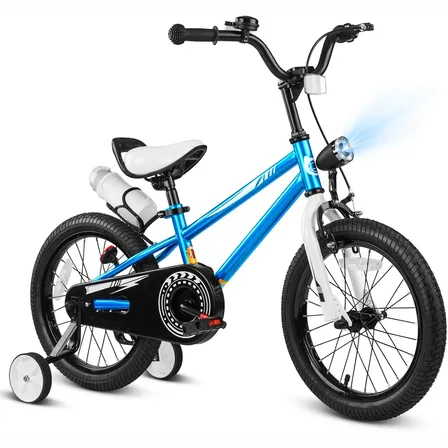
XJD Boys 12/14/16" Training Wheel Bike – Blue
The XJD Boys Bike in Blue is a training wheel bike for riders 71–122 cm tall—rou…$169
$199