

What size bike for boys should i get
Choose a boys’ bike by measured height first, then confirm inseam clearance, comfortable reach, brake control and confidence on the actual bicycle. Do not size up just for growth.
Measure before choosing a wheel size
Measure the child without shoes, standing straight against a wall. Record total height from floor to the top of the head. Then measure inseam from the floor to the crotch; a book held level between the legs can help mark that point.
Use height to identify a starting wheel size in the table below. Age is only a rough cross-check because children of the same age can differ substantially in height, proportions and riding ability. The inseam measurement becomes especially useful when checking whether the child can stand over the bicycle with comfortable clearance.
Compare the measurements with XBikes starting points
| Wheel size | Starting age | Rider height |
|---|---|---|
| 12 Inch | 3–4 | 34–40 in / 86–102 cm |
| 14 Inch | 3–6 | 37–45 in / 94–114 cm |
| 16 Inch | 4–7 | 40–48 in / 102–122 cm |
| 18 Inch | 5–9 | 43–52 in / 109–132 cm |
| 20 Inch | 7–12 | 48–60 in / 122–152 cm |
| 24 Inch | 10–14 | 54–64 in / 137–163 cm |
| 26 Inch | Youth and adults | Over 60 in / 153 cm |
Where ranges overlap, do not automatically choose the larger wheel. Compare both sizes in person if possible. The correct choice is the one the rider can mount, balance, steer, stop and control comfortably now.
Perform the individual fit check
Have the child try the complete bicycle rather than relying on its wheel label. The American Academy of Pediatrics advises against buying an oversized bicycle for a child to grow into. A larger bike may put the controls too far away or make mounting and stopping harder.
- Check stand-over: With the child straddling the bicycle, confirm comfortable clearance between the body and frame. Use the measured inseam to judge this on the actual frame; wheel size alone does not establish clearance.
- Check reach: The child should reach the handlebar without stretching, locking the elbows or losing a balanced riding position.
- Check brake control: Confirm the rider can comfortably reach and operate the bicycle’s braking controls. Do not assume this from height or age.
- Check handling: Ask the child to start, steer, turn and stop in a controlled area. Current confidence matters, particularly when choosing between overlapping sizes.
How the supplied boys’ bikes fit this decision
The three supplied catalog options are useful when the height-based starting point is 12, 14 or 16 inches: each is offered with those three SKU labels, allowing a direct size comparison within the listed range. They are not substitutes when the fit check points to 18, 20, 24 or 26 inches.
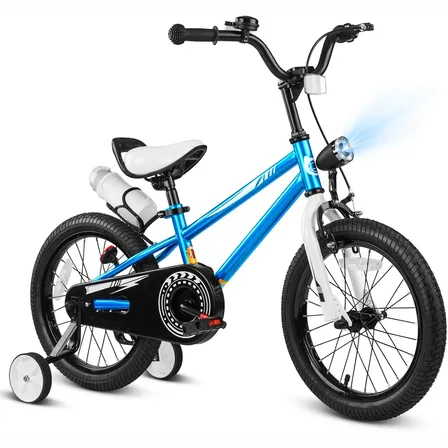
 XJD Boys 12/14/16" Training Wheel Bike – Blue
A Training Wheel Bike offered with 12 Inch, 14 Inch and 16 Inch SKU labels; relevant when the rider’s measured height and individual fit check point to one of those sizes.
 XJD Kids' Training Wheel Bike for Boys & Girls, 12/14/16 Inch – White
A Training Wheel Bike for boys and girls with 12 Inch, 14 Inch and 16 Inch options, useful for comparing those size starting points after measuring the rider.
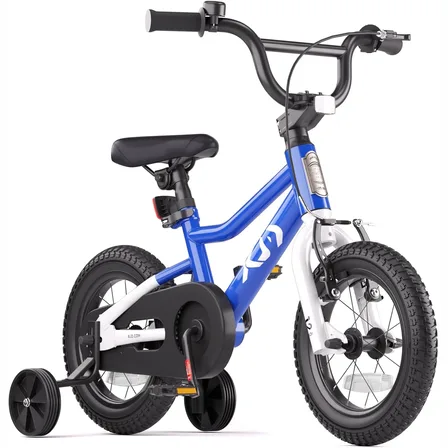
 XJD Boys & Girls BMX Bike with Training Wheels, 12/14/16" – Blue
A Kids' BMX Bike with Training Wheels available in 12 Inch, 14 Inch and 16 Inch labels; consider it only when measurements and an individual control check support one of those sizes.
XJD Boys 12/14/16" Training Wheel Bike – Blue is categorized as a Training Wheel Bike and has 12 Inch, 14 Inch and 16 Inch options. XJD Kids' Training Wheel Bike for Boys & Girls, 12/14/16 Inch – White is also categorized as a Training Wheel Bike with the same three available size labels.
XJD Boys & Girls BMX Bike with Training Wheels, 12/14/16" – Blue is categorized as a Kids' BMX Bike and is likewise available in 12 Inch, 14 Inch and 16 Inch labels. These catalog distinctions can help narrow the style category, but none proves individual fit. Compare the exact selected size with the child’s measurements and an actual try-on.
Before the first ride
For assembly, adjustment, maintenance, load limits, compatibility and torque, follow the exact product manual or use a qualified bicycle mechanic. Do not guess procedures or settings. Check that the bicycle is ready for use according to its manual before the child rides.
A bicycle helmet must fit properly, sit level and have its straps used according to the helmet manufacturer’s instructions, consistent with U.S. Consumer Product Safety Commission guidance. Helmet fit is separate from bicycle fit; confirm both.
Make the final size decision
Start with the child’s measured height, shortlist the matching wheel size or overlapping sizes, and then use inseam clearance, reach, brake operation and controlled riding to decide. Choose the bike the boy can control confidently today—not a larger one intended mainly for future growth. If his measurements indicate 12, 14 or 16 inches, compare the relevant supplied SKU directly; otherwise, continue with the wheel size indicated by the table and an individual fit check.
Bikes for your next adventure
-
XJD Boys 12/14/16" Training Wheel Bike – Blue
The XJD Boys Bike in Blue is a training wheel bike for riders 71–122 cm tall—rou…$169
$199 -
XJD Boys & Girls BMX Bike with Training Wheels, 12/14/16" – Blue
The XJD Boys & Girls BMX Bike in Blue is a first pedal bike for kids roughly age…$99.99
$119.99 -

Black XJD Kids Bike for Boys – 12, 14 & 16 Inch Sizes
For a son between roughly 3 and 8 years old, the XJD Kids Bike in Black covers t…$169
$199