

What size bike for four year old boy
For a four-year-old boy, start by comparing a measured height with 12-, 14-, and 16-inch bikes. Most four-year-olds fall into the 14- or 16-inch ranges, but the correct size is the one he can stand over, reach, steer, and brake confidently during an individual fit check.
Choose the starting size from his height
Age identifies possible wheel sizes; it does not settle the fit. Measure your child without shoes, standing straight against a wall, then compare the result with these XBikes starting points:
| Wheel size | Starting age range | Rider-height range |
|---|---|---|
| 12 Inch | Ages 3–4 | 34–40 in / 86–102 cm |
| 14 Inch | Ages 3–6 | 37–45 in / 94–114 cm |
| 16 Inch | Ages 4–7 | 40–48 in / 102–122 cm |
A four-year-old measuring below 40 inches may need a 12- or 14-inch bike. At 40 inches, all three published height ranges overlap, so a real fit comparison is especially important. From 41 to 45 inches, compare 14 and 16 inches. From 46 to 48 inches, 16 inches is the matching starting point among these sizes.
Do not round a measurement upward or choose a larger bicycle simply to leave growing room. An oversized bike can make starting, stopping, turning, and recovering balance harder.
Measure inseam as well as overall height
Overall height narrows the wheel-size choice, while inseam helps reveal whether the frame works for the individual child. Have him stand in socks with his feet slightly apart. Place a firm, thin book between his legs, gently raise it to simulate the bicycle saddle, and measure vertically from the floor to the book's top edge.
There is no universal inseam-to-wheel-size conversion supplied here because frame shapes and adjustment ranges can differ. Take the measurement when trying the exact bicycle. He should be able to stand over it without the frame pressing into him and get on and off without struggling.
Perform the fit check on the exact bike
Once height suggests a size, have the child try that bicycle rather than relying only on its wheel label. Check the complete riding position:
- Stand-over: He can straddle the bicycle comfortably and remain balanced.
- Reach: He can hold the handlebar without stretching, locking his elbows, or leaning excessively.
- Steering: He can turn the handlebar while staying in control and looking ahead.
- Brake control: If the bike has hand controls, his fingers can reach and operate them securely from a normal grip.
- Confidence: He can start, stop, and place a foot down without fear or hesitation.
If one of these checks fails, do not assume he will grow into the bike. Compare the next smaller size or a different frame. If two sizes fit the height chart, control and current confidence should decide.
How the supplied XBikes options help
Both catalog options are training-wheel bikes offered with 12 Inch, 14 Inch, and 16 Inch SKU labels, so they cover all three starting sizes relevant to many four-year-olds. This makes them useful candidates to compare after measuring height and inseam, although their SKU labels do not replace trying the exact bicycle.
 XJD Boys 12/14/16" Training Wheel Bike – Blue
Available in 12 Inch, 14 Inch, and 16 Inch versions, this blue training-wheel bike provides relevant sizes to compare after measuring the child and completing an individual fit check.
 XJD Kids' Training Wheel Bike for Boys & Girls, 12/14/16 Inch – White
This white training-wheel bike is offered in 12 Inch, 14 Inch, and 16 Inch versions, making it relevant for hands-on size comparison based on measured height, reach, control, and confidence.
The XJD Boys 12/14/16" Training Wheel Bike – Blue is listed in 12-, 14-, and 16-inch versions. Choose which version to inspect from the child's measured height, then confirm stand-over, reach, brake control, and confidence on that exact version.
The XJD Kids' Training Wheel Bike for Boys & Girls, 12/14/16 Inch – White has the same supplied wheel-size choices: 12 Inch, 14 Inch, and 16 Inch. Its main catalog distinction here is its white presentation and inclusive title; no different fit standard is provided.
Training wheels may be relevant if the child is not yet ready to balance independently. They do not make an oversized frame appropriate, and they do not remove the need to check reach, steering, stopping, and stand-over clearance. For assembly, adjustment, compatibility, load limits, maintenance, or torque requirements, follow the exact product manual or ask a qualified bicycle mechanic.
Finish the decision safely
After choosing the smaller set of plausible sizes, let the child test them in a controlled area under close adult supervision. Reject any option that makes him stretch for the handlebar, struggle with controls, or feel unable to stop and put a foot down.
Add a properly fitting bicycle helmet. It should sit level, fit securely, and have its straps adjusted according to the helmet manufacturer's instructions. Recheck bicycle and helmet fit as the child grows.
For your four-year-old boy, measure his height and inseam now: compare 12 and 14 inches below 40 inches tall, compare 14 and 16 inches from 41 to 45 inches, and start with 16 inches from 46 to 48 inches—then buy only after the exact bike passes his hands-on fit and control check.
Bikes for your next adventure
-

XJD Kids Bike for Girls – Pink, 12/14/16/20 Inch with Training Wheels
The XJD Kids Bike for Girls in Pink is a training-wheel bike built to carry your…$139
$159 -
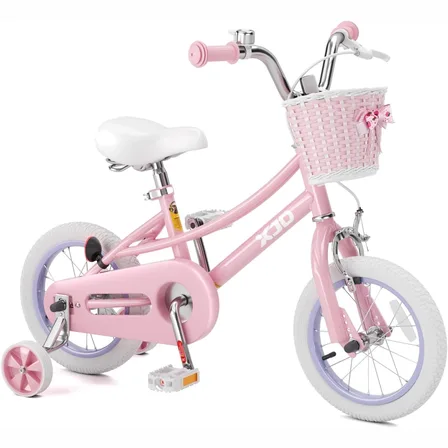
Pink 12/14/16/20" XJD Girls Bike with Training Wheels & Basket
The Pink XJD Girls Bike with Training Wheels & Basket is a first-bike pick f…$65.99
$75.99 -

Light Pink XJD Girls' Bicycle with Basket & Training Wheels
The Light Pink XJD Girls' Bicycle with Basket & Training Wheels is a retro-style…$109.99
$129.99