

What size bike for seven year old boy
For a seven-year-old boy, start with an 18-inch or 20-inch bike: compare his measured height first. XBikes starts 18-inch bikes at 43–52 in (109–132 cm) and 20-inch bikes at 48–60 in (122–152 cm). A 16-inch bike may fit if he is 40–48 in (102–122 cm), but age alone cannot determine the right size.
Measure him before choosing a wheel size
Measure his height without shoes, standing straight against a wall. Also measure his inseam from the floor to the crotch while he stands naturally. Height places him in a useful starting range; inseam helps you judge stand-over clearance on the actual bicycle.
Write down both measurements rather than relying on clothing size or an estimate. Then compare his height with the XBikes starting points below. Where ranges overlap, his control, reach and confidence should settle the decision.
| Wheel size | XBikes age starting point | Rider height | Relevance at age seven |
|---|---|---|---|
| 16 Inch | Ages 4–7 | 40–48 in / 102–122 cm | Possible for a shorter rider who fits and controls it well |
| 18 Inch | Ages 5–9 | 43–52 in / 109–132 cm | A common starting comparison within the supplied ranges |
| 20 Inch | Ages 7–12 | 48–60 in / 122–152 cm | Possible when his measured height and individual fit support it |
Use the overlap to make the decision
A seven-year-old who is 46 in tall falls within both the 16-inch and 18-inch height ranges. At 50 in, the comparison shifts to 18-inch and 20-inch bikes. These overlaps are intentional starting points, not proof that either option fits.
Do not automatically select the larger wheel for future growth. The American Academy of Pediatrics guidance summarized by HealthyChildren recommends having the child try the bicycle and avoiding an oversized bike bought merely to grow into. A bike that matches a chart can still be unsuitable if its frame shape, controls or riding position do not match the child.
Check the actual bicycle, not just the label
Have him try the exact model while wearing the shoes he will use for riding. Make these checks before deciding:
- Stand-over: He should be able to straddle the bicycle with usable clearance rather than being pressed against the frame.
- Starting and stopping: He should be able to get on, start and stop without the bicycle overwhelming him.
- Reach: He should reach the handlebar in a controlled position, without stretching or losing comfortable steering.
- Brake control: He must be able to reach and operate the fitted brake controls reliably.
- Confidence: Choose the size he can control now. Hesitation caused by excessive size is a reason to reconsider.
If assembly, adjustment, compatibility, load limits or maintenance details are unclear, follow the exact product manual or ask a qualified bicycle mechanic. Do not transfer procedures or settings from a different model.
How the supplied 16-inch options help
The supplied catalog contains 12-, 14- and 16-inch choices, so these products are relevant only when his measured height and hands-on fit point to 16 inches. They also provide a nearest-size comparison when evaluating whether he has already outgrown that range. Neither product offers an 18-inch or 20-inch SKU in the supplied facts, so they are not substitutes when either larger wheel size is required.
 XJD Boys & Girls BMX Bike with Training Wheels, 12/14/16" – Blue
Available in 12, 14 and 16 Inch labels. Its 16 Inch version is relevant only if the rider fits the 40–48 in height starting range and passes an individual control check.
 Black XJD Kids Bike for Boys – 12, 14 & 16 Inch Sizes
This boys' bike has 12, 14 and 16 Inch size labels and is cataloged under Training Wheel Bikes. Use the 16 Inch option only as a fit candidate or nearest-size comparison.
XJD Boys & Girls BMX Bike with Training Wheels, 12/14/16" – Blue
This Kids' BMX Bikes option has 12 Inch, 14 Inch and 16 Inch SKU labels. For this question, only its 16 Inch version is a plausible comparison, and only for a child within the 40–48 in (102–122 cm) starting range who passes the individual fit checks.
Black XJD Kids Bike for Boys – 12, 14 & 16 Inch Sizes
This product is cataloged under Training Wheel Bikes and likewise offers 12 Inch, 14 Inch and 16 Inch labels. Its wording identifies it as a boys' bike, but that title is not fit evidence. Compare the 16 Inch choice using measured height, inseam, reach, braking and confidence.
Complete the fit with a properly fitted helmet
A correctly sized bicycle does not replace protective equipment. The U.S. Consumer Product Safety Commission advises that a bicycle helmet must fit properly, sit level on the head and have its straps used according to the helmet manufacturer's instructions. Recheck the fit rather than assuming a familiar helmet still fits.
Make the seven-year-old size decision
Measure him now. If he is 43–52 in (109–132 cm), try an 18-inch bike; if he is 48–60 in (122–152 cm), include a 20-inch bike in the comparison. Consider either supplied 16-inch product only if he is 40–48 in (102–122 cm) and controls that exact bicycle comfortably. Buy neither an age label nor extra growth room: choose the bike he can straddle, reach, brake and ride with confidence today.
Bikes for your next adventure
-
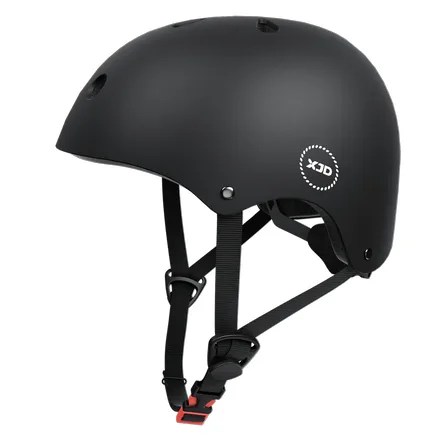
7-in-1 Kids Helmet & Protective Gear Set from XJD – Black or Blue
If you're outfitting one kid (or a couple of siblings) for biking, scootering, o…$59.99
-

Kids Bike Helmet by XJD for Boys & Girls – Black, Blue, Green, Pink, Purple
The XJD Kids Bike Helmet covers a wide 2-to-8-year age range thanks to two head-…$59.99
-

Kids Bike Helmet by XJD for Girls – Pink
The XJD Kids Bike Helmet in Pink is a lightweight multi-sport helmet for girls r…$59.99
$99