

What size bike should a 12 year old boy have
Most 12-year-old boys should start with a 24-inch bike, but height and actual fit matter more than age. Measure him before choosing.
Choose the starting wheel size by measured height
Have the rider stand straight without shoes against a wall, then measure from the floor to the top of his head. Compare that measurement with the XBikes starting points below. The ranges overlap because two wheel sizes can sometimes be worth trying, but they are not interchangeable: frame shape, reach and the rider’s confidence still affect control.
| Wheel size | XBikes age starting point | Rider height |
|---|---|---|
| 20 Inch | Ages 7–12 | 48–60 in / 122–152 cm |
| 24 Inch | Ages 10–14 | 54–64 in / 137–163 cm |
| 26 Inch | Youth and adults over 60 in / 153 cm |
For a 12-year-old measuring 54–60 inches (137–152 cm), begin by trying a 24-inch bike, while recognizing that this height also overlaps the 20-inch range. A rider under 54 inches (137 cm) should begin with a 20-inch option. At more than 60 inches (153 cm), compare a 24-inch bike with a 26-inch model and select by fit and control rather than assuming the larger wheels are automatically suitable.
Measure inseam as well as total height
For the inseam, have him stand in socks with his feet slightly apart. Place a firm book between his legs, raise it gently to simulate a saddle, and measure vertically from the floor to the top edge of the book. Record the result without rounding it up.
There is no supplied universal inseam-to-wheel-size formula, so use this measurement during an in-person fit check. With the bicycle upright, confirm that he can straddle the frame comfortably rather than being pressed against it. The exact clearance needed depends on the bicycle, so follow its product manual or ask a qualified bicycle mechanic instead of relying on an invented number.
Perform the control check before buying
A height range only identifies what to try. Let the child sit on and ride the actual bicycle in a controlled area, with appropriate supervision. Check all of the following:
- He can mount, start, steer and stop without the bicycle feeling unwieldy.
- He can reach the handlebar without stretching, locking his elbows or leaning excessively.
- He can operate each brake control confidently and repeatedly with his hands in a normal riding position.
- He can turn his head, look ahead and make a controlled turn while maintaining balance.
- He appears calm and in command at low speed, not merely able to remain on the bicycle.
If he cannot comfortably straddle the frame, reach the controls or brake reliably, reject that fit even when his age and height appear in the listed range. Do not buy an oversized bicycle solely to leave room for growth.
How the supplied 24-inch bicycle helps
The supplied catalog option, the 24-Inch Purple XJD Beach Cruiser Bike with U-Brake, gives parents a concrete 24-inch beach cruiser bicycle to compare with the rider’s measurements and hands-on fit. Its wheel size matches the usual starting point for many 12-year-olds who are 54–64 inches (137–163 cm), but the catalog facts do not establish its frame dimensions, reach or individual suitability.
The product shown below is relevant because it lets you examine the 24-inch category identified by the XBikes chart. It is a comparison candidate, not proof of fit; confirm stand-over comfort, reach, brake operation and confidence on the exact bicycle.
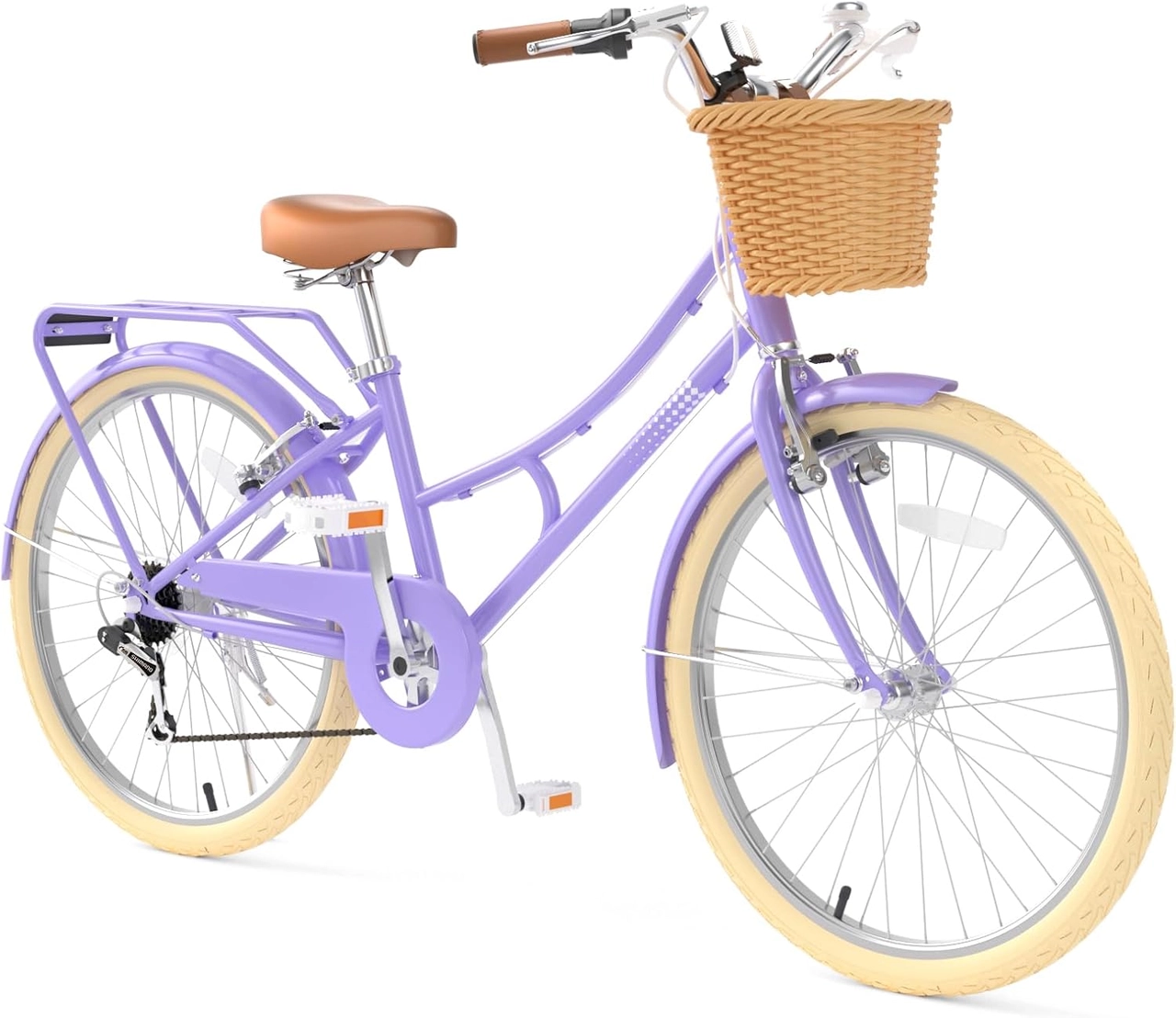
The supplied U-brake description identifies the catalog model but does not prove that a particular child can reach or operate its brake control. Check that directly. For assembly, adjustment, maintenance, compatibility, load limits or torque requirements, follow the exact product manual or use a qualified bicycle mechanic.
Account for skill and confidence
Two boys of the same age and height may need different choices. A confident rider who controls a bicycle smoothly may evaluate an overlapping larger option, while a cautious or less experienced rider may have better control on the smaller fitting option. The deciding question is not whether he can physically sit on the bike, but whether he can manage it predictably.
Do not treat age as permission to skip the trial. A growth spurt may place a 12-year-old near the 26-inch starting point, while another may still fit the 20-inch range. Neither situation is unusual within these starting points.
Make the final decision
- Measure height and inseam without shoes.
- Use height to shortlist 20-, 24- or 26-inch bicycles.
- Try each plausible size and compare stand-over comfort, reach, braking and low-speed control.
- Choose the bicycle he controls now, rather than one intended for future growth.
Finish by fitting a bicycle helmet properly: it should sit level, and its straps should be used according to the helmet manufacturer’s instructions. For this 12-year-old, select the 24-inch starting point only if his measurements and real-world control confirm it; otherwise move to the smaller or larger height-appropriate option and repeat the same fit check.
Bikes for your next adventure
-

Kids Bike Helmet by XJD for Boys & Girls – Black, Blue, Green, Pink, Purple
The XJD Kids Bike Helmet covers a wide 2-to-8-year age range thanks to two head-…$59.99
-

Kids Bike Helmet by XJD for Girls – Pink
The XJD Kids Bike Helmet in Pink is a lightweight multi-sport helmet for girls r…$59.99
$99 -

XJD Kids Bike for Girls – Pink, 12/14/16/20 Inch with Training Wheels
The XJD Kids Bike for Girls in Pink is a training-wheel bike built to carry your…$139
$159