

What size bike should a 12 year old boy ride
Most 12-year-old boys should start by trying a 20-inch or 24-inch bike. Measure his height first: 20-inch suits 48–60 inches, while 24-inch suits 54–64 inches.
Choose between 20-inch and 24-inch wheels
Age narrows the search, but it does not determine fit. Under the XBikes starting points, a 20-inch bike covers ages 7–12 and rider heights of 48–60 inches (122–152 cm). A 24-inch bike covers ages 10–14 and heights of 54–64 inches (137–163 cm).
That overlap matters. A 12-year-old who is 55 inches tall could reasonably try both sizes. His inseam, reach, brake control and confidence should decide which one fits. If he is over 60 inches (153 cm), a 26-inch bicycle may also be worth trying because that is the XBikes starting point for youth and adults above that height.
| Measured rider height | Wheel size to try first | What to compare |
|---|---|---|
| 48–53 inches (122–136 cm) | 20 inch | Stand-over room, reach and control |
| 54–60 inches (137–152 cm) | 20 and 24 inch | Compare both through an individual fit check |
| 61–64 inches (155–163 cm) | 24 inch; consider 26 inch | Check whether either size permits confident control |
| Over 64 inches (163 cm) | 26 inch starting point | Confirm the complete bicycle fits, not just its wheels |
Measure him before comparing bikes
Measure height without shoes, with his back straight against a wall. For inseam, have him stand with his feet slightly apart and measure from the floor to the crotch. Record both measurements rather than relying on clothing size or an estimate from his age.
Wheel size is only a starting point; frame shapes and riding positions can differ even when the wheel labels match. Compare the measurements with the ranges above, then have him try the complete bicycle. Do not order a larger size merely to leave growing room.
Perform a fit and control check
Have the rider wear the shoes he will normally use. During the trial, check these points:
- Stand-over: He should be able to straddle the bike without the frame preventing a stable stance.
- Starting and stopping: He should get on, set off, stop and put a foot down without struggling or leaning excessively.
- Reach: He should hold the handlebar without stretching, locking his elbows or losing a comfortable, controlled position.
- Brake access: His hands must reach and operate the brake controls reliably while he maintains his grip and steering control.
- Confidence: He should turn, look around and ride at low speed without appearing overwhelmed by the bicycle.
If a 24-inch bicycle technically matches his height but feels unwieldy, compare it with a 20-inch model. If a 20-inch bicycle feels cramped despite falling within the range, try a 24-inch model and repeat every check. A qualified bicycle mechanic can help when the choice remains unclear.
How the supplied XBikes models help with comparison
The catalog options below cover the likely 20-, 24- and 26-inch comparison sizes for a 12-year-old. They are useful only after measuring the rider, and their wheel labels do not replace a hands-on check of stand-over, reach, braking and control.
 XJD 24-Inch Green Beach Cruiser Bike with U-Brake
Available in 24-inch and 26-inch SKU options, this model provides comparison points for riders whose measured height supports those sizes; it does not offer a supplied 20-inch option.
 Pink XJD Beach Cruiser Bike, 24"/26", U-Brake
Its supplied 24-inch and 26-inch SKU labels make it relevant for comparing larger starting sizes, but the rider still needs checks for stand-over, reach, braking and control.
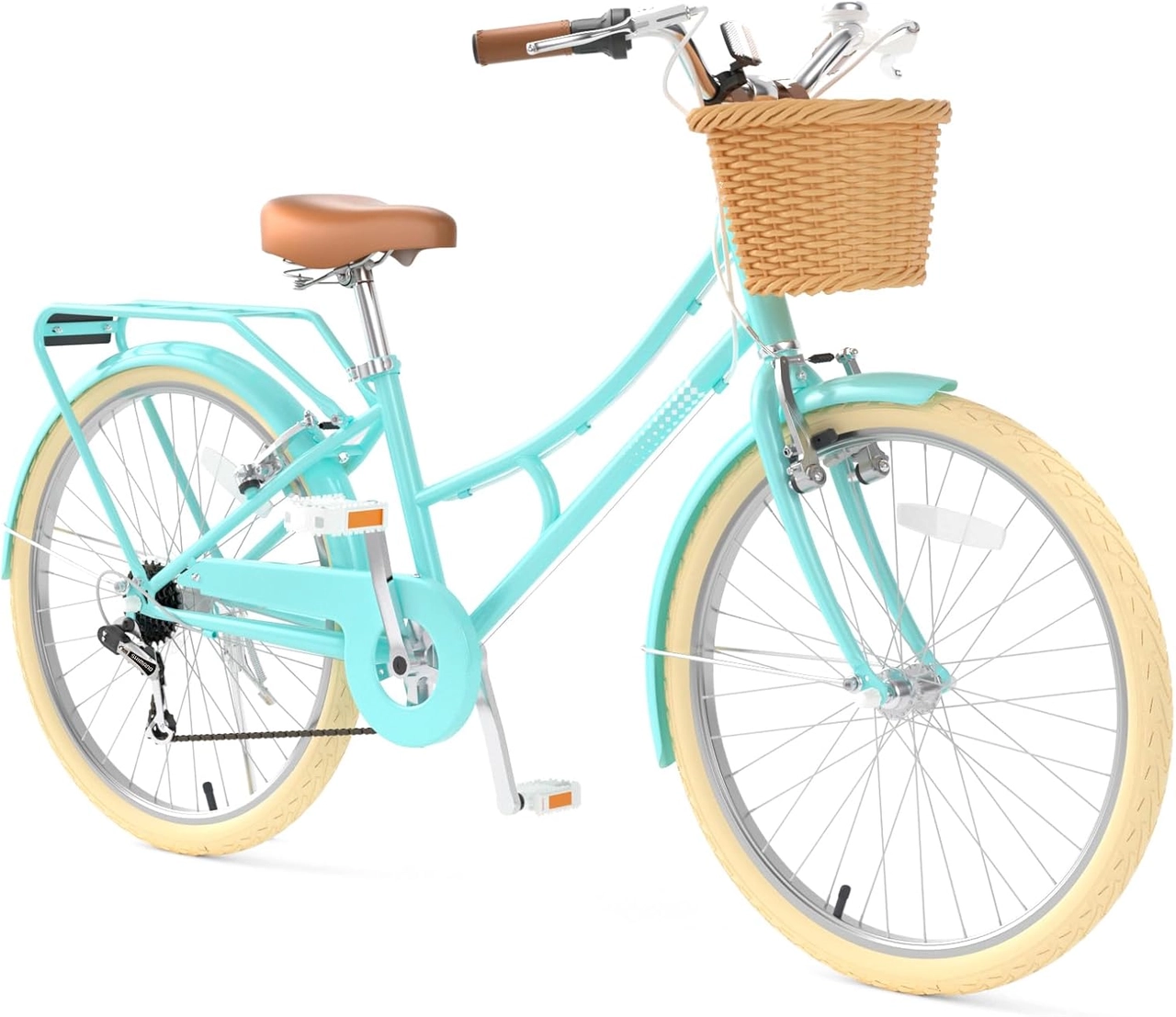
 XJD Kids Beach Cruiser Bicycle, Rear Rack & V-Brakes, Mint Green
With supplied 20-inch, 24-inch and 26-inch SKU labels, this model spans all three wheel-size starting points potentially relevant to a 12-year-old after measurement.
XJD Kids Beach Cruiser Bicycle, Rear Rack & V-Brakes, Mint Green has 20-inch, 24-inch and 26-inch SKU labels. That makes it the only supplied model that lets a parent compare all three relevant wheel-size starting points within one listed model range.
XJD 24-Inch Green Beach Cruiser Bike with U-Brake is offered in Green / 24 Inch, Pink / 24 Inch and Pink / 26 Inch SKU labels. Its 24-inch versions align with the usual starting range for many 12-year-olds; the 26-inch option is relevant only when his measured height and individual fit support it.
Pink XJD Beach Cruiser Bike, 24"/26", U-Brake has 24-inch and 26-inch SKU labels. It can provide two comparison points for a taller rider, but it has no supplied 20-inch option for a smaller or less-confident 12-year-old.
Use the exact product manual or a qualified bicycle mechanic for assembly, maintenance, adjustment procedures, compatibility, load limits and torque information.
Do not size up for future growth
An oversized bike can make mounting, stopping, steering and reaching the brakes harder. The appropriate choice is the size he controls now, even if a larger wheel might last longer. Recheck fit as he grows, particularly after a noticeable height increase or if his riding position becomes cramped.
Finish the setup with a properly fitting bicycle helmet. It should sit level and be secured with its straps according to the helmet manufacturer’s instructions. A helmet does not correct poor bicycle fit, so check both separately.
The decision to make today
Measure his height and inseam, use 20 inches for a 48–60-inch rider and 24 inches for a 54–64-inch rider as starting points, then test the complete bike. In the overlap, choose the bicycle he can straddle, reach, brake and steer with greater confidence—not the larger one he may eventually grow into.
Bikes for your next adventure
-

Kids Bike Helmet by XJD for Boys & Girls – Black, Blue, Green, Pink, Purple
The XJD Kids Bike Helmet covers a wide 2-to-8-year age range thanks to two head-…$59.99
-

Kids Bike Helmet by XJD for Girls – Pink
The XJD Kids Bike Helmet in Pink is a lightweight multi-sport helmet for girls r…$59.99
$99 -

XJD Kids Bike for Girls – Pink, 12/14/16/20 Inch with Training Wheels
The XJD Kids Bike for Girls in Pink is a training-wheel bike built to carry your…$139
$159