

What size of a bike to buy for boys
Choose a boys’ bike by measuring his height and inseam, then matching his height to a wheel-size starting point and checking stand-over clearance, reach and brake control in person. Do not size up merely for future growth.
Measure the rider before choosing a wheel size
Measure height without shoes, with the child standing straight against a wall. Then measure inseam from the floor to the crotch while he stands with feet slightly apart. Record both measurements in inches or centimetres.
Height identifies a sensible wheel-size range. Inseam helps with the essential stand-over check, but wheel diameter does not tell you the frame’s exact stand-over height. Frame shapes differ, so compare the measurements with the specific bicycle and have the child try it whenever possible.
Compare his measured height with these starting points
| Wheel size | Rider height | Age starting point |
|---|---|---|
| 12 Inch | 34–40 in / 86–102 cm | 3–4 |
| 14 Inch | 37–45 in / 94–114 cm | 3–6 |
| 16 Inch | 40–48 in / 102–122 cm | 4–7 |
| 18 Inch | 43–52 in / 109–132 cm | 5–9 |
| 20 Inch | 48–60 in / 122–152 cm | 7–12 |
| 24 Inch | 54–64 in / 137–163 cm | 10–14 |
| 26 Inch | Over 60 in / 153 cm | Youth and adults |
Use measured height before age. The ranges overlap because children of similar ages can differ in proportions, coordination and confidence. An overlap means “try both,” not “either one automatically fits.”
Resolve an overlap with a real fit check
When his height appears in two ranges, place him over each candidate bike and check the complete riding position. He should be able to stand over the frame with usable clearance rather than being pressed against it. Seated, he should reach the handlebar without an exaggerated stretch or cramped posture.
Ask him to hold the grips, steer smoothly and operate the brakes with control. He should be able to start, stop and put a foot down without panic. Current confidence matters: a larger bicycle that feels intimidating is not a better purchase simply because it may last longer.
If adjustments cannot produce a controlled position, reject that size. Follow the exact product manual for assembly, adjustment, compatibility, maintenance and limits, or ask a qualified bicycle mechanic; those details cannot be inferred from wheel size.
How the supplied 12, 14 and 16 Inch options help
The three catalog options make direct comparison practical for boys whose measured heights point to 12, 14 or 16 Inch wheels. Each is offered with those three size labels, so the next step is to compare the relevant label and then verify individual fit rather than choosing from the title alone.
 XJD Boys 12/14/16" Training Wheel Bike – Blue
A Training Wheel Bikes option offered in 12 Inch, 14 Inch and 16 Inch labels; relevant when the rider’s measured height and individual fit check support one of those sizes.
 XJD Kids' Training Wheel Bike for Boys & Girls, 12/14/16 Inch – White
This Training Wheel Bikes model has 12 Inch, 14 Inch and 16 Inch labels. Use it as a candidate only after matching measured height and confirming stand-over, reach and control.
 XJD Boys & Girls BMX Bike with Training Wheels, 12/14/16" – Blue
A Kids' BMX Bikes catalog option with training wheels and 12 Inch, 14 Inch and 16 Inch labels. Its BMX classification does not replace an individual size and control check.
XJD Boys 12/14/16" Training Wheel Bike – Blue is a Training Wheel Bikes option with 12 Inch, 14 Inch and 16 Inch labels. XJD Kids' Training Wheel Bike for Boys & Girls, 12/14/16 Inch – White offers the same three labels in that category. Compare them only on these verified catalog distinctions, then consult each exact listing and manual for details not supplied here.
XJD Boys & Girls BMX Bike with Training Wheels, 12/14/16" – Blue also has 12 Inch, 14 Inch and 16 Inch labels, but its catalog category and topic are Kids' BMX Bikes. “BMX” is a catalog classification here, not proof of a particular geometry, component, use or fit.
These products are relevant only when measurement and a hands-on check support one of their available sizes. If the rider needs an 18, 20, 24 or 26 Inch bicycle, the displayed products are smaller-size comparison points, not substitutes.
Do not let training wheels decide the frame size
Training wheels appear in all three supplied titles, but that feature does not replace correct sizing. Select the bicycle size from the rider’s body measurements and control first. Then decide whether training wheels suit his present confidence and learning stage.
Do not infer training-wheel setup, removal steps or compatibility from a title. Use the exact product manual or a qualified bicycle mechanic for those questions.
Complete the safety check before riding
- Have the child try the bicycle and reject an oversized bike bought only for growth.
- Confirm stand-over clearance, comfortable reach, steering control and reliable access to the brakes.
- Check that the selected SKU label matches the wheel size you evaluated.
- Use a properly fitting bicycle helmet. It should sit level, with straps adjusted according to the helmet manufacturer’s instructions.
- Follow the bicycle’s exact manual for assembly and maintenance, or use a qualified bicycle mechanic.
Make the final size decision
Measure him now, shortlist the wheel-size row that contains his height, and test every plausible overlap. Buy only the size on which he can stand over, reach, steer and operate the brakes confidently today; if no available 12, 14 or 16 Inch option passes those checks, choose neither supplied product size.
Bikes for your next adventure
-

Blue XJD Kids Bike Helmet for Boys & Girls
The Blue XJD Kids Bike Helmet is a lightweight, adjustable multi-sport helmet fo…$59.99
$99 -
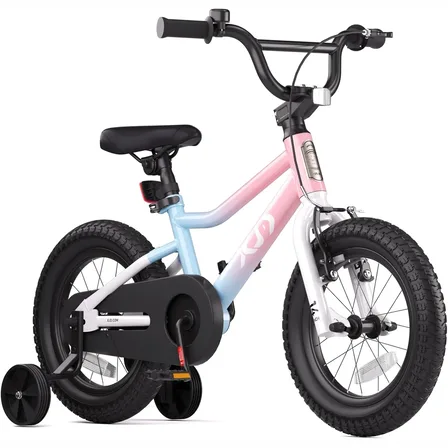
XJD Girls BMX Bike 12/14/16 Inch with Training Wheels – Pink Blue
The XJD Girls BMX Bike in Pink/Blue is built as a first pedal bike for kids roug…$99.99
$119.99 -

Kids Bike Helmet by XJD for Boys & Girls – Black, Blue, Green, Pink, Purple
The XJD Kids Bike Helmet covers a wide 2-to-8-year age range thanks to two head-…$59.99