

What size of bike for 10 year old boy
For most 10-year-old boys, start by comparing 20-inch and 24-inch bikes. Measure his height first: 20-inch suits 48–60 in (122–152 cm), while 24-inch starts at 54 in (137 cm). Then confirm stand-over clearance, reach and brake control on the actual bike.
Choose the starting size from measured height
Age points you toward a likely wheel size, but it does not settle the fit. The XBikes starting range for a 20-inch bike is ages 7–12 and a rider height of 48–60 in (122–152 cm). For a 24-inch bike, it is ages 10–14 and 54–64 in (137–163 cm).
This means many 10-year-olds fall into the overlap between 54 and 60 inches (137–152 cm). A rider in that overlap should try both sizes rather than choosing the larger one automatically. A child below 54 inches (137 cm) will usually begin the comparison with a 20-inch bike. A child from 60 to 64 inches (153–163 cm) will usually begin with a 24-inch bike. Over 60 inches (153 cm), a 26-inch bike also enters the XBikes youth-and-adult starting range, but it still needs an individual fit check.
| Measured rider height | Wheel-size starting point | Next step |
|---|---|---|
| 48–53 in (122–136 cm) | 20 Inch | Try a 20-inch bike and verify control. |
| 54–59 in (137–152 cm) | 20 or 24 Inch overlap | Compare both on the rider. |
| 60–64 in (153–163 cm) | 24 Inch; 26 Inch also begins over 60 in | Try the plausible sizes and reject any that compromise control. |
Measure before comparing bikes
Measure height with the boy standing barefoot against a wall, looking straight ahead, with his heels on the floor. Record the result in inches or centimetres. Do not estimate from clothing size or compare him with classmates.
Measure inseam as well. With shoes off and feet slightly apart, place a firm, level object between the legs to represent the saddle area, then measure vertically from the floor to its top. There is no supplied numerical inseam-to-frame formula here; use the measurement when checking whether he can stand over the actual bicycle without the frame pressing into him.
Check the actual fit, not just the wheel label
Have him try the bicycle in the shoes he normally rides in. A correctly chosen wheel category can still feel wrong because bicycle frames and riding positions differ. Do not buy an oversized bike merely to leave room for growth.
- Stand-over: He should be able to straddle the bike with practical clearance and without the frame forcing an awkward stance.
- Reach: He should hold the handlebar without stretching, locking his elbows or losing a stable seated position.
- Brake control: He must comfortably reach and operate the brake controls while keeping secure control of the handlebar.
- Starting and stopping: He should mount, set off, steer at low speed and stop without panic or assistance.
- Confidence: If the larger option makes him hesitant or reduces control, choose the smaller suitable option rather than expecting him to grow into it.
How the supplied 24-inch and 26-inch bikes help
The catalog choices provide relevant comparison points when his measured height makes a 24-inch or 26-inch bicycle plausible. The XJD 24-Inch Green Beach Cruiser Bike with U-Brake has Green / 24 Inch, Pink / 24 Inch and Pink / 26 Inch SKU labels. The Pink XJD Beach Cruiser Bike, 24"/26", U-Brake has 24 Inch and 26 Inch SKU labels. Both are beach cruiser bikes and list a U-brake in their exact titles.
These options are relevant to a 10-year-old only after height and hands-on fit support their listed wheel size. They do not include a 20-inch option, so if measurement points to 20 inches, treat them as larger comparison points—not substitutes for a 20-inch bike. Likewise, a 26-inch label is not equivalent to 24 inches and should not be selected solely because the child is tall for his age.
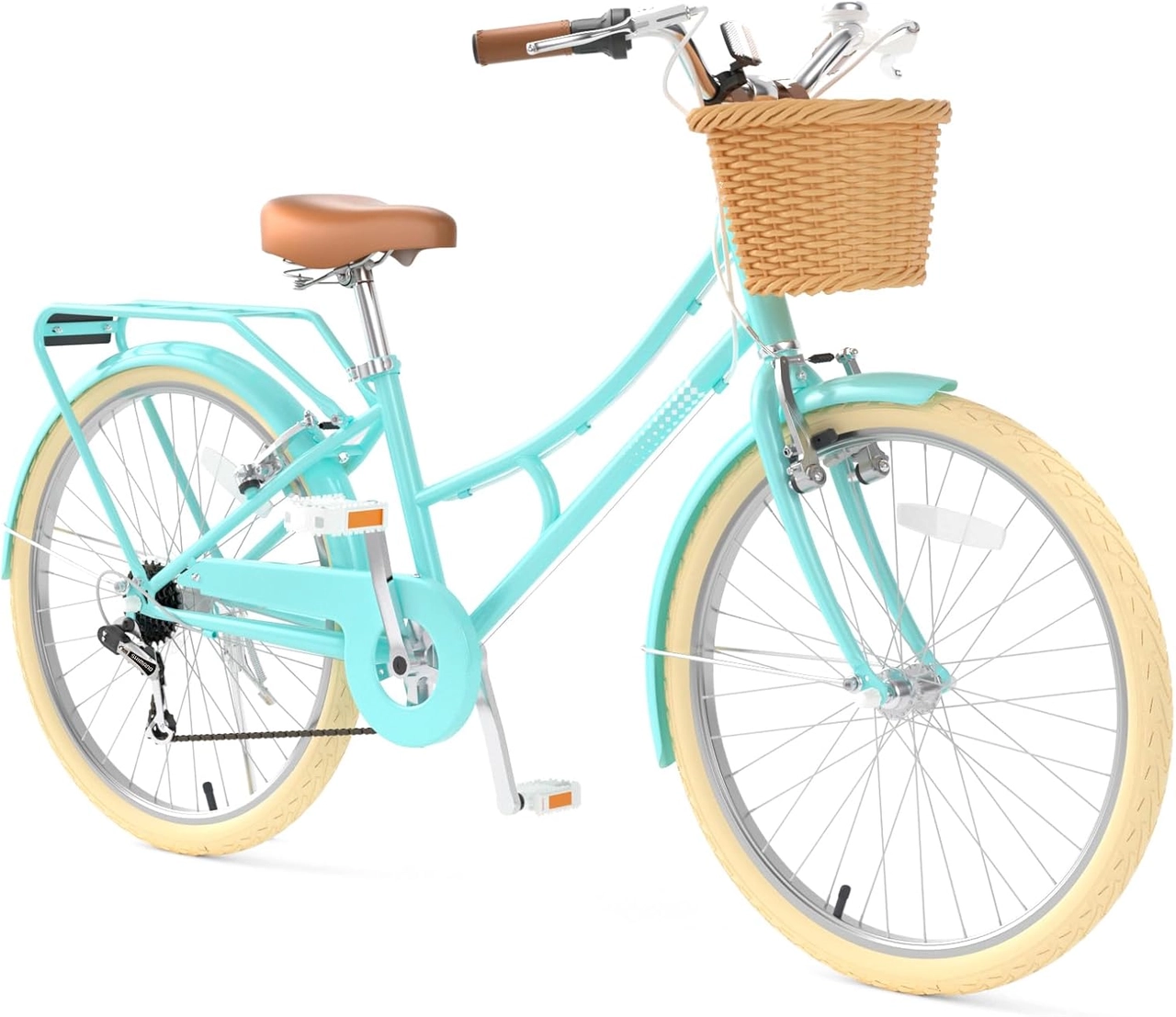 XJD 24-Inch Green Beach Cruiser Bike with U-Brake
A 24-inch or 26-inch beach cruiser comparison option with listed Green and Pink SKU labels. Consider it only when the rider’s measured height and hands-on control support the selected wheel size.
 Pink XJD Beach Cruiser Bike, 24"/26", U-Brake
A Pink XJD beach cruiser offered with 24 Inch and 26 Inch SKU labels. It is relevant for comparing those sizes, but neither listed option substitutes for a 20-inch bike when that fits the rider.
Make the final decision in this order
- Measure height and inseam accurately.
- Use height to shortlist 20-inch, 24-inch or, when over 60 inches (153 cm), 26-inch possibilities.
- Have him try each plausible bicycle and compare stand-over, reach, brake operation, starting, steering and stopping.
- Choose the size he can control now; do not size up only for future growth.
- Set up and maintain the chosen bicycle according to its exact product manual, or ask a qualified bicycle mechanic when instructions or adjustments are unclear.
Before the first ride
Use a properly fitting bicycle helmet. It should sit level, and its straps should be adjusted according to the helmet manufacturer’s instructions. Recheck the bicycle fit after adjustments and as the child grows.
For the typical 10-year-old boy, the practical decision is therefore 20 versus 24 inches: measure him, use 54 inches (137 cm) as the start of the supplied 24-inch height range, and let present-day control—not age or anticipated growth—decide.
Bikes for your next adventure
-

Black XJD Toddler Bike Helmet, Adjustable – Kids' Protective Helmet
The XJD Toddler Bike Helmet in black is an adjustable protective helmet for kids…$20.39
-

XJD Girls Bike for Kids Ages 3-8, 12/14/16 Inch with Training Wheels – Purple
The XJD Girls Bike in Purple is a training-wheel bicycle for kids ages 3 to 8, f…$149
$169 -

Pink Girls' 12/14/16" Bike by XJD – Basket & Doll Seat
The XJD Pink Girls' Bike with Basket & Doll Seat is made for riders 71–122 cm ta…$75.99
$99.99