

What size of bike for 12 year old boy
Most 12-year-old boys should start by trying a 20-inch or 24-inch bike: use 20 inches at 48–60 in (122–152 cm) and 24 inches at 54–64 in (137–163 cm), then confirm fit in person.
Choose by height, not age alone
At age 12, a boy may fall within either XBikes starting range. A 20-inch bike covers ages 7–12 and heights of 48–60 in (122–152 cm). A 24-inch bike covers ages 10–14 and heights of 54–64 in (137–163 cm). Because the ranges overlap, age cannot settle the choice.
If he is over 60 in (153 cm), a 26-inch bike can also be considered because XBikes identifies that size for youth and adults above that height. However, being tall enough to enter a wheel-size range does not prove that a particular frame will fit.
| Measured rider height | Starting wheel size to try |
|---|---|
| 48–53 in (122–136 cm) | 20 Inch |
| 54–60 in (137–152 cm) | Compare 20 Inch and 24 Inch |
| 61–64 in (155–163 cm) | Compare 24 Inch and 26 Inch |
| Over 64 in (163 cm) | Start with 26 Inch |
These are starting points, not guarantees. When measurements fall near a boundary, compare both relevant sizes rather than rounding up automatically.
Measure him before shopping
Measure height without shoes, with his back straight against a wall. Then measure inseam: while he stands naturally, place a firm book between his legs to represent the saddle area and measure from the floor to the top edge of the book.
Use height to identify the likely wheel-size range. Use inseam during the actual bicycle check, because wheel diameter alone does not reveal the frame’s stand-over clearance. Frame shapes and dimensions can differ even when two bicycles use the same wheel size.
Check the fit on the actual bicycle
Have the child try the exact bike. The American Academy of Pediatrics advises against buying an oversized bicycle merely for future growth. During the fit check, look for all of the following:
- He can straddle the frame with usable clearance rather than being pressed against it.
- He can mount, start, steer, turn and stop without struggling against the bicycle’s size.
- His riding position allows a comfortable reach to the handlebar without excessive stretching.
- He can reach and operate the brake controls reliably with his hands in a normal riding position.
- The bike feels manageable at his present confidence and skill level, including at low speed.
If a larger wheel size compromises stand-over, reach, balance or brake control, choose the smaller properly fitting option. A bicycle he can control now is more appropriate than one intended mainly to last through a growth spurt.
How the supplied XBikes options relate
The catalog choices help compare the two larger sizes relevant to many 12-year-olds. The XJD 24-Inch Green Beach Cruiser Bike with U-Brake has Green / 24 Inch, Pink / 24 Inch and Pink / 26 Inch SKU labels. The Pink XJD Beach Cruiser Bike, 24"/26", U-Brake has 24 Inch and 26 Inch SKU labels. Both therefore provide 24-inch and 26-inch comparison points, but neither supplies a 20-inch option.
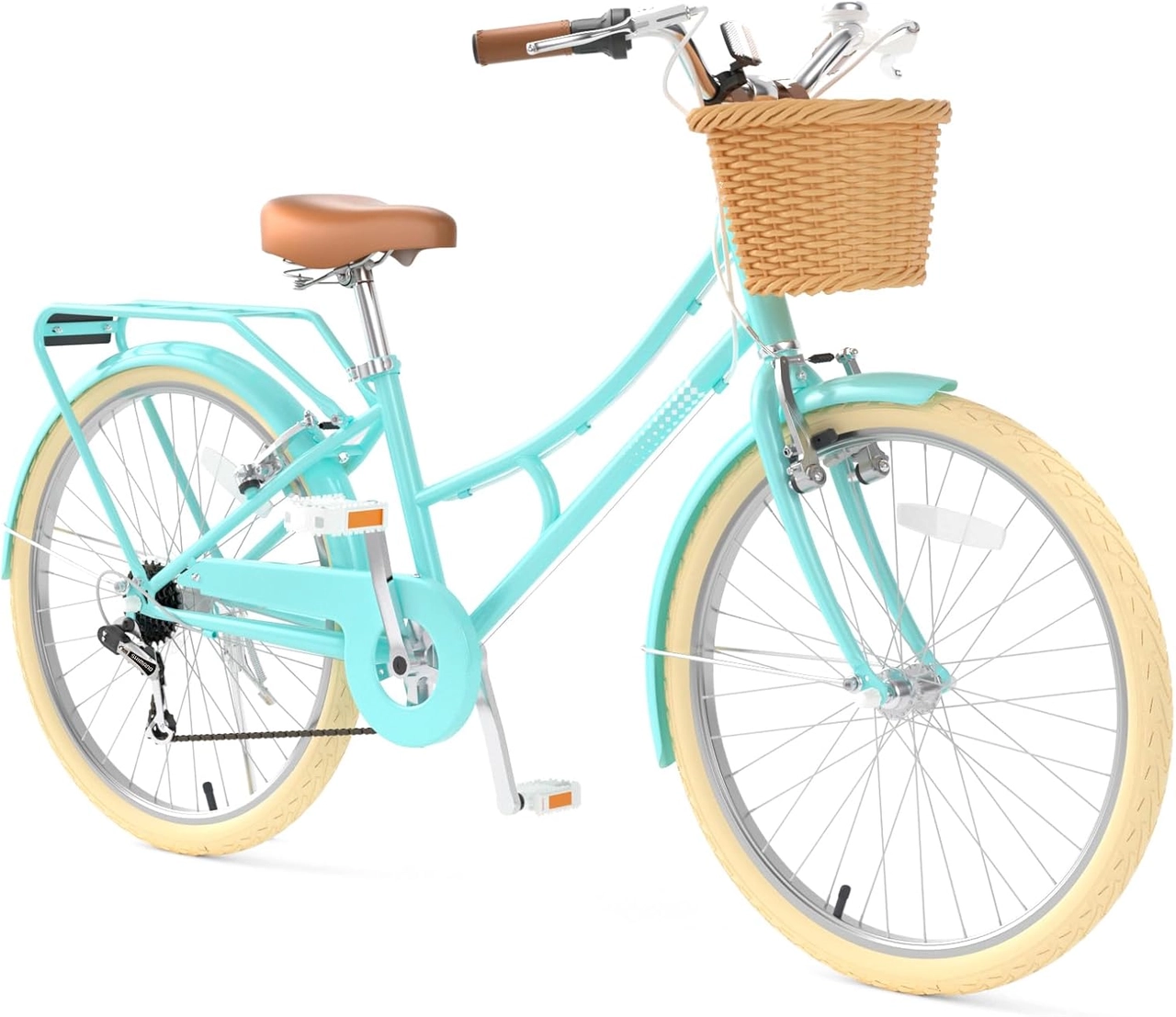 XJD 24-Inch Green Beach Cruiser Bike with U-Brake
A 24- or 26-inch beach-cruiser comparison option with supplied Green and Pink SKU labels. Check the selected size against the rider’s measured height, inseam, reach and control.
 Pink XJD Beach Cruiser Bike, 24"/26", U-Brake
This beach cruiser offers supplied 24 Inch and 26 Inch SKU labels, making it relevant for side-by-side size consideration when the rider meets the corresponding height starting point and passes an individual fit check.
For a rider measuring 54–64 in (137–163 cm), the 24-inch versions are within the XBikes height starting point and deserve an individual fit check. For a rider over 60 in (153 cm), the 26-inch versions may also be tried and compared. A 26-inch bike is not equivalent to a 24-inch bike, and catalog availability does not establish fit.
If the boy measures 48–53 in (122–136 cm), these supplied products are not appropriate substitutes for the indicated 20-inch starting point. From 54–60 in (137–152 cm), compare a properly sized 20-inch bicycle with these 24-inch options before deciding. Color labels should be treated as preferences only, not evidence about fit.
Do the final control and safety check
Before choosing, let him repeat a simple sequence in a safe setting: straddle, mount, push off, ride slowly, turn, brake and dismount. Reject any candidate that makes one of those actions uncertain. Current confidence matters alongside physical measurements.
Use a bicycle helmet that fits properly, sits level and has its straps adjusted according to the helmet manufacturer’s instructions, following U.S. Consumer Product Safety Commission guidance. For assembly, maintenance, load limits, compatibility and torque requirements, follow the exact bicycle manual or ask a qualified bicycle mechanic; those details cannot be inferred from wheel size.
The next step is straightforward: measure his height and inseam today, shortlist 20, 24 or 26 inches from the stated ranges, and buy only after he can comfortably straddle, reach, steer and brake the exact bicycle.
Bikes for your next adventure
-

XJD Girls Bike for Kids Ages 3-8, 12/14/16 Inch with Training Wheels – Purple
The XJD Girls Bike in Purple is a training-wheel bicycle for kids ages 3 to 8, f…$149
$169 -

Pink Girls' 12/14/16" Bike by XJD – Basket & Doll Seat
The XJD Pink Girls' Bike with Basket & Doll Seat is made for riders 71–122 cm ta…$75.99
$99.99 -

Black XJD Toddler Bike Helmet, Adjustable – Kids' Protective Helmet
The XJD Toddler Bike Helmet in black is an adjustable protective helmet for kids…$20.39