

Why boys love bike
Boys often love bikes because riding brings movement, independence, challenge and shared play. The right bike supports that excitement by fitting the individual child now—not by matching a stereotype or leaving excessive room for growth.
What makes a bike appealing to a boy?
A bicycle lets a child choose a direction, practise a skill and feel progress with every ride. Some boys enjoy speed, some enjoy exploring, and others simply want to ride beside friends or family. Colour and styling may spark the first interest, but comfortable control is what helps that interest last.
There is no special geometry that every boy needs. Compare bikes around the rider’s measured body size, reach, brake control and confidence. Ask him which appearance he likes, while keeping the fit decision grounded in what he can safely and comfortably manage today.
Measure before comparing wheel sizes
Measure the child’s standing height without shoes. Then measure inseam from the floor to the crotch, using a book held level to imitate the point of contact. Record both measurements rather than relying on age or clothing size.
Use the XBikes ranges below only as starting points. Overlapping ranges are normal, so two wheel sizes may appear plausible. A real fit check must decide between them.
| Wheel size | Starting age | Rider height |
|---|---|---|
| 12 Inch | 3–4 | 34–40 in / 86–102 cm |
| 14 Inch | 3–6 | 37–45 in / 94–114 cm |
| 16 Inch | 4–7 | 40–48 in / 102–122 cm |
| 18 Inch | 5–9 | 43–52 in / 109–132 cm |
| 20 Inch | 7–12 | 48–60 in / 122–152 cm |
| 24 Inch | 10–14 | 54–64 in / 137–163 cm |
| 26 Inch | Youth and adults | Over 60 in / 153 cm |
Prioritise measured height and inseam over age. Never move up merely because a birthday is near or because a larger bicycle seems economical for future growth.
Turn the size estimate into a fit check
Have the child try the exact bicycle whenever possible. A useful check covers four points:
- Stand-over: he should be able to straddle the bicycle with appropriate clearance rather than being pressed against the frame.
- Reach: he should hold the handlebar without stretching, locking his elbows or losing a balanced posture.
- Brake control: if the bicycle has hand controls, confirm that his hands can reach and operate them effectively.
- Confidence: he should be able to start, steer, stop and get off without the bicycle feeling intimidating.
If the child is between plausible sizes, compare both in person. Choose current control over growth room. A bike that is too large can make starting, stopping and steering harder, which undermines the very independence that makes riding enjoyable.
How the supplied boys’ bikes compare
The three supplied catalog options are relevant because each is a training-wheel bike offered in 12 Inch, 14 Inch and 16 Inch labels. They let families compare blue, black and white presentations after measurements indicate one of those sizes, while keeping the underlying size choice central.
 XJD Boys 12/14/16" Training Wheel Bike – Blue
A blue training-wheel bike offered with 12 Inch, 14 Inch and 16 Inch SKU labels; relevant when the rider’s measurements and individual fit check indicate one of those sizes.
 Black XJD Kids Bike for Boys – 12, 14 & 16 Inch Sizes
A black boys’ training-wheel bike available in 12 Inch, 14 Inch and 16 Inch labels, providing a colour alternative after size, reach, control and confidence are checked.
 XJD Kids' Training Wheel Bike for Boys & Girls, 12/14/16 Inch – White
A white training-wheel bike catalogued for boys and girls, with 12 Inch, 14 Inch and 16 Inch options for riders whose measurements and fit check support those sizes.
XJD Boys 12/14/16" Training Wheel Bike – Blue is the blue option, with 12 Inch, 14 Inch and 16 Inch variants. Black XJD Kids Bike for Boys – 12, 14 & 16 Inch Sizes provides the same three size labels in black. XJD Kids' Training Wheel Bike for Boys & Girls, 12/14/16 Inch – White provides those size labels in white and is catalogued for boys and girls.
These facts support comparison by listed size, colour and training-wheel category only. They do not establish differences in brakes, materials, weight, load limits, availability or other specifications. Check each exact listing and product manual for missing details.
If measurement points to 18, 20, 24 or 26 Inch, none of these products has that exact wheel size. They are nearest-size comparison points, not substitutes; do not treat a 16 Inch model as equivalent to a required larger size.
Decide whether training wheels fit his next step
Training wheels may be relevant when a child is still developing confidence with pedalling and steering. Their presence does not remove the need for correct stand-over, comfortable reach or effective stopping control. Consider what the child can already do rather than assuming every beginner follows the same path.
Before buying, establish where he will ride and how he currently starts, balances, steers and stops. If you cannot confirm correct assembly, adjustment, compatibility or maintenance from the exact manual, use a qualified bicycle mechanic. Follow the product manual for all torque values, load limits and procedures.
Make enthusiasm safer and more durable
A properly fitting bicycle helmet is essential. It should sit level, fit properly and have its straps adjusted according to the helmet manufacturer’s instructions. Recheck the fit as the child grows and whenever the adjustment has shifted.
For the final decision, let the boy choose among colours he genuinely likes only after you have measured him and confirmed stand-over, reach, brake operation and present confidence on the exact bike. If 12, 14 or 16 Inch fits, compare the three supplied training-wheel options; if it does not, keep looking for the measured size rather than sizing up or down to force a match.
Bikes for your next adventure
-
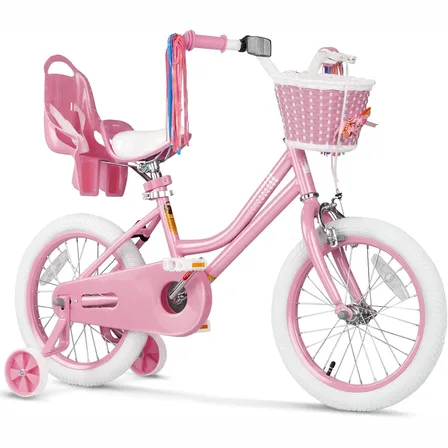
XJD Pink Girls' Bike – Kids 12/14/16 Inch Training Wheel Bicycle
The XJD Pink Girls' Bike is a training-wheel bicycle for girls ages 3 to 8 (ride…$149
$169 -
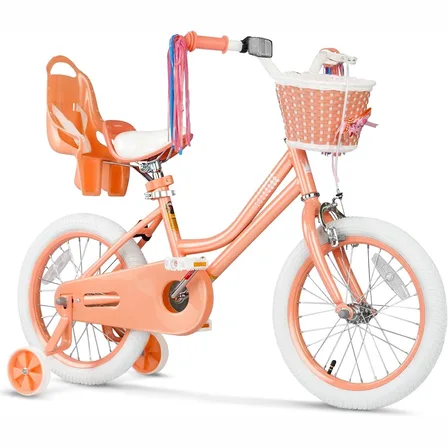
Girls 12/14/16 Inch Kids Bike by XJD with Training Wheels – Peach
The XJD Girls Bike in Peach is a training-wheel bike built for girls roughly 3 t…$149
$169 -

XJD Girls BMX Bike 12/14/16 Inch with Training Wheels – Pink Blue
The XJD Girls BMX Bike in Pink/Blue is built as a first pedal bike for kids roug…$99.99
$119.99