

A bike for a 6 year old
For a 6-year-old, start with a 16-inch bike, then confirm fit using measured height, inseam, reach, brake control and riding confidence.
The short answer by height
Age is only a starting point. In the XBikes sizing guide, a 16 Inch bike covers ages 4–7 and rider heights of 40–48 in (102–122 cm), so it is the usual first size to try for a 6-year-old. A shorter child may fit a 14 Inch bike, while a taller child may need an 18 Inch bike.
| Wheel size | XBikes starting range | Relevance at age six |
|---|---|---|
| 14 Inch | Ages 3–6; 37–45 in / 94–114 cm | Worth trying for a shorter rider |
| 16 Inch | Ages 4–7; 40–48 in / 102–122 cm | The main starting point |
| 18 Inch | Ages 5–9; 43–52 in / 109–132 cm | May suit a taller rider |
| 20 Inch | Ages 7–12; 48–60 in / 122–152 cm | Consider only if height and an individual fit check support it |
These ranges overlap deliberately. Do not choose a larger wheel merely because the child will eventually grow into it.
Measure before comparing bikes
Measure the child’s standing height without shoes. Then measure inseam from the floor to the crotch while the child stands upright, also without shoes. Record both measurements rather than estimating from clothing size or age.
Use standing height to select the first wheel size to try. Use the inseam during the physical fit check: the child needs comfortable clearance when straddling the bicycle. Because frame shapes differ, wheel diameter alone cannot prove that clearance.
Check the fit on the actual bicycle
Have the child try the bike instead of relying solely on its label. Check that the rider can mount and dismount without struggling, stand over the frame comfortably, and sit in a controlled position. The handlebars should be reachable without an extreme stretch or awkwardly locked arms.
Ask the child to operate each brake control fitted to the bicycle. They should be able to reach and use it confidently while maintaining their grip and steering position. Also watch a short, supervised start, stop and turn in a traffic-free area. If the rider cannot control the bike calmly, reconsider the size or setup.
When training-wheel models are relevant
The supplied catalog options are training-wheel bikes, so they are most relevant when a child still needs that type of support. Their available size labels let you compare 14 Inch and 16 Inch choices after measuring the rider; one option also offers a 20 Inch label. They do not establish fit by themselves.
 Light Pink XJD Girls' Bicycle with Basket & Training Wheels
Available in 12 Inch, 14 Inch, 16 Inch and 20 Inch labels. Its 14 Inch and 16 Inch options are the most relevant starting comparisons for many six-year-olds, while every size still requires an individual fit check.
 Blue XJD Girls Bike with Training Wheels – 12/14/16 Inch
This training-wheel bike is available in 12 Inch, 14 Inch and 16 Inch labels. Compare the 14 Inch and 16 Inch versions against the child’s measured height, inseam, reach, brake control and confidence.
 XJD Boys 12/14/16" Training Wheel Bike – Blue
Available with 12 Inch, 14 Inch and 16 Inch labels and training wheels. For a six-year-old, the 14 Inch and 16 Inch versions may be relevant depending on measured height and the result of an actual fit check.
Light Pink XJD Girls' Bicycle with Basket & Training Wheels is offered in 12 Inch, 14 Inch, 16 Inch and 20 Inch labels. For a typical six-year-old comparison, begin with its 14 Inch and 16 Inch versions. Consider its 20 Inch version only when the child measures at least 48 in (122 cm) and passes the complete fit check.
Blue XJD Girls Bike with Training Wheels – 12/14/16 Inch provides 12 Inch, 14 Inch and 16 Inch labels. Its 14 Inch and 16 Inch choices cover the most relevant supplied starting ranges for age six, subject to the child’s measurements and control.
XJD Boys 12/14/16" Training Wheel Bike – Blue likewise has 12 Inch, 14 Inch and 16 Inch labels. Compare its 14 Inch and 16 Inch versions using the same height, stand-over, reach and brake checks rather than treating wording in the title as fit evidence.
None of these supplied products has an 18 Inch label. If the child’s measurements and trial indicate that 18 Inch gives the appropriate fit, these catalog options are not the relevant match simply because they include neighboring sizes.
Choose support according to current confidence
A six-year-old who cannot yet start, balance, steer and stop consistently may find a training-wheel model relevant. A rider who already balances independently may not need training wheels, so compare bicycles that match that skill level instead of selecting support based on age.
Confidence does not justify oversizing. A nervous rider may have more difficulty controlling a bike that is too large, while an experienced rider still needs proper stand-over clearance, reach and brake access.
Complete the safety and setup checks
Use a bicycle helmet that fits properly, sits level and has straps adjusted according to the helmet manufacturer’s instructions. Before every ride, confirm that the child can see clearly, steer, brake and place themselves securely when stopping.
For assembly, adjustments, maintenance, compatibility, load limits and torque settings, follow the exact bicycle’s product manual. If instructions are missing or the setup is uncertain, use a qualified bicycle mechanic rather than guessing.
Your next decision
Measure the child now. If height is 40–48 in (102–122 cm), try a 16 Inch bike first; compare 14 Inch for a shorter rider and 18 Inch for a taller one. Buy only after the child demonstrates comfortable stand-over, natural reach, usable brakes and calm control on that exact bicycle.
Bikes for your next adventure
-

XJD Girls Bike for Kids Ages 3-8, 12/14/16 Inch with Training Wheels – Purple
The XJD Girls Bike in Purple is a training-wheel bicycle for kids ages 3 to 8, f…$149
$169 -
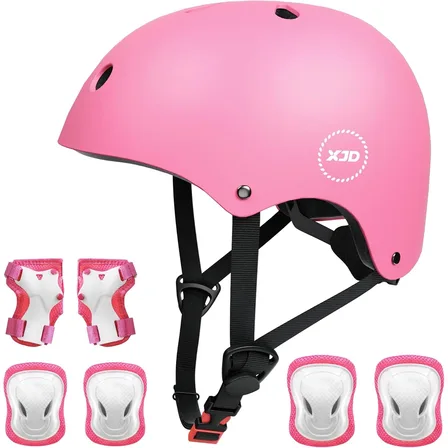
XJD Kids Helmet & Protective Gear Set for Girls, Pink
The XJD Kids Helmet & Protective Gear Set in Pink is a complete safety kit for g…$24.64
-

Pink Girls' 12/14/16" Bike by XJD – Basket & Doll Seat
The XJD Pink Girls' Bike with Basket & Doll Seat is made for riders 71–122 cm ta…$75.99
$99.99