

A bike for a 7 year old
For a 7-year-old, start by comparing 16-, 18- and 20-inch bikes, then choose by measured height and an in-person fit—not age alone.
Which wheel size should you check?
Under the XBikes starting points, a 16-inch bike covers riders 40–48 in (102–122 cm), an 18-inch bike covers 43–52 in (109–132 cm), and a 20-inch bike covers 48–60 in (122–152 cm). Their ranges overlap, so a seventh birthday does not identify one correct size.
If the child is below 48 in (122 cm), begin with the 16- and 18-inch possibilities that include their measured height. At 48 in (122 cm) or taller, add 20-inch bikes to the comparison. A smaller or less-confident rider may fit differently from a taller child of the same age, even when both appear in a wheel size’s stated range.
| Wheel size | XBikes age starting point | Rider-height starting point |
|---|---|---|
| 16 Inch | Ages 4–7 | 40–48 in / 102–122 cm |
| 18 Inch | Ages 5–9 | 43–52 in / 109–132 cm |
| 20 Inch | Ages 7–12 | 48–60 in / 122–152 cm |
These figures narrow the search; they do not replace trying the bicycle.
Measure before comparing bikes
Measure the child’s standing height without shoes. Also measure inseam: with feet slightly apart, measure from the floor to the crotch. Keep both measurements available while checking the bicycle, because wheel diameter alone does not reveal stand-over clearance or how the frame feels to that particular rider.
Do not deliberately buy an oversized bicycle for future growth. The child needs usable clearance and control now. If two sizes include the measured height, the deciding evidence should come from the actual fit, reach and riding confidence—not from choosing the larger number automatically.
Run this fit check on the actual bicycle
- Stand-over: Have the child straddle the bicycle with both feet firmly on the ground. Confirm there is comfortable clearance rather than contact with the frame.
- Starting and stopping: Ask the child to mount, start, stop and put a foot down without leaning or stretching awkwardly.
- Reach: With hands in the normal riding position, check that the child is not locked out, cramped or pulled too far forward.
- Brake control: Confirm the child can reach and operate the fitted controls reliably while maintaining a secure grip.
- Confidence: Watch for controlled steering and calm stops. A technically plausible size is not a good fit if the rider cannot control it confidently.
If any adjustment, assembly step or component setup is uncertain, follow the exact product manual or ask a qualified bicycle mechanic. Do not improvise torque settings or compatibility decisions.
How the supplied XBikes options relate
The supplied products are training-wheel bicycles, so they are most relevant when a 7-year-old still needs that type of support and fits an offered size. They help compare 16-inch catalog options, while one also provides a 20-inch label for a taller child’s fit check.
 Light Pink XJD Girls' Bicycle with Basket & Training Wheels
Offers 16 Inch and 20 Inch labels relevant to the main size comparison for a 7-year-old, plus training wheels. Confirm measured height, stand-over, reach, brake control and confidence before choosing.
 Blue XJD Girls Bike with Training Wheels – 12/14/16 Inch
Its 16 Inch label may suit a 7-year-old within the supplied 40–48 in (102–122 cm) starting range who needs training wheels, but an individual fit check remains necessary.
 XJD Boys 12/14/16" Training Wheel Bike – Blue
Provides a 16 Inch training-wheel option that may be relevant within the supplied height range. It has no supplied 18- or 20-inch label, so it will not suit every 7-year-old.
Light Pink XJD Girls' Bicycle with Basket & Training Wheels is offered in 12 Inch, 14 Inch, 16 Inch and 20 Inch labels. For this question, only its 16- and 20-inch versions are plausible starting comparisons, subject to the child’s measurements and an individual fit check. No 18-inch label is supplied.
Blue XJD Girls Bike with Training Wheels – 12/14/16 Inch is offered in 12 Inch, 14 Inch and 16 Inch. Its 16-inch version may be relevant for a 7-year-old measuring within 40–48 in (102–122 cm) who still needs training wheels. It does not provide an 18- or 20-inch option in the supplied facts.
XJD Boys 12/14/16" Training Wheel Bike – Blue likewise has 12 Inch, 14 Inch and 16 Inch labels. Consider its 16-inch version only when the rider’s measured height and real-world control support that size; the wording in the title is a catalog label, not proof of fit.
If the child fits the 18-inch starting range better, none of these three supplied products has a verified 18-inch label. If the child no longer needs training wheels, this set may also be the wrong comparison regardless of wheel size.
Finish the decision safely
Once the fit is confirmed, add a bicycle helmet that fits properly, sits level and has its straps used according to the helmet manufacturer’s instructions. Recheck that the rider can brake, steer and dismount comfortably in a low-traffic practice area.
Your next step is simple: measure height and inseam today, shortlist only the sizes containing the measured height, and have the 7-year-old try them. Choose the bicycle they can stand over, reach, brake and control now—even if that means rejecting a larger size or all three supplied training-wheel options.
Bikes for your next adventure
-

Pink Girls' 12/14/16" Bike by XJD – Basket & Doll Seat
The XJD Pink Girls' Bike with Basket & Doll Seat is made for riders 71–122 cm ta…$75.99
$99.99 -
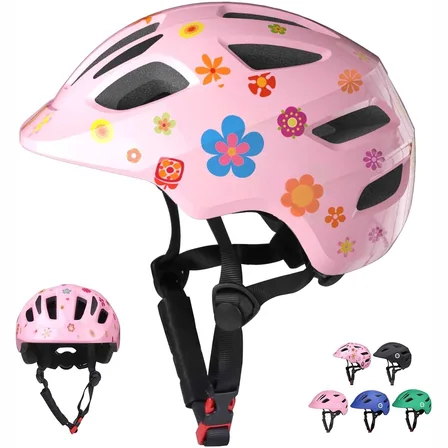
XJD Kids Bike Helmet for Girls, Pink Flowers, Adjustable (XS–S)
The XJD Kids Bike Helmet in Pink Flowers is an adjustable toddler-and-kids helme…$21.24
$24.99 -
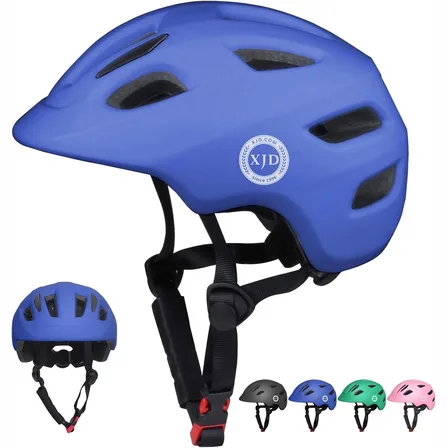
Blue XJD Kids' Bike Helmet, Adjustable Fit – Sizes XS & S
The Blue XJD Kids' Bike Helmet is a lightweight, adjustable helmet for toddlers …$20.39