

A child learning to ride a bike
A child learning to ride a bike needs a correctly fitted bicycle, a level helmet, a quiet practice area and short, confidence-led sessions.
Measure the rider before choosing a bike
Start with the child’s current height and inseam, measured while wearing the shoes they will ride in. Height gives you a wheel-size starting point; inseam helps you judge stand-over room and whether the child can put a foot down confidently. Age is only a secondary reference.
When the child tries the bicycle, check the whole riding position. They should be able to straddle it comfortably, reach the handlebars without stretching, steer without fighting the bike and operate its brakes with their hands in a controlled position. Do not buy an oversized bicycle for future growth: a bike that is difficult to mount, stop or steer can make learning harder.
Compare the relevant wheel-size starting points
| Wheel size | Starting age | Rider height |
|---|---|---|
| 12 Inch | 3–4 | 34–40 in / 86–102 cm |
| 14 Inch | 3–6 | 37–45 in / 94–114 cm |
| 16 Inch | 4–7 | 40–48 in / 102–122 cm |
| 18 Inch | 5–9 | 43–52 in / 109–132 cm |
| 20 Inch | 7–12 | 48–60 in / 122–152 cm |
| 24 Inch | 10–14 | 54–64 in / 137–163 cm |
| 26 Inch | Youth and adults over 60 in | Over 60 in / 153 cm |
These ranges overlap deliberately. If the child falls within two rows, compare both sizes in person rather than choosing automatically by age. Give priority to measured height, inseam, reach, brake control and current confidence. The appropriate choice is the bike the child can control now.
When the supplied training-wheel bikes are relevant
The catalog options below are relevant when the fit check points toward a 12, 14 or 16 Inch bicycle and the family wants to compare training-wheel models. Both supplied bicycles offer those three wheel-size labels, so the useful decision is the correct size and fit—not an assumption based on the model wording.
 Blue XJD Girls Bike with Training Wheels – 12/14/16 Inch
A training-wheel bike offered in 12 Inch, 14 Inch and 16 Inch labels; relevant only when the child’s measurements, reach, brake control and confidence confirm one of those sizes.
 XJD Boys 12/14/16" Training Wheel Bike – Blue
A blue training-wheel bike with 12 Inch, 14 Inch and 16 Inch labels. Its catalog title does not determine rider fit; use the individual measurement and control checks.
Blue XJD Girls Bike with Training Wheels – 12/14/16 Inch is categorized as a training-wheel bike and is available in 12 Inch, 14 Inch and 16 Inch labels. XJD Boys 12/14/16" Training Wheel Bike – Blue has the same supplied category and size-label choices.
The words “Girls” and “Boys” are catalog naming, not fit measurements. Choose between the models only after confirming the child’s physical fit and control. The supplied facts do not establish differences in brakes, weight, materials, geometry, load limits or included equipment beyond the stated training-wheel category, color wording and wheel-size labels.
If the rider’s measurements point to 18, 20, 24 or 26 Inch, neither supplied product is a substitute. They may illustrate the smaller training-wheel category, but the correct next step is to find the indicated size and perform a fresh fit check.
Teach one skill at a time
Use a flat, open area away from traffic, parked vehicles, slopes and other obstacles. Begin by showing the child how to mount, look ahead, hold a steady line and stop on request. Keep the first sessions short enough that attention and confidence remain intact.
- Practice mounting and placing hands and feet consistently.
- Rehearse braking and stopping before adding speed.
- Work on looking ahead and steering toward a clear marker.
- Add pedaling or longer glides only when stopping remains controlled.
- Introduce turns gradually in both directions.
Training wheels can support early pedaling and steering practice, but they do not remove the need to learn balance or controlled braking. Watch the child rather than following a fixed timetable. Reduce assistance only when they remain calm, stop reliably and can recover from a small wobble without panic.
Check the helmet and bicycle before each session
A bicycle helmet must fit properly, sit level on the head and use its straps according to the helmet manufacturer’s instructions. Replace guesswork with the instructions supplied for that exact helmet.
Before riding, check that the bicycle appears intact, the tires are ready for use, the steering and wheels move as intended, and the brakes respond predictably. Product-specific assembly, adjustment, maintenance, compatibility, load limits and torque procedures are not provided here. Follow the exact bicycle manual or ask a qualified bicycle mechanic to inspect or adjust the bike.
Decide the next step from control, not age
Measure the child today, identify the matching row, and have them try that size. Compare an overlapping size only if they can straddle, reach, steer and brake confidently on both. Select one of the supplied 12, 14 or 16 Inch training-wheel bikes only when its labeled size passes that individual check; otherwise continue the search in the size the rider actually needs.
Bikes for your next adventure
-
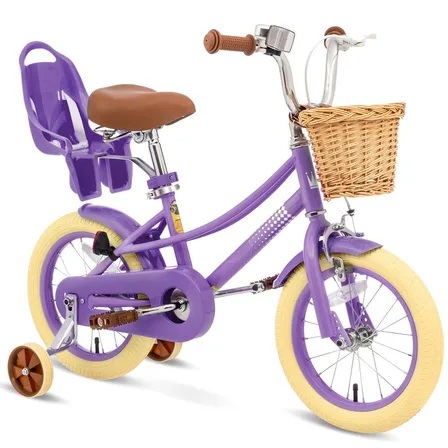
XJD Girls' Bike with Training Wheels, 12/14/16/20 Inch – Purple
The XJD girls' bike with training wheels in Purple is built to grow with your ri…$139
$159 -
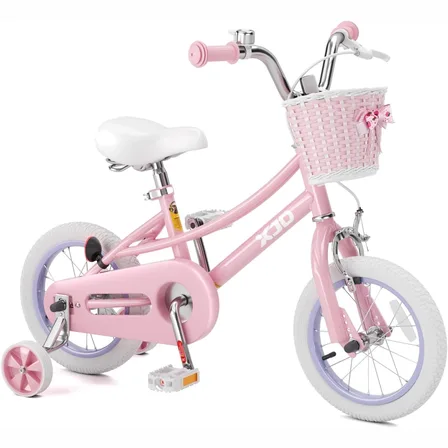
Pink 12/14/16/20" XJD Girls Bike with Training Wheels & Basket
The Pink XJD Girls Bike with Training Wheels & Basket is a first-bike pick f…$65.99
$75.99 -
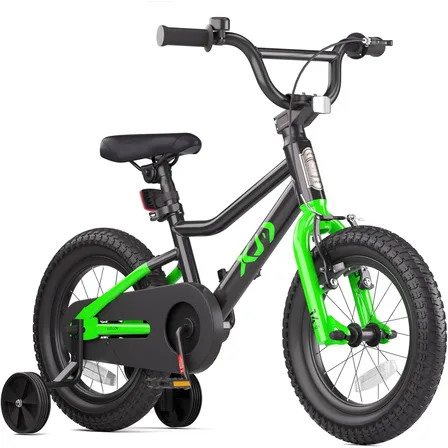
Black XJD Kids' BMX Bicycle with Training Wheels
The XJD Kids' BMX Bicycle with Training Wheels is built for children roughly 3 t…$99.99
$119.99