

A child riding a bicycle has a total mass of
A child riding a bicycle has a total mass equal to the child’s mass plus the bicycle’s mass and everything carried. Without those values, no numerical total can be calculated.
How to calculate the total mass
Use the relationship total mass = child + bicycle + helmet, clothing, bags, basket contents and other carried items. Record every value in the same unit, normally kilograms or pounds, and add them. Mass is not the same as weight in physics, although household scales commonly display a mass value.
For example, if the child and all worn or carried items measure 24 kg and the bicycle measures 9 kg, the combined mass is 33 kg. This example explains the calculation only; it is not a limit or specification for any XBikes product.
What a parent should measure
- Measure the child ready to ride. Include the helmet, normal clothing and footwear.
- Measure the bicycle separately. Include permanently attached accessories and anything already in its basket or carrier.
- Add removable cargo. Include a backpack, bottle, toys or other items that will travel with the rider.
- Compare the result with the exact manual. Use the manufacturer’s stated load limit if one is provided. The supplied catalog facts do not provide load limits for these bicycles.
A practical alternative is to weigh the child while holding the bicycle, if the scale can be used safely and within its own capacity, then add anything omitted. Do not ask a child to balance on a scale while seated on the bicycle.
Total mass does not determine bicycle size
The combined mass may matter when checking a stated load limit, but it does not select the wheel size. Measure the rider’s standing height and inseam, then check stand-over clearance, reach, brake control and present confidence on the actual bicycle. Have the child try it, and do not choose an oversized bicycle merely to allow room for growth.
| Wheel size | XBikes starting point |
|---|---|
| 12 Inch | Ages 3–4; 34–40 in / 86–102 cm |
| 14 Inch | Ages 3–6; 37–45 in / 94–114 cm |
| 16 Inch | Ages 4–7; 40–48 in / 102–122 cm |
| 18 Inch | Ages 5–9; 43–52 in / 109–132 cm |
| 20 Inch | Ages 7–12; 48–60 in / 122–152 cm |
| 24 Inch | Ages 10–14; 54–64 in / 137–163 cm |
| 26 Inch | Youth and adults over 60 in / 153 cm |
These ranges are starting points, not proof of fit. When age and measured height suggest different sizes, prioritize measured height and the individual fit check. The child should be able to stand over the bicycle, reach its controls comfortably and operate its brakes reliably.
How the listed bicycles relate to the question
The three catalog options are relevant only after the calculation and fit checks show that a training-wheel bicycle in one of their listed wheel sizes is appropriate. Their size labels let you compare possible starting points, but the supplied facts provide no bicycle mass or load capacity, so none can complete the total-mass calculation by itself.
 Light Pink XJD Girls' Bicycle with Basket & Training Wheels
Available in 12, 14, 16 and 20 Inch labels. Its title specifies a basket and training wheels, but no bicycle mass or load limit is supplied, so consult the exact manual.
 Blue XJD Girls Bike with Training Wheels – 12/14/16 Inch
A training-wheel bicycle offered with 12, 14 and 16 Inch labels. Those sizes can be compared with the XBikes height starting points, while individual fit and the exact manual remain necessary.
 XJD Boys 12/14/16" Training Wheel Bike – Blue
A blue training-wheel bicycle listed in 12, 14 and 16 Inch sizes. The “Boys” wording is a catalog label rather than fit evidence; use measurements, control and confidence.
Light Pink XJD Girls' Bicycle with Basket & Training Wheels is listed in 12 Inch, 14 Inch, 16 Inch and 20 Inch sizes. It is the only supplied option with a 20 Inch label, and its exact title identifies a basket and training wheels.
Blue XJD Girls Bike with Training Wheels – 12/14/16 Inch is listed in 12 Inch, 14 Inch and 16 Inch sizes. XJD Boys 12/14/16" Training Wheel Bike – Blue has the same three supplied size labels. Wording such as “Girls” or “Boys” is part of each catalog title, not evidence of fit; select according to measurements, control and confidence.
Check limits, setup and helmet fit
Before riding, compare the calculated total with any load information in the exact product manual. If a limit, assembly instruction, compatibility detail or torque value is missing or unclear, do not guess: follow that manual or ask a qualified bicycle mechanic. The catalog information supplied here cannot establish whether any listed bicycle supports a particular combined mass.
A bicycle helmet should fit properly, sit level and have its straps adjusted according to the helmet manufacturer’s instructions. Include the helmet and other carried equipment when calculating the real riding total.
Make the title-specific decision
Write down the child-ready-to-ride mass, bicycle mass and cargo mass, then add them. If any value or applicable limit is unknown, measure it or consult the exact manual before deciding. Only then use height, inseam, reach, brake control and confidence—not total mass or age alone—to choose among the available wheel sizes.
Bikes for your next adventure
-

XJD Girls Bike for Kids Ages 3-8, 12/14/16 Inch with Training Wheels – Purple
The XJD Girls Bike in Purple is a training-wheel bicycle for kids ages 3 to 8, f…$149
$169 -

Light Purple XJD Toddler Bike Helmet, Adjustable, Size XS (46–51 cm)
This Light Purple XJD toddler bike helmet is made for the smallest riders — the …$20.39
-
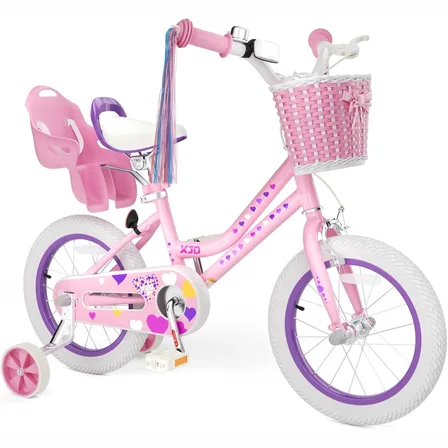
Light Pink XJD Girls' Bicycle with Basket & Training Wheels
The Light Pink XJD Girls' Bicycle with Basket & Training Wheels is a retro-style…$109.99
$129.99