

A bost bike for kids
A good bike for a child is the smallest suitable wheel size that fits now: measure the rider, check control in person, and never size up merely for growth.
Measure before choosing a wheel size
Start by measuring the child’s height without shoes. Measure inseam as well, because two children of equal height can have different leg lengths. Age is only a starting point; measured height, stand-over clearance, reach, brake control and present confidence decide whether a bicycle actually fits.
| Wheel size | Starting age | Rider height |
|---|---|---|
| 12 Inch | 3–4 | 34–40 in / 86–102 cm |
| 14 Inch | 3–6 | 37–45 in / 94–114 cm |
| 16 Inch | 4–7 | 40–48 in / 102–122 cm |
| 18 Inch | 5–9 | 43–52 in / 109–132 cm |
| 20 Inch | 7–12 | 48–60 in / 122–152 cm |
| 24 Inch | 10–14 | 54–64 in / 137–163 cm |
| 26 Inch | Youth and adults | Over 60 in / 153 cm |
Where height ranges overlap, do not automatically choose the larger wheel. Have the child try both relevant sizes and select according to the complete fit check below.
Check whether the bike fits today
Ask the child to stand over the bicycle and confirm that the frame does not prevent comfortable clearance. Seated, the rider should reach the handlebar naturally without stretching, twisting or locking the arms. They should be able to steer while looking ahead and remain composed when starting and stopping.
Check every brake control fitted to the exact bicycle. The child must be able to reach and operate it reliably with their hands in a normal riding position. If reach or control is doubtful, do not assume practice or growth will solve it. Try another size or configuration.
A short supervised trial should reveal whether the rider can mount, start, steer, stop and put a foot down without panic. The right bike is one the child can control now—not an oversized model bought to last longer.
Compare the supplied XBikes options
These catalog options help answer the title when the child needs a training-wheel bike in a 12, 14 or 16 Inch size; one option also offers a 20 Inch label. The useful comparison is available wheel-size labels and listed equipment, followed by an individual fit check.
 Light Pink XJD Girls' Bicycle with Basket & Training Wheels
Relevant for riders who fit a 12, 14, 16 or 20 Inch option and need training wheels; its supplied title also specifies a basket. Confirm individual fit before choosing.
 Blue XJD Girls Bike with Training Wheels – 12/14/16 Inch
A training-wheel option with supplied 12, 14 and 16 Inch labels. Compare the child’s measured height with the XBikes starting points, then verify stand-over, reach and control.
 XJD Boys 12/14/16" Training Wheel Bike – Blue
A blue training-wheel bike offered under 12, 14 and 16 Inch labels. It is relevant only when one of those sizes passes the rider’s individual fit and control check.
Light Pink XJD Girls' Bicycle with Basket & Training Wheels is listed in 12, 14, 16 and 20 Inch labels. It is the only supplied option extending to 20 Inch and the only title that specifies a basket. Its 20 Inch version is a starting point for riders measuring 48–60 in / 122–152 cm, but fit and confidence still govern.
Blue XJD Girls Bike with Training Wheels – 12/14/16 Inch is available in 12, 14 and 16 Inch labels. XJD Boys 12/14/16" Training Wheel Bike – Blue has the same supplied size-label range. Their titles differ in catalog wording, but the provided facts do not establish differences in frame geometry, components, weight or performance.
These three products are relevant only if the rider fits one of their supplied size labels and training wheels suit the child’s current needs. They are not relevant when the fit check points to 18, 24 or 26 Inch, or when the family wants a configuration not established by the supplied facts.
Decide whether training wheels fit the rider’s stage
Training wheels may be relevant when a child needs lateral support while developing pedaling, steering and stopping confidence. Their presence does not correct a bicycle that is too large, too small or difficult for the child to control.
Before ordering, compare the rider’s measured height with the table, then confirm the chosen model can be adjusted for the individual rider according to its exact manual. Do not infer adjustment range, training-wheel compatibility, load limits or assembly details from the product title. For any missing specification, consult that product’s manual or a qualified bicycle mechanic.
Complete the safety and handover checks
- Have the child try the bicycle rather than relying on an age label.
- Recheck stand-over clearance, seated reach, steering control and access to every fitted brake control.
- Use a bicycle helmet that fits properly, sits level and has straps adjusted according to the helmet manufacturer’s instructions.
- Follow the exact bicycle manual for assembly, adjustment, maintenance and torque requirements; use a qualified bicycle mechanic when anything is unclear.
- Begin in a flat, open area away from traffic, with close adult supervision.
For “A bost bike for kids,” the practical decision is simple: record height and inseam today, shortlist only matching wheel sizes, and buy only after the child demonstrates comfortable stand-over, reach, braking and control on the actual fit.
Bikes for your next adventure
-

XJD Girls Bike for Kids Ages 3-8, 12/14/16 Inch with Training Wheels – Purple
The XJD Girls Bike in Purple is a training-wheel bicycle for kids ages 3 to 8, f…$149
$169 -
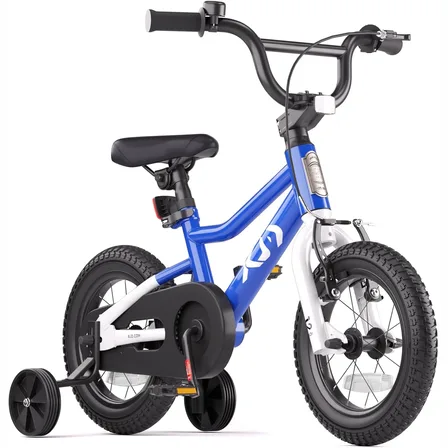
XJD Boys & Girls BMX Bike with Training Wheels, 12/14/16" – Blue
The XJD Boys & Girls BMX Bike in Blue is a first pedal bike for kids roughly age…$99.99
$119.99 -

XJD Girls BMX Bike 12/14/16 Inch with Training Wheels – Pink Blue
The XJD Girls BMX Bike in Pink/Blue is built as a first pedal bike for kids roug…$99.99
$119.99