

A child's first bicycle has 12 inch tires
A child’s first bicycle can have 12-inch tires when the rider measures 34–40 in (86–102 cm), but wheel size alone does not confirm a safe, comfortable fit. Measure the child, then check stand-over clearance, reach, brake control and confidence on the actual bicycle.
Start with height, not the birthday
XBikes uses 12 inches as a starting wheel size for ages 3–4 and rider heights of 34–40 in (86–102 cm). Age is only a rough guide: two children of the same age can have different proportions, reach and coordination.
Measure height with the child standing upright without shoes, heels against a wall and eyes level. Mark the top of the head and measure from the floor. Also measure inseam from the floor to the crotch while the child stands naturally. Record both measurements rather than estimating from clothing size.
If the measured height is outside the 12-inch range, compare the next relevant starting point instead of assuming the child will grow into the bicycle. XBikes places 14-inch wheels at 37–45 in (94–114 cm), generally ages 3–6, and 16-inch wheels at 40–48 in (102–122 cm), generally ages 4–7. Overlapping ranges mean that an actual fit check must decide between sizes.
What to check on a 12-inch bicycle
Have the child try the exact bicycle. When standing over it, the child needs usable clearance rather than contact with the frame. When seated, the child should reach the handlebar without stretching, leaning excessively or locking the elbows.
Ask the child to demonstrate each control while remaining balanced. If the bicycle has hand-operated brakes, the child must be able to reach and operate them reliably. Check whether the child can start, stop, steer and place a foot down without panic. A nominally correct wheel size is still unsuitable when reach, control or confidence is poor.
- Height: compare the measured result with 34–40 in (86–102 cm).
- Inseam and stand-over: confirm comfortable clearance on the actual frame.
- Reach: make sure steering does not require an awkward stretch.
- Braking: verify that the child can reach and use the fitted controls.
- Confidence: watch a controlled start, turn and stop in a traffic-free area.
Do not size up only for growth
An oversized first bicycle can make mounting, steering and stopping harder. Do not choose a 14- or 16-inch model merely because it may last longer. Move above 12 inches only when the child’s measurements and an individual trial support the larger size.
A child at 37–40 in (94–102 cm) falls within both the supplied 12- and 14-inch starting ranges. A child at exactly 40 in (102 cm) also reaches the start of the 16-inch range. In these overlaps, compare stand-over clearance, handlebar reach, brake operation and present confidence on each candidate. The larger wheel is not automatically the correct choice.
How the supplied XBikes options relate
The supplied catalog choices help because both offer 12-, 14- and 16-inch SKU labels, allowing parents to compare the requested 12-inch option with adjacent sizes without treating them as equivalent. Both are categorized as Training Wheel Bikes; the catalog supplies no further fit, component or construction details.
 XJD Girls Bike for Kids Ages 3-8, 12/14/16 Inch with Training Wheels – Purple
Available in 12 Inch, 14 Inch and 16 Inch labels and categorized as a Training Wheel Bike. Its title’s age wording is a catalog label, so confirm fit from measured height and an individual trial.
 Girls 12/14/16 Inch Kids Bike by XJD with Training Wheels – Peach
A Training Wheel Bike offered with 12 Inch, 14 Inch and 16 Inch labels. It is relevant for comparing the requested size with adjacent options, but each size requires its own fit check.
XJD Girls Bike for Kids Ages 3-8, 12/14/16 Inch with Training Wheels – Purple is available with 12 Inch, 14 Inch and 16 Inch labels. The age wording is part of its exact catalog title, not evidence that it fits every child in that span. Use the measured-height ranges and an individual trial.
Girls 12/14/16 Inch Kids Bike by XJD with Training Wheels – Peach likewise lists 12 Inch, 14 Inch and 16 Inch options and belongs to the Training Wheel Bikes category. Choose among those labels through measurements and hands-on fit, not color or an assumption that neighboring sizes are interchangeable.
Prepare the bicycle and helmet correctly
Before riding, follow the exact product manual for assembly, adjustments, maintenance, load limits, compatibility and any torque requirements. Those details are not supplied here and should not be guessed. If the instructions are missing, unclear or beyond your tools, use a qualified bicycle mechanic.
A bicycle helmet must fit the child properly, sit level and have its straps adjusted according to the helmet manufacturer’s instructions. Recheck the fit whenever the helmet or clothing changes. Begin practice in a level, traffic-free area with close adult supervision.
Make the 12-inch decision
Choose a 12-inch first bicycle only if the child measures within the 34–40 in (86–102 cm) starting range and the actual bicycle passes the stand-over, reach, braking and confidence checks. If any check fails, do not rely on the tire label: compare another size or frame in person before buying.
Bikes for your next adventure
-
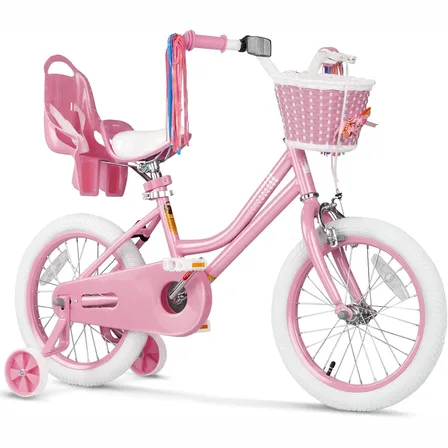
XJD Pink Girls' Bike – Kids 12/14/16 Inch Training Wheel Bicycle
The XJD Pink Girls' Bike is a training-wheel bicycle for girls ages 3 to 8 (ride…$149
$169 -

Light Pink XJD Girls' Bicycle with Basket & Training Wheels
The Light Pink XJD Girls' Bicycle with Basket & Training Wheels is a retro-style…$109.99
$129.99 -
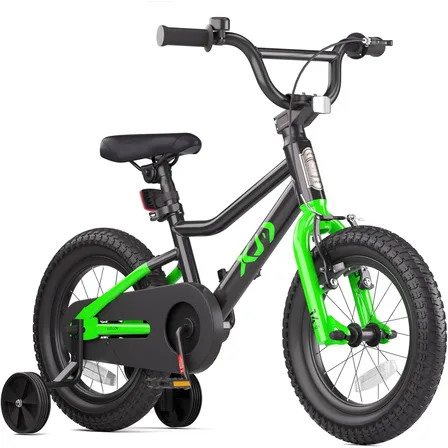
Black XJD Kids' BMX Bicycle with Training Wheels
The XJD Kids' BMX Bicycle with Training Wheels is built for children roughly 3 t…$99.99
$119.99