

Are child bike trailers safe
Child bike trailers can be safe when the trailer fits the child and towing bicycle, is assembled exactly as directed, and is used in suitable conditions.
What parents should check first
Safety depends on the complete setup, not simply on choosing a trailer-shaped product. Before riding, identify the trailer’s stated child-size requirements, passenger and cargo limits, towing-bike compatibility, approved attachment method, and permitted riding conditions. Those details must come from the exact trailer manual.
Measure the child as the manufacturer directs and check that the seated child has enough room without contacting the frame or cover. Confirm that the restraint can be adjusted securely and that the child can wear a properly fitted bicycle helmet without the helmet forcing the head into an awkward position. The U.S. Consumer Product Safety Commission advises that a helmet should sit level and that its straps should be adjusted according to the helmet manufacturer’s instructions.
Compare the trailer, bicycle and route
| Check | What to compare |
|---|---|
| Child fit | The child’s measurements and seated position against the trailer manual. |
| Capacity | The combined passenger and cargo load against the stated limit. |
| Connection | The tow bicycle and attachment point against the compatibility instructions. |
| Condition | Fasteners, restraint, tires, wheels, frame, cover and connection parts for damage or looseness. |
| Route | Traffic, surface, visibility, turns, slopes and stopping space against the manufacturer’s permitted use. |
A trailer changes the bicycle’s width, length, turning path, acceleration and braking. The rider should therefore practise with the empty trailer in a traffic-free area, then repeat the handling check with the permitted load before taking a child onto a route. If the bicycle feels unstable, the connection moves unexpectedly, or braking and turning cannot be controlled confidently, do not carry the child.
Use it in a way that reduces avoidable risk
- Complete assembly and every pre-ride check specified in the manual.
- Secure the child with the supplied restraint exactly as instructed, and secure cargo so it cannot shift.
- Use all required attachment and retention components; do not improvise incompatible parts.
- Choose a low-traffic, predictable route with enough clearance for the trailer.
- Make the trailer conspicuous using only visibility equipment approved for that model.
- Ride smoothly and leave additional room for turns and stops.
Follow local rules governing trailers, passengers and helmets. Stop immediately after a collision, attachment problem, damaged component or unexplained change in handling. For missing torque values, maintenance intervals, repairs, load limits or compatibility information, consult the exact product manual or a qualified bicycle mechanic rather than guessing.
When a child bike trailer is not appropriate
Do not use a trailer when the child falls outside its stated fit requirements, cannot maintain the position required by its instructions, or cannot use its restraint and helmet correctly. It is also unsuitable when the trailer exceeds its load limit, lacks confirmed compatibility with the towing bicycle, has damaged or missing parts, or cannot be assembled precisely as specified.
Conditions matter too. A compatible trailer does not make poor visibility, hazardous surfaces, dense traffic or uncertain bike handling acceptable. If the route or rider does not provide a comfortable margin for controlling the longer, wider setup, postpone the trip or choose another form of transport.
How the supplied kids’ bikes relate to this decision
The supplied catalog items are training-wheel bicycles, not child bike trailers. They do not answer trailer capacity, attachment or passenger-fit questions. They become relevant only when comparing trailer transport with a child riding a separate, individually fitted bicycle.
XJD Kids' Training Wheel Bike for Boys & Girls, 12/14/16 Inch – White offers 12 Inch, 14 Inch and 16 Inch choices. Girls' Training Wheel Bike by XJD, 12–20 Inch Wheels – Blue offers 12 Inch, 14 Inch, 16 Inch and 20 Inch choices. These are comparison options for a child ready to control a bicycle independently; they are not trailer substitutes or evidence that trailer travel is safe.
 XJD Kids' Training Wheel Bike for Boys & Girls, 12/14/16 Inch – White
A training-wheel bicycle offered in 12 Inch, 14 Inch and 16 Inch sizes. It is relevant only when comparing trailer transport with a separately fitted bicycle for a child ready to ride.
 Girls' Training Wheel Bike by XJD, 12–20 Inch Wheels – Blue
A training-wheel bicycle with 12 Inch, 14 Inch, 16 Inch and 20 Inch options. Use it as a size comparison for independent riding, not as a substitute for trailer safety checks.
If the child may be ready for a separate bicycle
Measure the child’s standing height, then use wheel size only as a starting point: 12 Inch corresponds to 34–40 in / 86–102 cm and ages 3–4; 14 Inch to 37–45 in / 94–114 cm and ages 3–6; 16 Inch to 40–48 in / 102–122 cm and ages 4–7; and 20 Inch to 48–60 in / 122–152 cm and ages 7–12.
Height and age do not establish fit by themselves. Have the child try the bicycle and check inseam and stand-over clearance, reach, brake control and present confidence. Consistent with American Academy of Pediatrics guidance, do not buy an oversized bicycle merely for future growth. Any age-like wording in a catalog title is a label, not fit evidence.
Make the decision
Use the trailer only after the child’s fit, total load, towing-bike compatibility, attachment, condition and route all pass the exact manual’s requirements and the adult can control the complete setup. If any answer is uncertain, do not ride with the child; find the manual or ask a qualified bicycle mechanic before the next trip.
Bikes for your next adventure
-
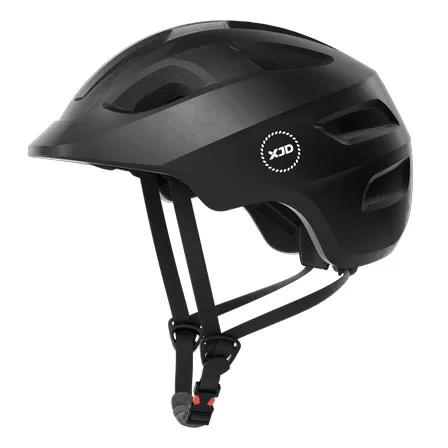
Kids Multi-Sport Bike Helmet by XJD – Black
7 reviews
The XJD Kids Multi-Sport Bike Helmet in Black is a lightweight, adjustable helme…$59.99
$49 -

Kids Bike Helmet by XJD for Girls – Pink
The XJD Kids Bike Helmet in Pink is a lightweight multi-sport helmet for girls r…$59.99
$99 -

Blue XJD Kids Bike Helmet for Boys & Girls
The Blue XJD Kids Bike Helmet is a lightweight, adjustable multi-sport helmet fo…$59.99
$99