

Are children bike trailers safe
Children’s bike trailers can be safe when the trailer fits the child and bicycle, is assembled exactly as directed, and is used with a properly fitted helmet on suitable routes.
Check whether your child is ready
Start with the trailer manufacturer’s exact requirements. Confirm the permitted passenger age, seated height, weight and number of occupants in the manual; these figures are not interchangeable between trailers. If any label is missing or unreadable, obtain the correct manual or ask a qualified bicycle mechanic before riding.
Measure the child’s weight and seated height, then compare both with the stated limits. Check that the child can sit securely for the whole trip and that the harness fits as the manufacturer describes. A child who cannot meet those requirements should not ride in that trailer.
Inspect the complete bicycle-and-trailer setup
Compatibility involves more than attaching a hitch. Verify that the trailer, hitch and bicycle are approved to work together, using the manuals for the exact models. Follow their assembly, load, maintenance and torque instructions; do not estimate an unspecified limit or tightening value.
- Confirm that the hitch and every required retention device are fitted correctly.
- Check tires, wheels, fasteners, harnesses and the trailer frame for damage or unusual movement.
- Secure passengers and cargo in their designated positions without exceeding any stated limit.
- Make sure fabric, straps and loose objects cannot contact a wheel or moving part.
- Test the bicycle’s steering and brakes in a traffic-free area before carrying a child.
Stop if a part is damaged, the connection will not lock as described, or the loaded bicycle cannot be controlled confidently. Use a qualified bicycle mechanic when compatibility or assembly remains uncertain.
Use helmets and choose the route deliberately
Each child should wear a bicycle helmet that fits properly, sits level and has straps adjusted according to the helmet manufacturer’s instructions. The towing rider should also use an appropriate, properly fitted helmet.
A trailer makes the bicycle longer, wider and heavier. Allow extra room for turns and more distance for stopping. Begin slowly away from traffic so the rider can feel how the loaded setup responds. Avoid routes, surfaces, weather or visibility conditions prohibited by either manual. Even where use is permitted, choose calm, predictable routes and reduce speed around corners, slopes, obstacles and other people.
Before every departure, repeat the attachment, harness, helmet, tire and brake checks. During the ride, stop if the child becomes uncomfortable, a connection changes, handling worsens or conditions cease to be suitable.
What to compare before choosing a trailer
| Measure or verify | What to compare it with |
|---|---|
| Child’s weight and seated height | The exact trailer manual’s passenger limits |
| Bicycle and hitch model | The manufacturer’s compatibility instructions |
| Helmet fit | The helmet maker’s fitting and strap directions |
| Loaded handling | Your ability to steer, stop and turn in a traffic-free test |
| Route conditions | Manual restrictions and the rider’s current confidence |
Do not rely on appearance, a child’s age alone or assumptions based on another trailer. If a required specification is unavailable, pause the purchase or ride until the manufacturer or a qualified mechanic can resolve it.
Where the supplied XBikes products fit
The supplied catalog contains training-wheel bicycles rather than child trailers. These options help answer the title only as later independent-riding comparison points: they do not establish trailer safety, replace a trailer, or prove that a child is ready to ride alone. Each is offered in 12, 14, 16 and 20 Inch wheel labels, so individual fit still decides whether any option is relevant.
 Girls' Training Wheel Bike by XJD, 12–20 Inch Wheels – Blue
A training-wheel bicycle offered in 12, 14, 16 and 20 Inch labels. It is relevant as an independent-riding comparison after trailer use, subject to measured fit, not as a trailer or trailer-safety substitute.
 XJD Girls' Bike with Training Wheels, 12/14/16/20 Inch – Purple
This purple training-wheel bicycle has supplied 12, 14, 16 and 20 Inch choices. Compare rider height and individual control before considering it; the catalog facts do not establish any trailer compatibility or trailer safety.
 XJD Kids Bike for Girls – Pink, 12/14/16/20 Inch with Training Wheels
This pink kids bike with training wheels is listed in 12, 14, 16 and 20 Inch sizes. It may suit a later independent-riding fit comparison, but it does not replace or verify a child trailer.
Girls' Training Wheel Bike by XJD, 12–20 Inch Wheels – Blue, XJD Girls' Bike with Training Wheels, 12/14/16/20 Inch – Purple, and XJD Kids Bike for Girls – Pink, 12/14/16/20 Inch with Training Wheels share the same supplied size choices: 12, 14, 16 and 20 Inch. The catalog facts distinguish their titles and colors, but provide no trailer compatibility, brake type, weight, material, certification or other safety evidence.
As starting points only, XBikes associates 12 Inch with 34–40 in (86–102 cm), ages 3–4; 14 Inch with 37–45 in (94–114 cm), ages 3–6; 16 Inch with 40–48 in (102–122 cm), ages 4–7; and 20 Inch with 48–60 in (122–152 cm), ages 7–12. Measure rider height first. Then have the child try the bicycle and check inseam clearance, stand-over, reach, brake control and current confidence. Never buy an oversized bicycle merely for growth.
Make the safe next decision
For trailer travel, proceed only after the measured child, exact trailer, hitch, bicycle and route all satisfy their manuals and the rider can control the loaded setup. Consider the three catalog bicycles only when the child is moving toward independent riding and passes an individual fit check; otherwise, they are not relevant to the immediate trailer decision.
Bikes for your next adventure
-
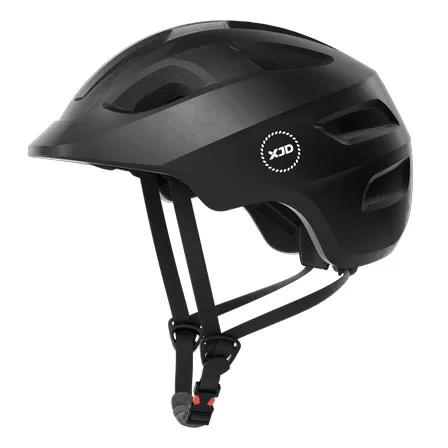
Kids Multi-Sport Bike Helmet by XJD – Black
7 reviews
The XJD Kids Multi-Sport Bike Helmet in Black is a lightweight, adjustable helme…$59.99
$49 -

Kids Bike Helmet by XJD for Girls – Pink
The XJD Kids Bike Helmet in Pink is a lightweight multi-sport helmet for girls r…$59.99
$99 -

Blue XJD Kids Bike Helmet for Boys & Girls
The Blue XJD Kids Bike Helmet is a lightweight, adjustable multi-sport helmet fo…$59.99
$99