

Are kids bike trailers safe
Kids bike trailers can be safe when the trailer fits the child and towing bicycle, is attached exactly as directed, and is used conservatively.
What makes a trailer suitable?
Begin with the trailer manufacturer’s limits and instructions. Confirm that your child meets every stated requirement, including sitting ability, size and any minimum or maximum limits. Do not estimate missing specifications or assume that a child who fits the seat can safely ride.
Check that the seat, harness and protective enclosure hold the child in the intended position without restricting breathing or placing straps against the neck. The child’s helmet should fit properly, sit level and have its straps adjusted according to the helmet manufacturer’s instructions. Make sure the helmet and head have adequate clearance inside the trailer.
If the manual is missing, the label is unreadable or the child cannot sit securely in the required position, do not use the trailer until the manufacturer or a qualified bicycle mechanic has confirmed what is appropriate.
Measure and compare before attaching it
Record the child’s current height and any other measurement required by the trailer manual. Then compare those measurements with its stated passenger limits rather than relying on age alone. Also check the combined passenger and cargo load against the exact manual; no universal load limit should be assumed.
For the towing bicycle, compare the hitch instructions with the bicycle’s frame, axle or attachment point. Compatibility cannot be judged by wheel size alone. Suspension parts, axle designs, accessories and unusual frames may affect whether a hitch can be installed correctly. Use the required hardware and torque values from the manuals, or ask a qualified bicycle mechanic to inspect the setup.
Run a stationary safety check
- Confirm that the hitch and every secondary retention device are installed as shown in the manual.
- Check tires, wheels, fasteners, fabric, frame and harness for damage, looseness or excessive wear.
- Secure cargo so it cannot shift, interfere with the child or change the trailer’s balance.
- Verify that the towing bicycle’s brakes, tires and steering work properly with no trailer attached.
- Make sure visibility equipment and any supplied safety flag are positioned according to the trailer instructions.
Never improvise a hitch repair, substitute unidentified hardware or guess at tightening specifications. Stop using equipment that is damaged or cannot be secured as designed.
Test the combination without a child
A trailer makes the bicycle longer and can change acceleration, braking, turning and balance. First tow it empty in a traffic-free area. Then test it with secured cargo while staying within the manual’s limits. Practice starting, stopping and making wide turns at low speed.
Do not carry a child if the bicycle feels unstable, the hitch moves unexpectedly, a wheel rubs, or you cannot stop smoothly and predictably. A mechanic should resolve those issues before passenger use.
Choose a low-risk ride
Use smooth, predictable routes away from motor traffic wherever possible. Slow down before corners and uneven surfaces, allow extra stopping distance, and avoid abrupt steering. Curbs, potholes, steep slopes, loose ground and narrow gaps can upset or damage a trailer even when the towing bicycle passes them.
Check the passenger regularly. Stop if the child becomes distressed, unbuckles the harness, shifts out of position or if conditions deteriorate. A properly fitted helmet and harness are essential precautions, but they do not make every route, speed or surface appropriate.
How the supplied bicycle is relevant
The supplied catalog item is not a bike trailer. The XJD Girls' Bike with Training Wheels, 12/14/16/20 Inch – Purple is relevant only when comparing trailer use with a later move to independent riding. Its available labels are 12 Inch, 14 Inch, 16 Inch and 20 Inch; they do not establish trailer compatibility or prove that a child is ready to stop riding as a passenger.

As XBikes starting points, 12 Inch corresponds to 34–40 in / 86–102 cm, 14 Inch to 37–45 in / 94–114 cm, 16 Inch to 40–48 in / 102–122 cm, and 20 Inch to 48–60 in / 122–152 cm. The associated age starting points are 3–4, 3–6, 4–7 and 7–12 respectively, but measured fit takes priority.
Have the child try the bicycle. Check stand-over clearance, reach, brake control and current confidence, and do not buy an oversized bicycle for growth. Because no trailer, hitch or compatibility information is supplied for this product, it should not be treated as a towing recommendation.
Make the final safety decision
Use the trailer only if the child fits its stated requirements, the helmet and harness fit correctly, the hitch is explicitly compatible, the entire setup passes inspection, and you can control it confidently on the intended route. If any limit, attachment detail or fit question remains uncertain, pause the ride and consult the exact product manual or a qualified bicycle mechanic.
Bikes for your next adventure
-
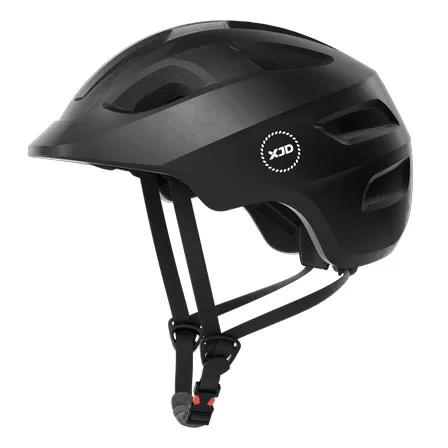
Kids Multi-Sport Bike Helmet by XJD – Black
7 reviews
The XJD Kids Multi-Sport Bike Helmet in Black is a lightweight, adjustable helme…$59.99
$49 -

Kids Bike Helmet by XJD for Girls – Pink
The XJD Kids Bike Helmet in Pink is a lightweight multi-sport helmet for girls r…$59.99
$99 -

Blue XJD Kids Bike Helmet for Boys & Girls
The Blue XJD Kids Bike Helmet is a lightweight, adjustable multi-sport helmet fo…$59.99
$99