

Are rear child bike seats safe
Rear child bike seats can be safe when the seat fits the bicycle and child, is installed exactly as directed, and is checked before every ride.
Decide whether the child and bicycle are suitable
Start with the instructions for the exact rear seat and bicycle. Confirm that the bicycle can accept that seat and that the child is within every stated size and load limit. Never estimate compatibility from appearance or substitute a similar model’s instructions.
The child must meet the seat manufacturer’s developmental requirements and remain securely positioned throughout the ride. If the child cannot do that, exceeds a limit, or cannot wear the required restraints and helmet correctly, do not use the seat.
Ask a qualified bicycle mechanic to check the combination when compatibility is unclear. The mechanic should also assess whether the bicycle, rack or frame attachment points, and seat form an approved system. Do not invent mounting methods or add unapproved hardware.
Measure and compare before installation
Record the child’s current measurements, including body weight and any dimensions requested by the seat manual. Compare them with the seat’s stated limits. Then identify the bicycle’s exact model and inspect its manual for rear-seat or rack compatibility.
- Child: Compare current measurements and developmental readiness with the seat manual.
- Bicycle: Confirm the permitted mounting location, attachment system and load limits.
- Helmet: Choose a bicycle helmet that fits properly, sits level and has straps adjusted according to its manufacturer’s instructions.
- Clearance: Follow the manual’s requirements for clearance from the wheel, moving parts, saddle and rider.
A rear seat raises and shifts the bicycle’s load, so the adult rider should also be able to mount, stop, balance and control the loaded bicycle confidently. If handling feels unstable, stop and reassess rather than trying to adapt during a trip.
Install and inspect the seat correctly
Use only the parts and sequence specified for the exact seat and bicycle. Follow all stated fastener, maintenance and torque instructions. Because those details are model-specific and are not supplied here, consult the manuals or have a qualified bicycle mechanic complete and inspect the installation.
Before each ride, check that the seat and restraints are secure, required guards or foot supports are correctly positioned, straps are not loose or twisted, and nothing can contact the wheel or drivetrain. Check the bicycle’s tires, steering and brakes according to its manual. Replace or repair damaged, missing or loose components before carrying a child.
Make the first ride a controlled test
Practice loading and unloading with the bicycle held securely and away from traffic. Do not leave a child unattended in a mounted seat, even if the bicycle appears supported. Sudden movement can upset its balance.
Begin in a quiet, level area. Test starting, gentle turning and controlled braking at low speed. Allow extra space for stopping and avoid abrupt maneuvers. Recheck the mounting after the initial test as directed by the manufacturer. If the bicycle flexes unexpectedly, the seat shifts, restraints loosen, or control is poor, discontinue use and seek a mechanic’s advice.
When these XBikes products are relevant
The supplied catalog products are children’s bicycles, not rear child seats. They do not establish whether a rear seat fits an adult bicycle and are not substitutes for one. They are relevant only as comparison points when a family is deciding whether a child may be ready to move from being carried to riding a correctly fitted bicycle.
The Black XJD Kids' BMX Bicycle with Training Wheels is a Kids' BMX Bikes option offered in 12 Inch, 14 Inch and 16 Inch labels. The Pink Girls' 12/14/16" Bike by XJD – Basket & Doll Seat is a Training Wheel Bikes option with the same three available size labels. The title’s “Doll Seat” wording describes the catalog product; it must not be treated as a child-passenger seat.
 Black XJD Kids' BMX Bicycle with Training Wheels
A children’s BMX bicycle offered in 12 Inch, 14 Inch and 16 Inch sizes; relevant only when comparing a transition to independent riding, not for determining rear-seat compatibility.
 Pink Girls' 12/14/16" Bike by XJD – Basket & Doll Seat
A training-wheel bicycle offered in 12 Inch, 14 Inch and 16 Inch sizes. Its catalog-listed doll seat is not a child-passenger seat or evidence about rear-seat safety.
Fit an independent bicycle by measurement
If comparing those bicycles, use wheel size only as a starting point. XBikes associates 12 Inch with 34–40 in (86–102 cm), 14 Inch with 37–45 in (94–114 cm), and 16 Inch with 40–48 in (102–122 cm). The overlapping ranges make an individual fit check essential.
Have the child try the bicycle. Prioritize measured height, inseam, comfortable stand-over, reach, brake control and current confidence over age alone. Do not buy an oversized bicycle merely for growth. A child who cannot reach the controls or manage the bicycle confidently is not ready for that fit, regardless of the size label.
Make the safe-use decision
Use a rear child bike seat only when the exact manuals confirm compatibility, the child meets every requirement, the helmet and restraints fit, and the adult can control the loaded bicycle. Otherwise, pause and consult a qualified mechanic. Consider either listed children’s bicycle only when the child is ready to ride independently and passes an in-person fit check.
Bikes for your next adventure
-

XJD Pink Beach Cruiser for Girls – Rear Rack & V-Brake
The XJD Pink Beach Cruiser for girls is the step-up bike for riders who've outgr…$179.99
$209.99 -

Flower Pink XJD Girls Bike with Doll Seat & Basket
The XJD Flower Pink girls' bike is made for riders 71–122 cm tall (roughly ages …$69.99
-
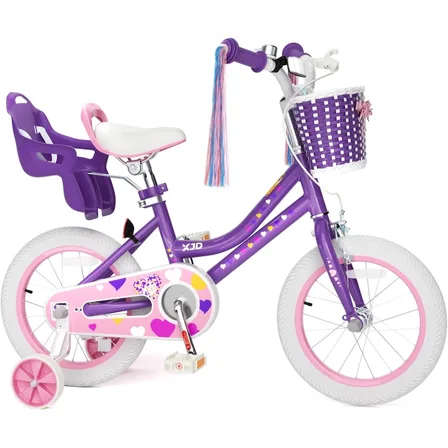
Purple XJD Girls' Bike with Doll Seat & Basket
For girls 71–122 cm tall (about ages 3–7), this XJD girls' bike in Purple pairs …$75.99
$99.99