

Are toddler bike seats safe
Toddler bike seats can be safe when the child, seat and bicycle are compatible, every restraint is used correctly, and the adult rides cautiously. Before riding, verify the seat manual’s child limits, bicycle requirements and installation instructions; if any point is unclear, use a qualified bicycle mechanic.
Check whether the child is ready
Do not decide from the word toddler alone. The seat manufacturer’s manual should specify the child’s permitted size, developmental requirements and any other restrictions. Measure the child as directed and compare the result with those limits. Never exceed a stated load limit or use a seat for a child who does not meet every requirement.
The child must remain correctly positioned throughout the ride. Confirm that the supplied restraint system fits securely and that feet, clothing and straps cannot reach moving bicycle parts. Follow the manual exactly rather than improvising padding, straps or mounting hardware.
Confirm that the seat fits the bicycle
A seat that accepts the child may still be wrong for the bicycle. Compare the seat manual’s mounting and compatibility requirements with the bicycle manufacturer’s instructions. Check the specified mounting location, permitted bicycle type, required clearances and any restrictions involving the frame or components.
Do not guess about fasteners, torque, adapters or maximum loads. Those details vary and are not supplied here. Use the exact manuals for the bicycle and child seat. Ask a qualified bicycle mechanic to inspect the installation if compatibility cannot be confirmed, hardware is missing, the seat shifts, or the instructions conflict.
Inspect the complete setup before every ride
- Make sure the seat and all attachment points are secure, with no looseness or visible damage.
- Fasten every child restraint and foot restraint according to the seat instructions.
- Check that the child’s helmet fits properly, sits level and has its straps adjusted according to the helmet manufacturer’s directions.
- Confirm that the adult rider can mount, steer, brake and put a foot down while controlling the bicycle’s changed balance.
- Test the bicycle without the child after installation, then begin with a short ride in a quiet, controlled place.
Stop immediately if the seat moves, the child can escape the restraints, a foot or garment can approach a wheel, or the adult cannot control the bicycle confidently.
Choose conditions that leave room for error
A correctly installed seat does not remove riding risk. Use conservative routes and speeds, avoid abrupt maneuvers, and allow more space for starting, turning and stopping. Keep both hands available for control. Do not leave a child unattended in a mounted seat, including when the bicycle is supported by a kickstand or leaned against an object.
Recheck the setup after transport, adjustment, a tip-over or any unusual movement. Replace or service parts only as directed by the relevant manufacturer. If damage or correct assembly cannot be established, do not ride until a qualified mechanic has assessed it.
What the supplied XBikes product can—and cannot—answer
The Blue XJD Girls Bike with Training Wheels – 12/14/16 Inch is a training-wheel bicycle offered in 12 Inch, 14 Inch and 16 Inch labels. It is not a toddler passenger seat, so it cannot establish whether a mounted child seat is safe or compatible. It is relevant only if “toddler bike seat” was intended to mean choosing a bicycle that the child rides independently.
These catalog options help by providing three wheel-size comparison points for a child’s own bicycle, while keeping that separate from the passenger-seat decision.

For those independent-riding options, XBikes lists 12 Inch as a starting point for ages 3–4 and heights 34–40 in / 86–102 cm; 14 Inch for ages 3–6 and 37–45 in / 94–114 cm; and 16 Inch for ages 4–7 and 40–48 in / 102–122 cm. These ranges are starting points, not proof of fit.
Measure the child’s height and inseam, then have the child try the bicycle. Check stand-over clearance, reach, brake control and present confidence. Do not buy an oversized bicycle merely for growth. Age should never override the child’s measured fit and ability to control the bicycle.
Make the safety decision
Use a toddler passenger seat only when the child meets its exact requirements, the manuals confirm bicycle compatibility, every restraint and attachment is correct, the helmet fits properly, and the adult retains confident control. If any one of those checks fails—or cannot be verified—do not ride. If the child will ride independently instead, assess the listed 12, 14 or 16 Inch bicycle by individual fit rather than treating it as a substitute for a passenger seat.
Bikes for your next adventure
-
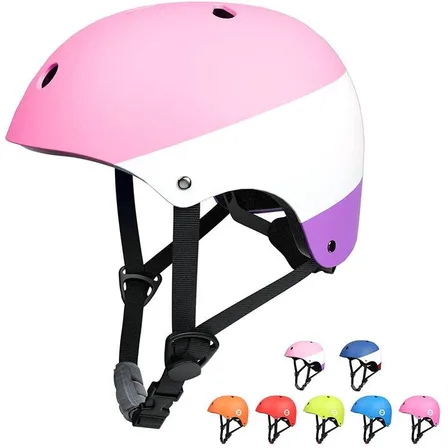
XJD Kids Bike Helmet for Boys & Girls, B White / Pink White
The XJD Kids Bike Helmet covers a wide age range — suggested for ages 2 through …$59.99
-

Flower Pink XJD Girls Bike with Doll Seat & Basket
The XJD Flower Pink girls' bike is made for riders 71–122 cm tall (roughly ages …$69.99
-
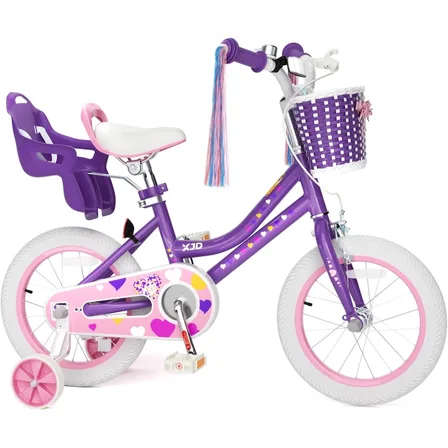
Purple XJD Girls' Bike with Doll Seat & Basket
For girls 71–122 cm tall (about ages 3–7), this XJD girls' bike in Purple pairs …$75.99
$99.99