

BMX Gear Ratio: Read Both Tooth Counts Before Comparing the Pedaling Setup
A BMX gear ratio needs two tooth counts: the driving chainring at the pedals and the driven sprocket at the rear. A front tooth count alone cannot supply the ratio. Record both before comparing the pedaling setup of two single-speed bicycles. The number helps describe a drivetrain, but it does not decide a child’s fit, promise a particular speed or establish that a replacement sprocket will work with the bicycle’s other components.
Calculate BMX gear ratio from two identified counts
For a simple chain-driven single-speed setup, divide the front tooth count by the rear tooth count. As a purely mathematical example, 36 divided by 18 gives a ratio of 2:1. That example is not a specification for the linked XJD bicycle. Read markings or obtain the exact component information rather than reaching near an installed chain to count moving teeth. Keep the complete pair in the record so another person can check the calculation.

Read the Blue XJD specification without filling a gap
The current Blue 20-inch Basic freestyle model lists a single-speed drivetrain, a 36T chainring and a 165 mm crank. It also describes wide tires, front and rear U-brakes and no supplied pegs. The available catalog evidence does not establish its rear sprocket tooth count for this article. Consequently, no exact gear ratio is assigned to it. Ask for that missing component detail before comparing its numerical ratio with another complete bicycle.
Keep wheel and crank measurements separate
The ratio describes rotations between the chain-driven sprockets; distance traveled also depends on the rolling wheel. Crank length describes the pedal’s path and leverage relationship, not the rear tooth count. Therefore two bicycles with the same ratio can still feel different to their riders. Do not turn a wheel label or a longer crank into a guessed ratio. For a young rider, manageable mounting, reach, braking and ordinary starts remain practical checks alongside the drivetrain description.
Interpret a comparison without promising a result
With the same wheel and other conditions, a larger front-to-rear ratio gives more wheel rotation for each crank revolution than a smaller one. That arithmetic does not mean every rider will travel faster; the rider still supplies the effort and controls the bicycle. Compare the expected route and comfortable pedaling task rather than choosing the largest number. An adult’s preferred freestyle setup is not evidence that a child needs the same parts or riding task.
Treat a change as a complete compatibility question
Changing a sprocket may involve hub or crank interfaces, chain width and length, chainline, clearance and wheel adjustment. Obtain exact model approval and competent installation before buying an alternative. A calculated target ratio does not verify those relationships. Keep the original and proposed component identities in one service request. After any approved work, check drivetrain movement, wheel security and brakes through the actual instructions; do not use a faster-looking ratio as permission for a new riding category.
Model details relevant to this task
The linked current BMX provides a real 36T front-chainring example with a separate crank-length specification. Its rear count remains unverified here, and the worked 36/18 calculation is explicitly hypothetical. No speed, hill capability, optimum child’s ratio or compatible upgrade is claimed from that example. The linked model details are available for Blue XJD Freestyle BMX Bike, 20-Inch – No Pegs.
Quick checklist
- Record both tooth counts.
- Divide front by rear.
- Keep example arithmetic labeled.
- Separate wheel and crank dimensions.
- Check whole-system compatibility.
Common questions
Can the ratio be calculated from 36T alone?
No. The rear sprocket tooth count is also required.
Does a higher ratio guarantee a faster ride?
No. It changes the rotation relationship; the rider, wheel, route and conditions still affect the actual ride.
Can two equal-ratio sprocket pairs be exchanged freely?
No. Their mounting, chain, clearance and other compatibility requirements still need verification.
Related collections
The BMX drivetrain configurations and other family bicycle arrangements provide further model details. Check the exact selected configuration when planning fit, handling and care.
Before the next outing
Use BMX gear ratio to describe an identified pair of sprockets accurately. Keep missing counts visible, separate the arithmetic from fit and performance, and require full compatibility before any component change.
Bikes for your next adventure
-

Blue XJD Freestyle BMX Bike, 20-Inch – No Pegs
The XJD 20-Inch Blue Freestyle BMX is an entry-level BMX bike for boys and girls…$189.99
-
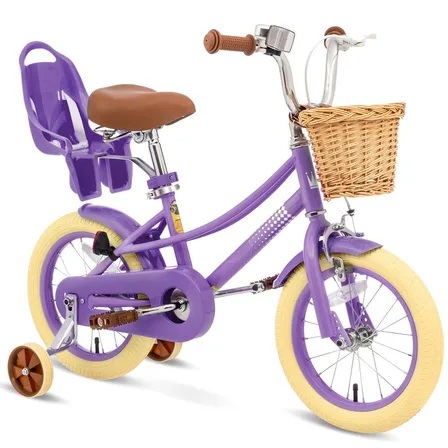
XJD Girls' Bike with Training Wheels, 12/14/16/20 Inch – Purple
The XJD girls' bike with training wheels in Purple is built to grow with your ri…$139
$159 -

Light Pink XJD Girls' Bicycle with Basket & Training Wheels
The Light Pink XJD Girls' Bicycle with Basket & Training Wheels is a retro-style…$109.99
$129.99