

Can a 5 year old ride a 12 inch bike
Yes, a 5-year-old can ride a 12-inch bike if the bike fits their body and they can control it confidently. However, XBikes lists 12 inches as a starting point for ages 3–4 and heights 34–40 in (86–102 cm), so many 5-year-olds should also compare 14- and 16-inch bikes.
Measure height before choosing
Have the child stand barefoot against a wall, looking straight ahead, and measure from the floor to the top of the head. Compare that result with the XBikes starting points below. Age narrows the search, but measured height is the more useful first check.
| Wheel size | Starting age | Rider height |
|---|---|---|
| 12 Inch | 3–4 | 34–40 in / 86–102 cm |
| 14 Inch | 3–6 | 37–45 in / 94–114 cm |
| 16 Inch | 4–7 | 40–48 in / 102–122 cm |
| 18 Inch | 5–9 | 43–52 in / 109–132 cm |
A 5-year-old who is 40 inches (102 cm) or shorter may still fall within the 12-inch height range. At that boundary, compare the actual fit of 12-, 14- and 16-inch models rather than choosing from the chart alone. A taller child is likely outside the stated 12-inch starting range.
Check inseam and stand-over clearance
Measure inseam with the child barefoot. Ask them to stand straight with feet slightly apart, place a firm book gently between the legs as though it were a saddle, then measure from the floor to the book’s top edge.
Next, have the child straddle the actual bicycle with both feet flat on the floor. There should be comfortable clearance between the child and the top tube. The supplied chart does not provide numerical stand-over targets, so do not infer clearance from wheel size or height alone. Follow the exact bicycle manual for adjustment limits, or ask a qualified bicycle mechanic to assess the fit.
Test reach, brakes and control
A correctly sized wheel label does not guarantee a usable riding position. With an adult stabilizing the bike, check whether the child can sit naturally, hold both grips without stretching, turn the handlebar without losing posture, and operate the brakes comfortably. Brake reach and operation depend on the exact bicycle, so inspect them on the assembled model.
- Reject a bike if the child must lean or stretch excessively to steer.
- Reject it if they cannot reach and operate the brakes reliably.
- Do not buy an oversized bicycle merely to leave room for growth.
- Consider current confidence: a hesitant beginner may manage a smaller, well-fitting bike more easily than a larger bike that feels intimidating.
Any assembly, adjustment, maintenance, compatibility or torque question should be resolved through the exact product manual or a qualified bicycle mechanic.
How the supplied bikes help with comparison
The three catalog options are relevant because each offers 12-, 14- and 16-inch SKU labels, allowing a parent to compare the requested 12-inch size with nearby sizes. The Pink 12/14/16/20" XJD Girls Bike with Training Wheels & Basket also lists a 20-inch option, although that larger size is not an equivalent substitute for a 12-inch bike.
 Black XJD Kids' BMX Bicycle with Training Wheels
Offers 12 Inch, 14 Inch and 16 Inch labels, making this Kids' BMX Bike relevant for comparing the requested size with nearby options after measuring the child.
 Pink Girls' 12/14/16" Bike by XJD – Basket & Doll Seat
This Training Wheel Bike lists 12 Inch, 14 Inch and 16 Inch options, so parents can compare adjacent wheel sizes while still confirming individual fit and control.
 Pink 12/14/16/20" XJD Girls Bike with Training Wheels & Basket
This Training Wheel Bike offers 12 Inch, 14 Inch, 16 Inch and 20 Inch labels. Its first three options support the immediate size comparison; 20 Inch is a separate, larger fit range.
Available size labels
The Black XJD Kids' BMX Bicycle with Training Wheels is categorized as a Kids' BMX Bike and has 12 Inch, 14 Inch and 16 Inch options. The Pink Girls' 12/14/16" Bike by XJD – Basket & Doll Seat is categorized as a Training Wheel Bike with the same three size labels.
The Pink 12/14/16/20" XJD Girls Bike with Training Wheels & Basket is also categorized as a Training Wheel Bike and adds a 20 Inch label. XBikes places 20 inches at ages 7–12 and heights 48–60 in (122–152 cm), so its presence should not influence the fit decision for a typical 5-year-old unless the child’s measurements independently support that range and an individual fit check confirms control.
These titles and categories identify catalog configurations only. They do not establish the child’s fit, brake reach, riding ability or readiness. Select the size label first, then verify the exact assembled bicycle with the child.
Make the 12-inch decision
Keep 12 inches under consideration only if the child measures within 34–40 in (86–102 cm) and the individual trial confirms stand-over clearance, comfortable reach, effective brake operation and confident control. If the child is taller or cramped on it, compare 14 or 16 inches using the stated height ranges and repeat every fit check; do not assume the next size automatically fits.
Before riding, provide a bicycle helmet that fits properly, sits level and has its straps adjusted according to the helmet manufacturer’s instructions. Then begin in a traffic-free practice area under close adult supervision. For this 5-year-old, the next step is simple: measure height and inseam today, shortlist the matching wheel sizes, and let the child try each candidate before choosing.
Bikes for your next adventure
-
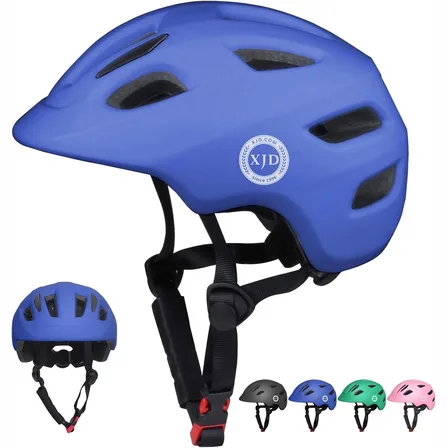
Blue XJD Kids' Bike Helmet, Adjustable Fit – Sizes XS & S
The Blue XJD Kids' Bike Helmet is a lightweight, adjustable helmet for toddlers …$20.39
-
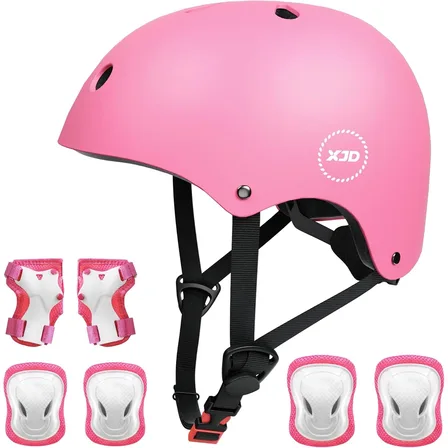
XJD Kids Helmet & Protective Gear Set for Girls, Pink
The XJD Kids Helmet & Protective Gear Set in Pink is a complete safety kit for g…$24.64
-
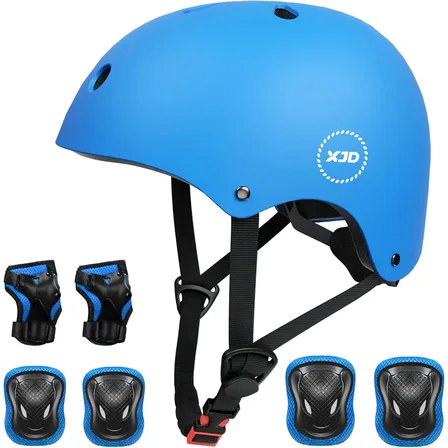
Blue XJD Helmet & Protective Gear Set for Kids, Sizes S/M
The Blue XJD Helmet & Protective Gear Set is made for kids roughly 3 to 8 years …$23.79