

Can jump bicycle carry a child
No—do not use a jump bicycle to carry a child unless its exact product manual explicitly approves the intended child seat, trailer or passenger setup. A bicycle built or used for jumps should never be assumed to support a second rider.
What “carry a child” means here
If you mean placing a child on the same bicycle, approval must come from the bicycle and child-carrier manufacturers. Check the exact manuals for compatible mounting points, load limits, permitted accessories and required assembly. Those details cannot be inferred from wheel size or appearance.
If the manuals do not clearly approve the complete setup, do not attach a child seat, tow a trailer or carry the child on the frame, handlebars, pegs or rack. A qualified bicycle mechanic can check compatibility, but should not replace missing manufacturer approval with a guess.
If you mean whether a child can ride a jump bicycle independently, the answer depends on individual fit and control. The label “jump bicycle” does not establish that the bicycle is suitable for that child or that the child is ready to jump.
Measure the child before comparing bicycles
Measure the child’s standing height and inseam while they wear the shoes normally used for riding. Then have the child try the bicycle. Age is only a starting point; measured fit and demonstrated control matter more.
- Stand-over: The child must be able to straddle the bicycle securely rather than being forced onto tiptoes by an oversized frame.
- Reach: They should hold the controls without stretching, locking their elbows or losing a stable riding position.
- Brake control: They must be able to reach and operate the fitted brakes confidently. Follow the bicycle manual for adjustment.
- Confidence: Confirm that they can start, steer, stop and dismount under control before considering ramps or jumps.
Do not buy an oversized bicycle merely to allow room for growth. A bicycle that the child cannot control now is not made suitable by an expected future fit.
Use wheel size only as a starting point
| Wheel size | Starting age | Rider height |
|---|---|---|
| 12 Inch | 3–4 | 34–40 in / 86–102 cm |
| 14 Inch | 3–6 | 37–45 in / 94–114 cm |
| 16 Inch | 4–7 | 40–48 in / 102–122 cm |
| 18 Inch | 5–9 | 43–52 in / 109–132 cm |
| 20 Inch | 7–12 | 48–60 in / 122–152 cm |
| 24 Inch | 10–14 | 54–64 in / 137–163 cm |
| 26 Inch | Youth and adults | Over 60 in / 153 cm |
Overlapping ranges are intentional starting points, not proof of fit. When two sizes appear possible, compare stand-over clearance, reach, brake operation and the child’s present confidence on each actual bicycle.
How the supplied product helps with the decision
The Purple XJD Girls' Bike with Doll Seat & Basket is listed in the Training Wheel Bikes category and is offered with 12 Inch, 14 Inch and 16 Inch SKU labels. Those three options provide relevant size comparison points when the child will ride independently; they do not establish that the bicycle can transport another child or serve as a jump bicycle.

Use the child’s measured height to identify a starting option, then arrange an individual fit check. The doll seat named in the product title is not evidence that it can carry a child, and neither the basket nor the training-wheel category proves passenger, child-seat, trailer or jumping compatibility. Consult the exact product manual for assembly, maintenance, load limits and accessory compatibility.
Separate ordinary riding from jumping
A child who fits a bicycle for ordinary riding is not automatically ready to jump it. First confirm controlled starts, straight riding, turning, braking and dismounting in a level area away from traffic. For any jump-related use, follow the bicycle manufacturer’s stated intended use and restrictions. If the manual does not authorize that use, choose a bicycle whose documentation does.
Do not attempt jumps while carrying a child or while using an attached child carrier. Added weight and a changing passenger position can affect balance, steering and stopping, while landing forces create demands that ordinary fit ranges do not address.
Helmet and pre-ride checks
The child needs a bicycle helmet that fits properly, sits level and has its straps adjusted according to the helmet manufacturer’s instructions. A helmet does not make an incompatible bicycle or carrying arrangement acceptable.
Before each ride, follow the bicycle’s manual for inspection and maintenance. If assembly, controls, fasteners, wheels or an accessory installation are uncertain, stop and have a qualified bicycle mechanic inspect the bicycle. Use only the manual’s procedures and torque values rather than invented or generic settings.
Your next decision
- Decide whether the child is a passenger or the bicycle’s rider.
- For a passenger, proceed only when every relevant manufacturer explicitly approves the complete carrying setup.
- For a rider, measure height and inseam, select a starting wheel size, and test stand-over, reach, braking and control on the actual bicycle.
- For jumping, require suitable documented intended use and proven basic riding control first.
Therefore, do not use an unverified jump bicycle to carry a child. If the child needs their own bicycle, compare the supplied 12, 14 and 16 Inch options against their measurements and complete a hands-on fit check before choosing.
Bikes for your next adventure
-
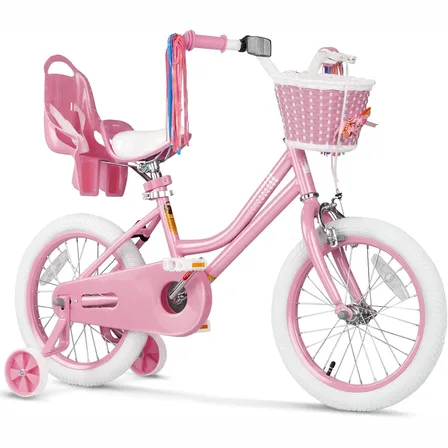
XJD Pink Girls' Bike – Kids 12/14/16 Inch Training Wheel Bicycle
The XJD Pink Girls' Bike is a training-wheel bicycle for girls ages 3 to 8 (ride…$149
$169 -

Kids Bike Helmet by XJD for Boys & Girls – Black, Blue, Green, Pink, Purple
The XJD Kids Bike Helmet covers a wide 2-to-8-year age range thanks to two head-…$59.99
-

Kids Bike Helmet by XJD for Girls – Pink
The XJD Kids Bike Helmet in Pink is a lightweight multi-sport helmet for girls r…$59.99
$99