

Can you add a child seat to any bike
No. You cannot add a child seat to every bike. The bicycle, seat and mounting system must be compatible, and the bike maker must permit the added load.
What decides whether a child seat will fit?
Start with the bicycle and child-seat manuals. Look for explicit approval of the seat type you plan to use, such as a rear frame-mounted, rack-mounted or front-mounted seat. A clamp that appears to fit is not proof that the bicycle can safely carry it.
Confirm all of the following before buying or installing a seat:
- Mounting location: Identify the exact frame tube, rack or other attachment point required by the seat.
- Manufacturer permission: Check that the bicycle and any rack are approved for carrying a child in that configuration.
- Load limits: Compare the limits for the bike, seat, rack and mounting hardware with the combined child-and-seat load. Follow the lowest applicable limit.
- Clearance: Verify space around the tire, brakes, cables, pedals and the rider’s heels through the full range of steering and pedaling.
- Condition: Do not attach a seat to damaged, cracked, loose or heavily corroded parts.
If a manual is missing, a load limit is unknown or the approval language is unclear, ask the manufacturer or a qualified bicycle mechanic. Do not invent a limit or treat a visual fit as confirmation.
What should you measure and compare?
Record the bicycle’s make, model and size, then identify the material and shape of the proposed mounting area from the bicycle manual. Measure that area only as directed by the child-seat manufacturer; required dimensions vary by mounting system.
For a rack-mounted seat, compare the seat’s requirements with the rack’s exact model, dimensions, attachment method and child-carrying approval. A rack intended for ordinary cargo is not automatically suitable for a child seat. For a frame-mounted seat, confirm that the specified clamp location is permitted and unobstructed.
Also compare the child’s current measurements with the child-seat manual, including every stated height, weight or developmental requirement. Use the exact product manual for assembly, fastener placement, torque, maintenance intervals and replacement parts.
Which bikes often require extra caution?
Compatibility deserves particular scrutiny when a bicycle has unusual tube shapes, limited mounting space, moving suspension parts, accessories near the proposed mount or no manufacturer-approved child-carrying arrangement. These features do not create one universal answer; the manuals and the complete installed configuration decide.
After installation, the adult rider must still be able to mount, dismount, steer, brake and place a foot down with control. A child seat raises and shifts the bicycle’s load, so handling will differ even when the hardware is compatible. If control feels uncertain, do not carry the child.
Are the supplied XBikes options relevant?
The supplied catalog item helps distinguish a child’s own bicycle from an adult bicycle intended to carry a passenger. The XJD Girls' Bike with Training Wheels, 12/14/16/20 Inch – Purple is categorized as a training-wheel bike and is offered in 12, 14, 16 and 20 Inch labels. Those facts help with wheel-size comparison, but they do not establish child-seat compatibility, passenger capacity, mounting points or load limits.

Accordingly, this product should be considered when choosing a bike for a child to ride, not as evidence that it can accept a child passenger seat. Its listed sizes are separate options, not interchangeable fits, and none should be selected from age alone.
If the child will ride their own bike
Use measured height as a starting point, then require an individual fit check. XBikes lists these starting points for the supplied sizes:
| Wheel label | Starting age | Rider height |
|---|---|---|
| 12 Inch | 3–4 | 34–40 in / 86–102 cm |
| 14 Inch | 3–6 | 37–45 in / 94–114 cm |
| 16 Inch | 4–7 | 40–48 in / 102–122 cm |
| 20 Inch | 7–12 | 48–60 in / 122–152 cm |
Have the child try the bicycle. Check stand-over clearance, reach, brake control and current confidence, and do not buy an oversized bike merely for growth. Age is only a starting point; it cannot replace measured height and an actual fit check.
What should you do next?
- Find the exact bicycle and child-seat manuals.
- Identify the intended mounting system and compare every required dimension, approval and load limit.
- Have a qualified bicycle mechanic inspect compatibility and installation when any point is uncertain.
- Before every ride, follow the manuals’ inspection instructions and confirm that the child’s properly fitting bicycle helmet sits level with its straps adjusted as the helmet manufacturer directs.
- Test the changed balance and braking without the child before deciding whether you can control the loaded bicycle.
Add the child seat only when every component is expressly compatible and the adult rider remains in control; otherwise choose a manufacturer-approved alternative rather than forcing the seat onto the bike.
Bikes for your next adventure
-

XJD Boys 12/14/16" Training Wheel Bike – Blue
The XJD Boys Bike in Blue is a training wheel bike for riders 71–122 cm tall—rou…$169
$199 -
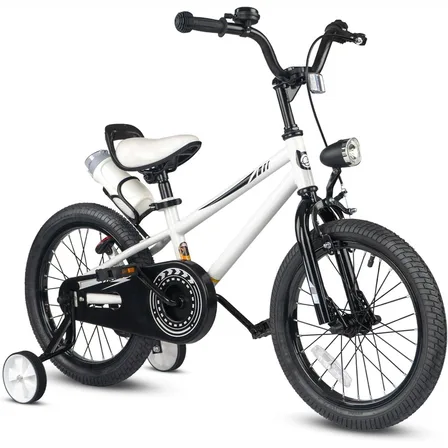
XJD Kids' Training Wheel Bike for Boys & Girls, 12/14/16 Inch – White
The XJD kids' training wheel bike in White is made for riders ages 3–8 (roughly …$169
$199 -
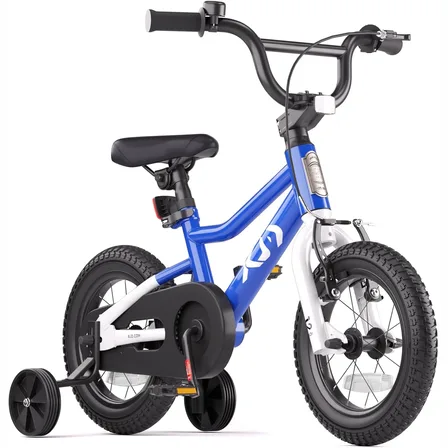
XJD Boys & Girls BMX Bike with Training Wheels, 12/14/16" – Blue
The XJD Boys & Girls BMX Bike in Blue is a first pedal bike for kids roughly age…$99.99
$119.99